







Question: Can you please help me with a detailed solution to this problem.? A third wav to understand the variance is that it is a sum
Can you please help me with a detailed solution to this problem.?
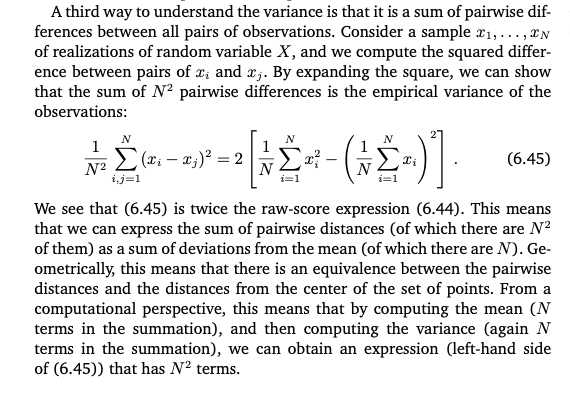

A third wav to understand the variance is that it is a sum of pairwise dif- ferences between all pairs of observations. Consider a sample 3:1,. .. ,3!\" of realizations of random variable I, and we compute the squared differ- ence between pairs of re; and xi. Ev expanding the square, we can show that the sum of N2 pairwise differences is the empirical variance of the observations: 1 N 2 1 N 2 1 N 2 -ZIIEixj) =2|:in(F2:si):| . [5.45] ttj=l i=1 i=1 \"E see that (15.45} is twice the raw-score expression [6.44]. This means that we can express the sum of pairwise distances {of which there are N2 of them] as a sum of deviations from the mean [of which there are N]. Ge- ometricallg this means that there is an equivalence between the pairwise distances and the distances from the center of the set of points. From a computational perspective, this means that by computing the mean {N terms in the summation], and then computing the variance {again N terms in the summation}, we can obtain an expression [left-hand side of [6.45)] that has N2 terms. 6.7 Prove the relationship in (6.45), which relates the pairwise difference be- tween examples in a dataset with the raw-score expression for the variance
Step by Step Solution
There are 3 Steps involved in it

Get step-by-step solutions from verified subject matter experts
 Study Help