







Question: Can you please help me with one annotation on this page? also, highlight the part or put it in a quotation. On the Record: Information
Can you please help me with one annotation on this page? also, highlight the part or put it in a quotation.
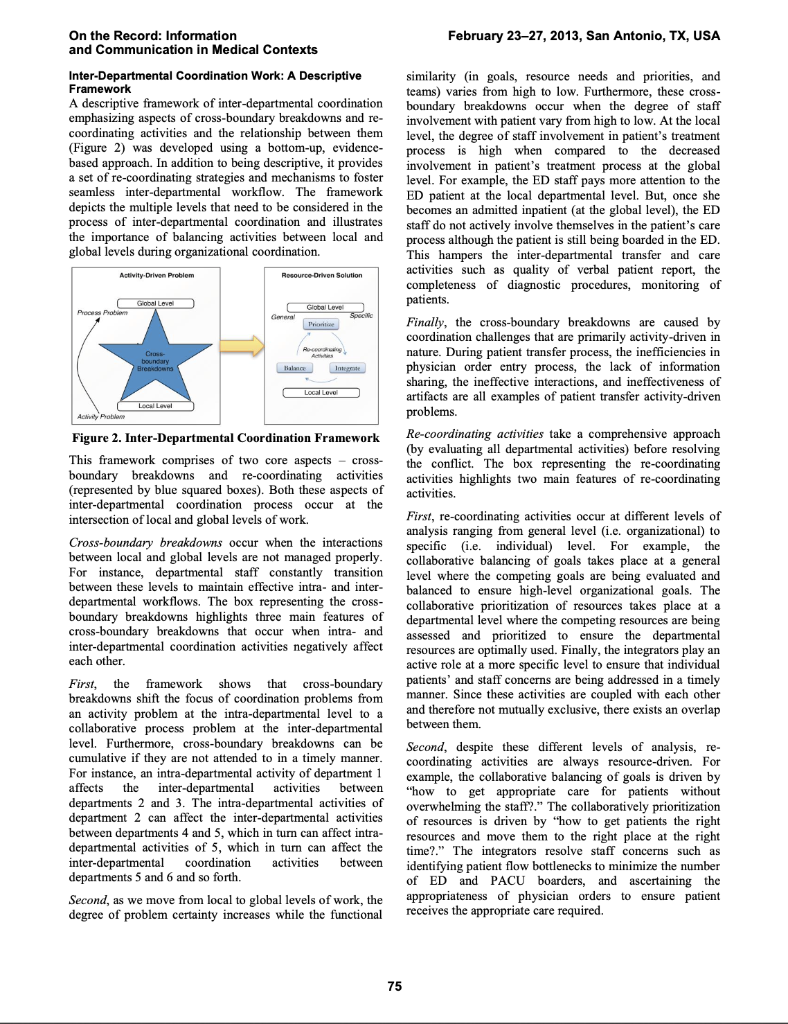
On the Record: Information and Communication in Medical Contexts February 2327, 2013, San Antonio, TX, USA Inter-Departmental Coordination Work: A Descriptive Framework A descriptive framework of inter-departmental coordination emphasizing aspects of cross-boundary breakdowns and re- coordinating activities and the relationship between them (Figure 2) was developed using a bottom-up, evidence- based approach. In addition to being descriptive, it provides a set of re-coordinating strategies and mechanisms to foster seamless inter-departmental workflow. The framework depicts the multiple levels that need to be considered in the process of inter-departmental coordination and illustrates the importance of balancing activities between local and global levels during organizational coordination. Activity-Driven Problem Resource-Driven Solution Gocal Level Global Level Processo Ger Sou boundary Brendono Local Love Local Level A Pobla Figure 2. Inter-Departmental Coordination Framework This framework comprises of two core aspects cross- boundary breakdowns and re-coordinating activities (represented by blue squared boxes). Both these aspects of inter-departmental coordination process occur at the intersection of local and global levels of work. Cross-boundary breakdowns occur when the interactions between local and global levels are not managed properly For instance, departmental staff constantly transition between these levels to maintain effective intra- and inter- departmental workflows. The box representing the cross- boundary breakdowns highlights three main features of cross-boundary breakdowns that occur when intra- and inter-departmental coordination activities negatively affect each other. First, the framework shows that cross-boundary breakdowns shift the focus of coordination problems from an activity problem at the intra-departmental level to a collaborative process problem at the inter-departmental level. Furthermore, cross-boundary breakdowns can be cumulative if they are not attended to in a timely manner. For instance, an intra-departmental activity of department 1 affects the inter-departmental activities between departments 2 and 3. The intra-departmental activities of department 2 can affect the inter-departmental activities between departments 4 and 5, which in turn can affect intra- departmental activities of 5, which in turn can affect the inter-departmental coordination activities between departments 5 and 6 and so forth. Second, as we move from local to global levels of work, the degree of problem certainty increases while the functional similarity in goals, resource needs and priorities, and teams) varies from high to low. Furthermore, these cross- boundary breakdowns occur when the degree of staff involvement with patient vary from high to low. At the local level, the degree of staff involvement in patient's treatment process is high when compared to the decreased involvement in patient's treatment process at the global level. For example, the ED staff pays more attention to the ED patient at the local departmental level. But, once she becomes an admitted inpatient at the global level), the ED staff do not actively involve themselves in the patient's care process although the patient is still being boarded in the ED. This hampers the inter-departmental transfer and care activities such as quality of verbal patient report, the completeness of diagnostic procedures, monitoring of patients. Finally, the cross-boundary breakdowns are caused by coordination challenges that are primarily activity-driven in nature. During patient transfer process, the inefficiencies in physician order entry process, the lack of information sharing, the ineffective interactions, and ineffectiveness of artifacts are all examples of patient transfer activity-driven problems. Re-coordinating activities take a comprehensive approach (by evaluating all departmental activities) before resolving the conflict. The box representing the re-coordinating activities highlights two main features of re-coordinating activities. First, re-coordinating activities occur at different levels of analysis ranging from general level (i.e. organizational) to specific (i.e. individual) level. For example, the collaborative balancing of goals takes place at a general level where the competing goals are being evaluated and balanced to ensure high-level organizational goals. The collaborative prioritization of resources takes place at a departmental level where the competing resources being assessed and prioritized to ensure the departmental resources are optimally used. Finally, the integrators play an active role at a more specific level to ensure that individual patients' and staff concerns are being addressed in a timely manner. Since these activities are coupled with each other and therefore not mutually exclusive, there exists an overlap between them. Second, despite these different levels of analysis, re- coordinating activities are always resource-driven. For example, the collaborative balancing of goals is driven by "how to get appropriate care for patients without overwhelming the staff?." The collaboratively prioritization of resources is driven by "how to get patients the right resources and move them to the right place at the right time?." The integrators resolve staff concerns such as identifying patient flow bottlenecks to minimize the number of ED and PACU boarders, and ascertaining the appropriateness of physician orders to ensure patient receives the appropriate care required. 75Step by Step Solution
There are 3 Steps involved in it
1 Expert Approved Answer
Step: 1 Unlock

Question Has Been Solved by an Expert!
Get step-by-step solutions from verified subject matter experts
Step: 2 Unlock
Step: 3 Unlock
 Study Help