



Question: Can you please help with questions 1-4 on this case study Step 1: Please read the following: Who comes to mind when you think of
Can you please help with questions 1-4 on this case study 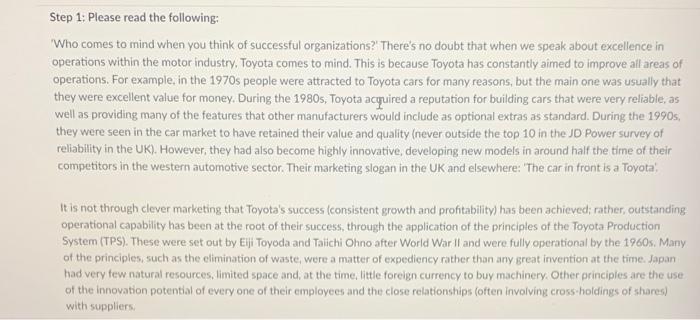
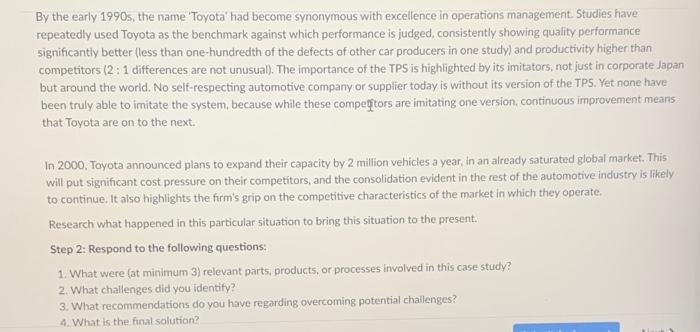
Step 1: Please read the following: Who comes to mind when you think of successful organizations?' There's no doubt that when we speak about excellence in operations within the motor industry. Toyota comes to mind. This is because Toyota has constantly aimed to improve all areas of operations. For example, in the 1970s people were attracted to Toyota cars for many reasons, but the main one was usually that they were excellent value for money. During the 1980s, Toyota acquired a reputation for building cars that were very reliable, as well as providing many of the features that other manufacturers would include as optional extras as standard. During the 1990s, they were seen in the car market to have retained their value and quality (never outside the top 10 in the JD Power survey of reliability in the UK). However, they had also become highly innovative, developing new models in around half the time of their competitors in the western automotive sector. Their marketing slogan in the UK and elsewhere: "The car in front is a Toyota, It is not through clever marketing that Toyota's success (consistent growth and profitability) has been achieved, rather outstanding operational capability has been at the root of their success, through the application of the principles of the Toyota Production System (TPS). These were set out by Eiji Toyoda and Talichi Ohno after World War II and were fully operational by the 1960s. Many of the principles, such as the elimination of waste, were a matter of expediency rather than any great invention at the time. Japan had very few natural resources, limited space and, at the time, little foreign currency to buy machinery. Other principles are the use of the innovation potential of every one of their employees and the close relationships (often involving cross holdings of shares) with suppliers By the early 1990s, the name 'Toyota' had become synonymous with excellence in operations management. Studies have repeatedly used Toyota as the benchmark against which performance is judged, consistently showing quality performance significantly better (less than one-hundredth of the defects of other car producers in one study) and productivity higher than competitors (2:1 differences are not unusual). The importance of the TPS is highlighted by its imitators, not just in corporate Japan but around the world. No self-respecting automotive company or supplier today is without its version of the TPS. Yet none have been truly able to imitate the system, because while these compeqtors are imitating one version, continuous improvement means that Toyota are on to the next. In 2000, Toyota announced plans to expand their capacity by 2 million vehicles a year, in an already saturated global market. This will put significant cost pressure on their competitors, and the consolidation evident in the rest of the automotive industry is likely to continue. It also highlights the firm's grip on the competitive characteristics of the market in which they operate. Research what happened in this particular situation to bring this situation to the present. Step 2: Respond to the following questions: 1. What were (at minimum 3) relevant parts, products, or processes involved in this case study? 2. What challenges did you identify? 3. What recommendations do you have regarding overcoming potential challenges? 4. What is the final solution Step by Step Solution
There are 3 Steps involved in it
1 Expert Approved Answer
Step: 1 Unlock

Question Has Been Solved by an Expert!
Get step-by-step solutions from verified subject matter experts
Step: 2 Unlock
Step: 3 Unlock