







Question: Please help with questions 1-9 on the case study Step 1: Please read the following: The changing fortunes at Apple The most striking change has
Please help with questions 1-9 on the case study 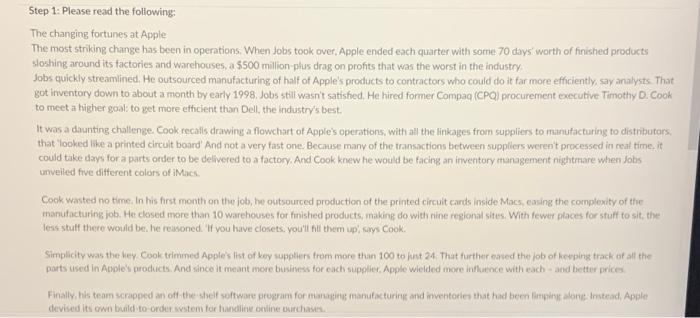
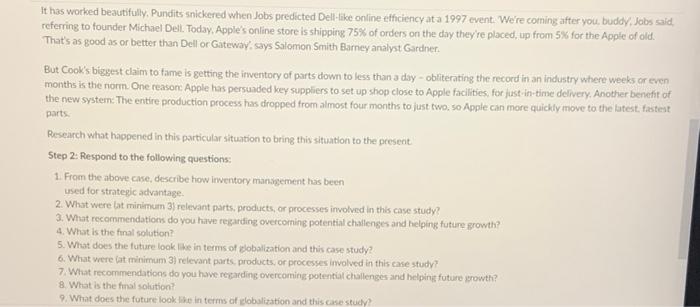
Step 1: Please read the following: The changing fortunes at Apple The most striking change has been in operations. When Jobs took over, Apple ended each quarter with some 70 days worth of finished products sloshing around its factories and warehouses, a $500 million plus drag on profits that was the worst in the industry Jobs quickly streamlined. He outsourced manufacturing of half of Apple's products to contractors who could do it far more efficiently, say analysts That got inventory down to about a month by carly 1998. Jobs still wasn't satished. He hired former Compaq (CPO) procurement executive Timothy D. Cook to meet a higher goal: to get more efficient than Dell, the industry's best It was a daunting challenge. Cook recalls drawing a flowchart of Apple's operations, with all the linkages from suppliers to manufacturing to distributors, that looked like a printed circuit board' And not a very fast one. Because many of the transactions between suppliers weren't processed in real time, it could take days for a parts order to be delivered to a factory, And Cook knew he would be facing an inventory management nightmare when Jobs unveiled five different colors of iMacs. Cook wasted no time. In his first month on the job, he outsourced production of the printed circuit cards inside Macs, casing the complexity of the manufacturing job. He closed more than 10 warehouses for finished products, making do with nine regional sites. With fewer places for stuff to sit, the Jess stult there would be he reasoned. If you have closets, you'll fill them up, says Cook Simplicity was the Wey Cook trimmed Apple's list of key suppliers from more than 100 ohnt 24. That further catect the fob of keeping track of all the parts used in Apple's products. And since it moant more business for each supolier. Apple wielded more infutoce with each - and better prices Finally, his team scrapped an off the shelf software program for managing manufacturing and inventories that had been impone Instead, Apple devised its own build to order system for handline online burchases It has worked beautifully, Pundits snickered when Jobs predicted Dell-like online efficiency at a 1997 event. We're coming after you, buddy, Jobs said referring to founder Michael Dell. Today, Apple's online store is shipping 75% of orders on the day they're placed, up from 5% for the Apple of old. That's as good as or better than Dell or Gateway, says Salomon Smith Barney analyst Gardner But Cook's biggest claim to fame is getting the inventory of parts down to less than a day - obliterating the record in an industry where weeks or even months is the norm One reason. Apple has persuaded key suppliers to set up shop close to Apple facilities, for just in time delivery. Another benefit of the new system. The entire production process has dropped from almost four months to just two, so Apple can more quickly move to the latest, fastest parts Research what happened in this particular situation to bring this situation to the present Step 2: Respond to the following questions: 1. From the above case, describe how inventory management has been used for strategic advantage 2. What were lat minimum 3 relevant parts, products, or processes involved in this case study? 3. What recommendatione do you have regarding overcoming potential challenges and helping future growth? 4. What is the final solution? 5. What does the future look like in terms of slobalization and this case study 6. What were cat minimum 3) relevant parts, products, or processes involved in this case study? 7. What recommendations do you have regarding overcoming potential challenges and helping future growth? 8. What is the fmal solution! 9. What does the future look like in terms of globalization and this case study Step 1: Please read the following: The changing fortunes at Apple The most striking change has been in operations. When Jobs took over, Apple ended each quarter with some 70 days worth of finished products sloshing around its factories and warehouses, a $500 million plus drag on profits that was the worst in the industry Jobs quickly streamlined. He outsourced manufacturing of half of Apple's products to contractors who could do it far more efficiently, say analysts That got inventory down to about a month by carly 1998. Jobs still wasn't satished. He hired former Compaq (CPO) procurement executive Timothy D. Cook to meet a higher goal: to get more efficient than Dell, the industry's best It was a daunting challenge. Cook recalls drawing a flowchart of Apple's operations, with all the linkages from suppliers to manufacturing to distributors, that looked like a printed circuit board' And not a very fast one. Because many of the transactions between suppliers weren't processed in real time, it could take days for a parts order to be delivered to a factory, And Cook knew he would be facing an inventory management nightmare when Jobs unveiled five different colors of iMacs. Cook wasted no time. In his first month on the job, he outsourced production of the printed circuit cards inside Macs, casing the complexity of the manufacturing job. He closed more than 10 warehouses for finished products, making do with nine regional sites. With fewer places for stuff to sit, the Jess stult there would be he reasoned. If you have closets, you'll fill them up, says Cook Simplicity was the Wey Cook trimmed Apple's list of key suppliers from more than 100 ohnt 24. That further catect the fob of keeping track of all the parts used in Apple's products. And since it moant more business for each supolier. Apple wielded more infutoce with each - and better prices Finally, his team scrapped an off the shelf software program for managing manufacturing and inventories that had been impone Instead, Apple devised its own build to order system for handline online burchases It has worked beautifully, Pundits snickered when Jobs predicted Dell-like online efficiency at a 1997 event. We're coming after you, buddy, Jobs said referring to founder Michael Dell. Today, Apple's online store is shipping 75% of orders on the day they're placed, up from 5% for the Apple of old. That's as good as or better than Dell or Gateway, says Salomon Smith Barney analyst Gardner But Cook's biggest claim to fame is getting the inventory of parts down to less than a day - obliterating the record in an industry where weeks or even months is the norm One reason. Apple has persuaded key suppliers to set up shop close to Apple facilities, for just in time delivery. Another benefit of the new system. The entire production process has dropped from almost four months to just two, so Apple can more quickly move to the latest, fastest parts Research what happened in this particular situation to bring this situation to the present Step 2: Respond to the following questions: 1. From the above case, describe how inventory management has been used for strategic advantage 2. What were lat minimum 3 relevant parts, products, or processes involved in this case study? 3. What recommendatione do you have regarding overcoming potential challenges and helping future growth? 4. What is the final solution? 5. What does the future look like in terms of slobalization and this case study 6. What were cat minimum 3) relevant parts, products, or processes involved in this case study? 7. What recommendations do you have regarding overcoming potential challenges and helping future growth? 8. What is the fmal solution! 9. What does the future look like in terms of globalization and this case study Step by Step Solution
There are 3 Steps involved in it
1 Expert Approved Answer
Step: 1 Unlock

Question Has Been Solved by an Expert!
Get step-by-step solutions from verified subject matter experts
Step: 2 Unlock
Step: 3 Unlock
 Study Help