







Question: can you please help with the following question Problem 3} Consider a solid, thermallyr conducting sphere of radius Ft and uniform thennal conductivity, k. Suppose
can you please help with the following question
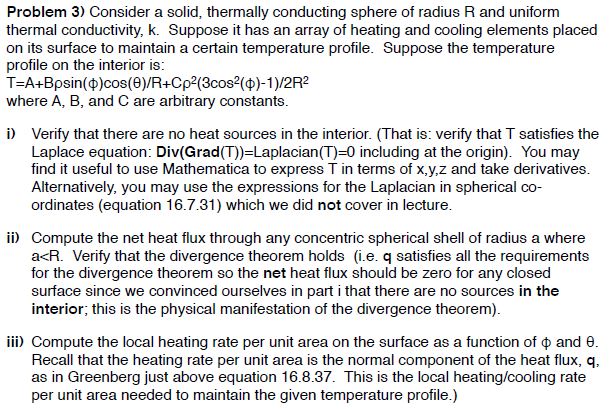
Problem 3} Consider a solid, thermallyr conducting sphere of radius Ft and uniform thennal conductivity, k. Suppose it has an array of heating and cooling elements placed on its surface to maintain a certain temperature prole. Suppose the temperature prole on the interior is: T=A+Bpsin()cos(9)fH+Cp3{3cos{j1 1:}?th where A, B, and C are arbitrary constants. i) Verify that there are no heat sources in the interior. (That is: verify that T satises the Laplace equation: DivfGradm}=Laplacianm=0 including at the origin}. You may nd it useful to use Mathematica to express T in terms of x,y,z and take derivatives. Altemavely, you may use the expressions for the Laplacian in spherical cor ordinates (equation 16.7.31) which we did not cover in lecture. ii) Compute the not heat flux through any concentric spherical shell of radius a where ath. Verify that the divergence theorem holds (i.e. q satisfies all the requirements for the divergeme theorem so the net heat flux should be zero for any closed surface since we convinced ourselves in part i that there are no sources in the interior; this is the physical manifestation of the divergence theorem). iii) Compute the local heating rate per unit area on the surface as a function of q: and El. Recall that the heating rate per unit area is the normal component of the heat ux, q. as in Greenberg just above equation 16.8.31 This is the local heating-cooling rate per unit area needed to maintain the given temperature prole.)
Step by Step Solution
There are 3 Steps involved in it

Get step-by-step solutions from verified subject matter experts
 Study Help