







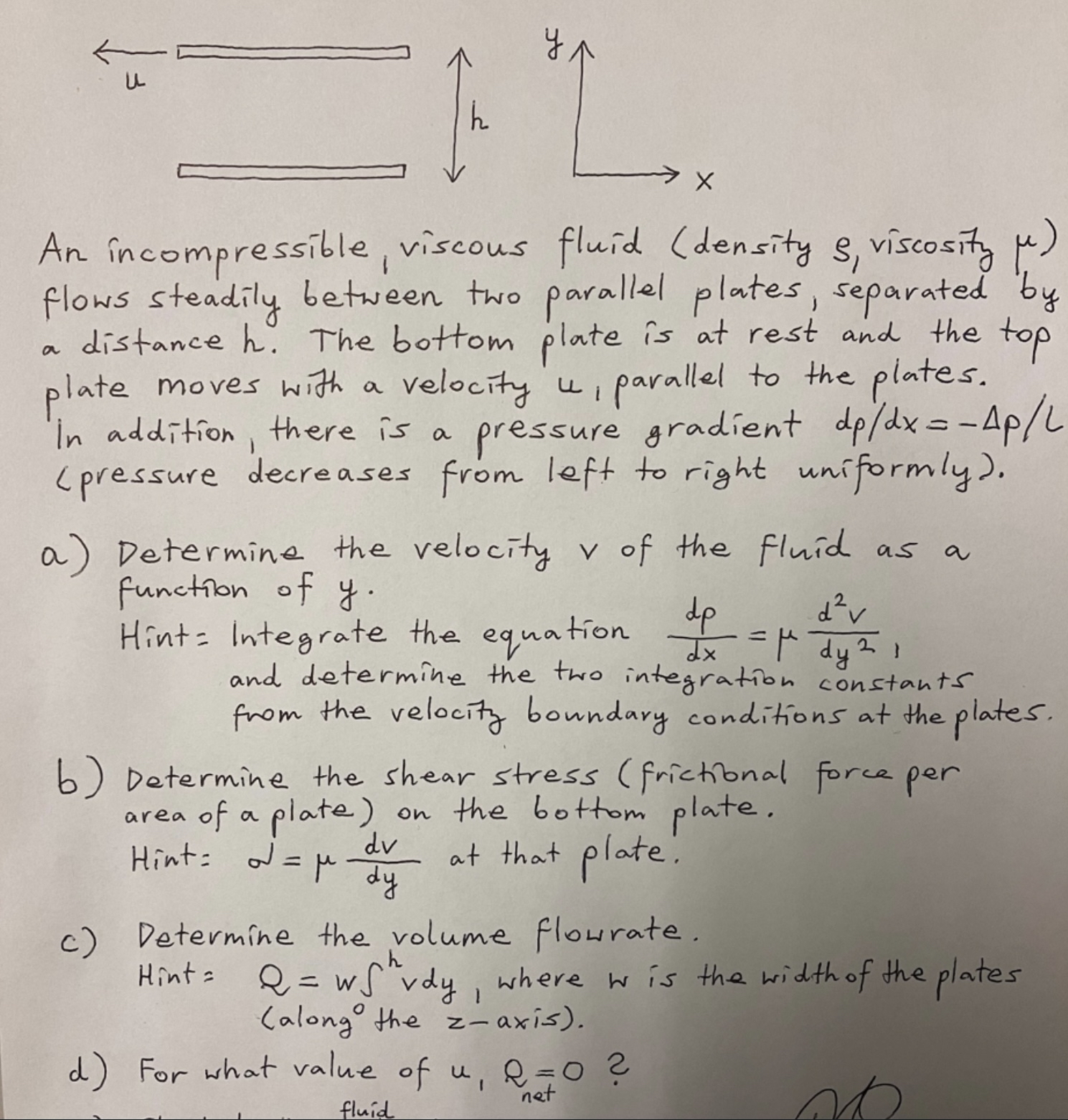
Question: Can you solve for a , b , c , and d An incompressible, viscous fluid ( density , viscosity ) flows steadily between two
Can you solve for a b c and d
An incompressible, viscous fluid density viscosity flows steadily between two parallel plates, separated by a distance The bottom plate is at rest and the top plate moves with a velocity parallel to the plates. In addition, there is a pressure gradient pressure decreases from left to right uniformly
a Determine the velocity of the fluid as a function of
Hint integrate the equation and determine the two integration constants from the velocity boundary conditions at the plates.
b Determine the shear stress frictional force per area of a plate on the bottom plate.
Hint at that plate.
c Determine the volume flowrate.
Hint where is the width of the plates along the axis
d For what value of
Step by Step Solution
There are 3 Steps involved in it
1 Expert Approved Answer
Step: 1 Unlock

Question Has Been Solved by an Expert!
Get step-by-step solutions from verified subject matter experts
Step: 2 Unlock
Step: 3 Unlock
 Study Help