







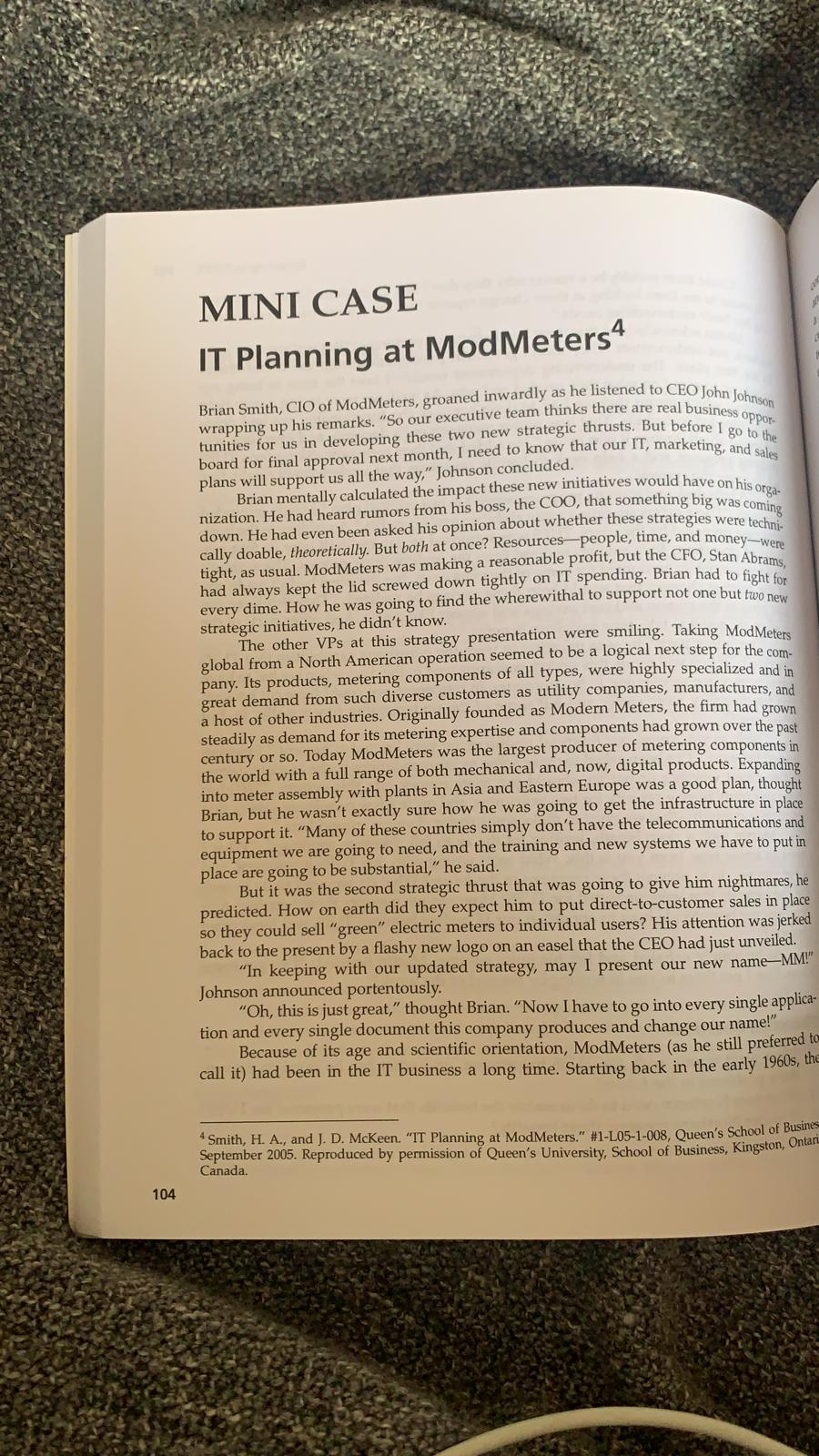
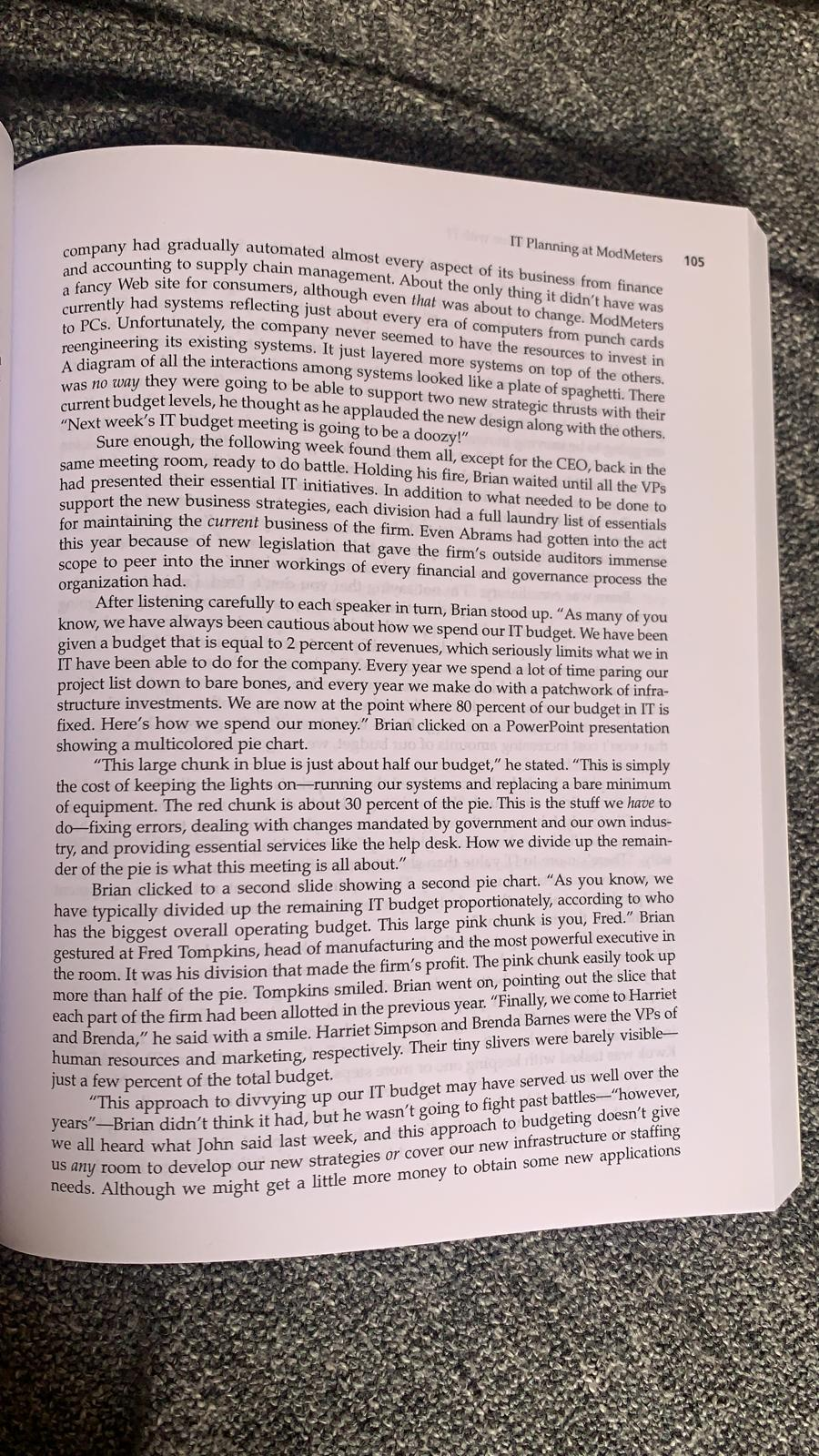
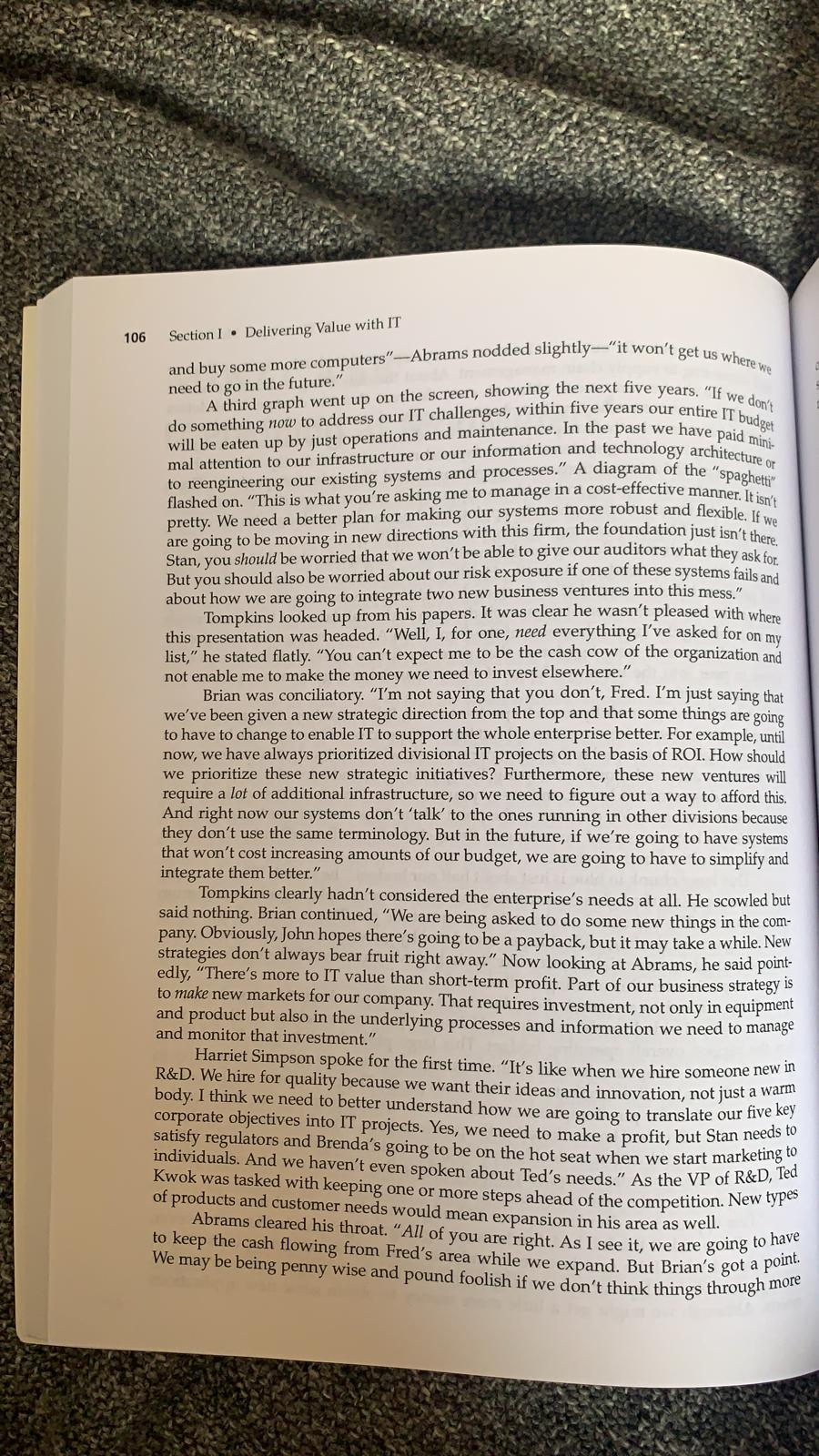
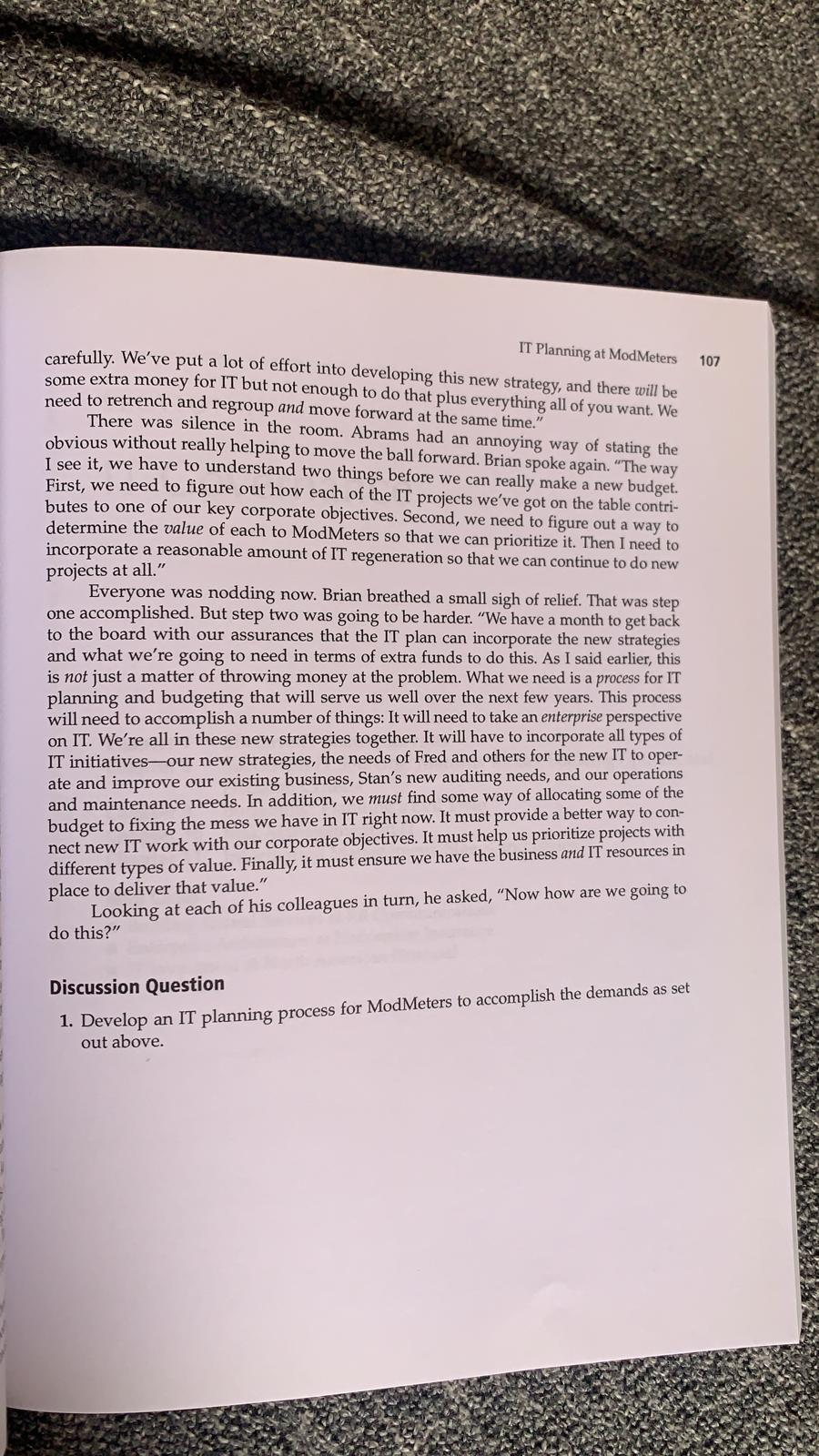
Question: can you write an introduction and conclusion MINI CASE IT Planning at ModMeters4 CEO John Johnson real business oppor- ut before I go to the
can you write an introduction and conclusion
MINI CASE IT Planning at ModMeters4 CEO John Johnson real business oppor- ut before I go to the u IT, marketing, and sales ning big was coming trategies were techni- CFO, Stan Abrams, Brian Smith, CIO of Mod Meters, groaned inwardly as he listened to CEO Job wrapping up his remarks. "So our executive team thinks there are real busi tunities for us in developing these two new strategic thrusts. But before board for final approval next month, I need to know that our IT, marketin plans will support us all the way," Johnson concluded. Brian mentally calculated the impact these new initiatives would have on his nization. He had heard rumors from his boss, the COO, that something big was down. He had even been asked his opinion about whether these strategies wer cally doable, theoretically. But both at once? Resources-people, time, and money a money-Were tight, as usual. ModMeters was making a reasonable profit, but the CFO, Stan Ab had always kept the lid screwed down tightly on IT spending. Brian had to figh every dime. How he was going to find the wherewithal to support not one but tun strategic initiatives, he didn't know. The other VPs at this strategy presentation were smiling. Taking Mod Meter global from a North American operation seemed to be a logical next step for the pany. Its products, metering components of all types, were highly specialized and in great demand from such diverse customers as utility companies, manufacturers, and a host of other industries. Originally founded as Modern Meters, the firm had grown steadily as demand for its metering expertise and components had grown over the past century or so. Today Mod Meters was the largest producer of metering components in the world with a full range of both mechanical and, now, digital products. Expanding into meter assembly with plants in Asia and Eastern Europe was a good plan, thought Brian, but he wasn't exactly sure how he was going to get the infrastructure in place to support it. "Many of these countries simply don't have the telecommunications and equipment we are going to need, and the training and new systems we have to put in place are going to be substantial," he said. But it was the second strategic thrust that was going to give him nightmares, he predicted. How on earth did they expect him to put direct-to-customer sales in place so they could sell "green" electric meters to individual users? His attention was jerked back to the present by a flashy new logo on an easel that the CEO had just unveiled. "In keeping with our updated strategy, may I present our new name-MM!" Johnson announced portentously. "Oh, this is just great," thought Brian. "Now I have to go into every single applica- tion and every single document this company produces and change our name!" Because of its age and scientific orientation, Mod Meters (as he still preferred to call it) had been in the IT business a long time. Starting back in the early 1960s, the * Smith, H. A., and J. D. McKeen. "IT Planning at Mod Meters." #1-L05-1-008, Queen's School of Bu September 2005. Reproduced by permission of Queen's University, School of Business, Kingston, Canada. 104 company had gradually aut and accounting to supply chain a fancy Web site for consu currently had systems refle reengineering its existing A diagram of all the interactic was no way they were going IT Planning at Mod Meters 105 gradually automated almost every aspect of its business from finance hing to supply chain management. About the only thing it didn't have was ite for consumers, although even that was about to change. ModMeters systems reflecting just about every era of computers from punch cards nately, the company never seemed to have the resources to invest in to PCs. Unfortunately, the company never se ing its existing systems. It just layered more systems on top of the others. of all the interactions among systems looked like a plate of spaghetti. There u they were going to be able to support two new strategic thrusts with their budget levels, he thought as he applauded the new design along with the others. "Next week's IT budget meeting is going to be ure enough, the following week found them all, except for the CEO, back in the meeting room, ready to do battle. Holding his fire, Brian waited until all the VPs Presented their essential IT initiatives. In addition to what needed to be done to fort the new business strategies, each division had a full laundry list of essentials ntaining the current business of the firm. Even Abrams had gotten into the act year because of new legislation that gave the firm's outside auditors immense pe to peer into the inner workings of every financial and governance process the same meeting room, read organization had. After listening carefully to each speaker in turn, Brian stood up. "As many of you know, we have always been cautious about how we spend our IT budget. We have been given a budget that is equal to 2 percent of revenues, which seriously limits what we in IT have been able to do for the company. Every year we spend a lot of time paring our proiect list down to bare bones, and every year we make do with a patchwork of infra- structure investments. We are now at the point where 80 percent of our budget in IT is fixed. Here's how we spend our money." Brian clicked on a PowerPoint presentation showing a multicolored pie chart. "This large chunk in blue is just about half our budget," he stated. "This is simply the cost of keeping the lights on-running our systems and replacing a bare minimum of equipment. The red chunk is about 30 percent of the pie. This is the stuff we have to do-fixing errors, dealing with changes mandated by government and our own indus- try, and providing essential services like the help desk. How we divide up the remain- der of the pie is what this meeting is all about." Brian clicked to a second slide showing a second pie chart. "As you know, we have typically divided up the remaining IT budget proportionately, according to who has the biggest overall operating budget. This large pink chunk is you, Fred." Brian gestured at Fred Tompkins, head of manufacturing and the most powerful executive in the room. It was his division that made the firm's profit. The pink chunk easily took up more than half of the pie. Tompkins smiled. Brian went on, pointing out the slice that each part of the firm had been allotted in the previous year. "Finally, we come to Harriet and Brenda," he said with a smile. Harriet Simpson and Brenda Barnes were the VPs of man resources and marketing, respectively. Their tiny slivers were barely visible- just a few percent of the total budget. 22:39 us any room to develop our new needs. Although we might be his approach to divvying up our IT budget may have served us well over the prian didn't think it had, but he wasn't going to fight past battles-"however, e all heard what John said last week, and this approach to budgeting does n to develop our new strategies or cover our new infrastructure or staffing mough we might get a little more money to obtain some new applications 106 lv_"it won't get us where we xt five years. "If we don's ive years our entire IT budget st we have paid mini- chnology architecture or gram of the "spaghetti fective manner. It isn't + and flexible. If we tion just isn't there litors what they ask for. Section I . Delivering Value with IT and buy some more computers"-Abrams nodded slightly"it won need to go in the future." A third graph went up on the screen, showing the next five yea do something now to address our IT challenges, within five years our en will be eaten up by just operations and maintenance. In the past we have mal attention to our infrastructure or our information and technology ar to reengineering our existing systems and processes." A diagram of the flashed on. "This is what you're asking me to manage in a cost-effective mannen pretty. We need a better plan for making our systems more robust and flexil are going to be moving in new directions with this firm, the foundation just Stan, you should be worried that we won't be able to give our auditors what they are But you should also be worried about our risk exposure if one of these systems about how we are going to integrate two new business ventures into this mess." Tompkins looked up from his papers. It was clear he wasn't pleased with wha this presentation was headed. "Well, I, for one, need everything I've asked for on mu list," he stated flatly. "You can't expect me to be the cash cow of the organization and not enable me to make the money we need to invest elsewhere." Brian was conciliatory. "I'm not saying that you don't, Fred. I'm just saying that we've been given a new strategic direction from the top and that some things are going to have to change to enable IT to support the whole enterprise better. For example, until now, we have always prioritized divisional IT projects on the basis of ROI. How should we prioritize these new strategic initiatives? Furthermore, these new ventures will require a lot of additional infrastructure, so we need to figure out a way to afford this. And right now our systems don't talk to the ones running in other divisions because they don't use the same terminology. But in the future, if we're going to have systems that won't cost increasing amounts of our budget, we are going to have to simplify and integrate them better." Tompkins clearly hadn't considered the enterprise's needs at all. He scowled but said nothing. Brian continued, "We are being asked to do some new things in the com- pany. Obviously, John hopes there's going to be a payback, but it may take a while. New strategies don't always bear fruit right away." Now looking at Abrams, he said point- edly, "There's more to IT value than short-term profit. Part of our business strategy to make new markets for our company. That requires investment, not only in equipment and product but also in the underlying processes and information we need to manage and monitor that investment." Harriet Simpson spoke for the first time. "It's like when we hire someone new R&D. We hire for quality because we want their ideas and innovation, not just body. I think we need to better understand how we are going to translate our corporate objectives into IT projects. Yes, we need to make a profit, but Stan net satisfy regulators and Brenda's going to be on the hot seat when we start marketing individuals. And we haven't even spoken about Ted's needs." As the VP of NA Kwok was tasked with keeping one or more steps ahead of the competition. of products and customer needs would mean expansion in his area as well. Abrams cleared his throat. "All of you are right. As I see it, we are gong to keep the cash flowing from Fred's area while we expand. But Brian s 80 We may be being penny wise and pound foolish if we don't think things throus ake a profit, but Stan needs to eds." As the VP of R&D, Ted he competition. New types We are going to have t Brian's got a point. things through more 107 IT Planning at ModMeters arefully. We've put a lot of effort into developing this new strategy, and there will be some extra money for IT but not enough to do that plus everything all of you want. We need to retrench and regroup and move forward at the same time." There was silence in the room. Abrams had an annoying way of stating the obvious without really helping to move the ball forward. Brian spoke again. "The way I see it, we have to understand two things before we can really make a new budget. First, we need to figure out how each of the IT projects we've got on the table contri- butes to one of our key corporate objectives. Second, we need to figure out a way to determine the value of each to Mod Meters so that we can prioritize it. Then I need to incorporate a reasonable amount of IT regeneration so that we can continue to do new projects at all." Everyone was nodding now. Brian breathed a small sigh of relief. That was step one accomplished. But step two was going to be harder. "We have a month to get back to the board with our assurances that the IT plan can incorporate the new strategies and what we're going to need in terms of extra funds to do this. As I said earlier, this is not just a matter of throwing money at the problem. What we need is a process for IT planning and budgeting that will serve us well over the next few years. This process will need to accomplish a number of things: It will need to take an enterprise perspective on IT. We're all in these new strategies together. It will have to incorporate all types of IT initiativesour new strategies, the needs of Fred and others for the new IT to oper- ate and improve our existing business, Stan's new auditing needs, and our operations and maintenance needs. In addition, we must find some way of allocating some of the budget to fixing the mess we have in IT right now. It must provide a better way to con- nect new IT work with our corporate objectives. It must help us prioritize projects with different types of value. Finally, it must ensure we have the business and IT resources in place to deliver that value." Looking at each of his colleagues in turn, he asked, "Now how are we going to do this?" Discussion Question 1. Develop an IT planning process for Mod Meters to accomplish the demands as set out above. MINI CASE IT Planning at ModMeters4 CEO John Johnson real business oppor- ut before I go to the u IT, marketing, and sales ning big was coming trategies were techni- CFO, Stan Abrams, Brian Smith, CIO of Mod Meters, groaned inwardly as he listened to CEO Job wrapping up his remarks. "So our executive team thinks there are real busi tunities for us in developing these two new strategic thrusts. But before board for final approval next month, I need to know that our IT, marketin plans will support us all the way," Johnson concluded. Brian mentally calculated the impact these new initiatives would have on his nization. He had heard rumors from his boss, the COO, that something big was down. He had even been asked his opinion about whether these strategies wer cally doable, theoretically. But both at once? Resources-people, time, and money a money-Were tight, as usual. ModMeters was making a reasonable profit, but the CFO, Stan Ab had always kept the lid screwed down tightly on IT spending. Brian had to figh every dime. How he was going to find the wherewithal to support not one but tun strategic initiatives, he didn't know. The other VPs at this strategy presentation were smiling. Taking Mod Meter global from a North American operation seemed to be a logical next step for the pany. Its products, metering components of all types, were highly specialized and in great demand from such diverse customers as utility companies, manufacturers, and a host of other industries. Originally founded as Modern Meters, the firm had grown steadily as demand for its metering expertise and components had grown over the past century or so. Today Mod Meters was the largest producer of metering components in the world with a full range of both mechanical and, now, digital products. Expanding into meter assembly with plants in Asia and Eastern Europe was a good plan, thought Brian, but he wasn't exactly sure how he was going to get the infrastructure in place to support it. "Many of these countries simply don't have the telecommunications and equipment we are going to need, and the training and new systems we have to put in place are going to be substantial," he said. But it was the second strategic thrust that was going to give him nightmares, he predicted. How on earth did they expect him to put direct-to-customer sales in place so they could sell "green" electric meters to individual users? His attention was jerked back to the present by a flashy new logo on an easel that the CEO had just unveiled. "In keeping with our updated strategy, may I present our new name-MM!" Johnson announced portentously. "Oh, this is just great," thought Brian. "Now I have to go into every single applica- tion and every single document this company produces and change our name!" Because of its age and scientific orientation, Mod Meters (as he still preferred to call it) had been in the IT business a long time. Starting back in the early 1960s, the * Smith, H. A., and J. D. McKeen. "IT Planning at Mod Meters." #1-L05-1-008, Queen's School of Bu September 2005. Reproduced by permission of Queen's University, School of Business, Kingston, Canada. 104 company had gradually aut and accounting to supply chain a fancy Web site for consu currently had systems refle reengineering its existing A diagram of all the interactic was no way they were going IT Planning at Mod Meters 105 gradually automated almost every aspect of its business from finance hing to supply chain management. About the only thing it didn't have was ite for consumers, although even that was about to change. ModMeters systems reflecting just about every era of computers from punch cards nately, the company never seemed to have the resources to invest in to PCs. Unfortunately, the company never se ing its existing systems. It just layered more systems on top of the others. of all the interactions among systems looked like a plate of spaghetti. There u they were going to be able to support two new strategic thrusts with their budget levels, he thought as he applauded the new design along with the others. "Next week's IT budget meeting is going to be ure enough, the following week found them all, except for the CEO, back in the meeting room, ready to do battle. Holding his fire, Brian waited until all the VPs Presented their essential IT initiatives. In addition to what needed to be done to fort the new business strategies, each division had a full laundry list of essentials ntaining the current business of the firm. Even Abrams had gotten into the act year because of new legislation that gave the firm's outside auditors immense pe to peer into the inner workings of every financial and governance process the same meeting room, read organization had. After listening carefully to each speaker in turn, Brian stood up. "As many of you know, we have always been cautious about how we spend our IT budget. We have been given a budget that is equal to 2 percent of revenues, which seriously limits what we in IT have been able to do for the company. Every year we spend a lot of time paring our proiect list down to bare bones, and every year we make do with a patchwork of infra- structure investments. We are now at the point where 80 percent of our budget in IT is fixed. Here's how we spend our money." Brian clicked on a PowerPoint presentation showing a multicolored pie chart. "This large chunk in blue is just about half our budget," he stated. "This is simply the cost of keeping the lights on-running our systems and replacing a bare minimum of equipment. The red chunk is about 30 percent of the pie. This is the stuff we have to do-fixing errors, dealing with changes mandated by government and our own indus- try, and providing essential services like the help desk. How we divide up the remain- der of the pie is what this meeting is all about." Brian clicked to a second slide showing a second pie chart. "As you know, we have typically divided up the remaining IT budget proportionately, according to who has the biggest overall operating budget. This large pink chunk is you, Fred." Brian gestured at Fred Tompkins, head of manufacturing and the most powerful executive in the room. It was his division that made the firm's profit. The pink chunk easily took up more than half of the pie. Tompkins smiled. Brian went on, pointing out the slice that each part of the firm had been allotted in the previous year. "Finally, we come to Harriet and Brenda," he said with a smile. Harriet Simpson and Brenda Barnes were the VPs of man resources and marketing, respectively. Their tiny slivers were barely visible- just a few percent of the total budget. 22:39 us any room to develop our new needs. Although we might be his approach to divvying up our IT budget may have served us well over the prian didn't think it had, but he wasn't going to fight past battles-"however, e all heard what John said last week, and this approach to budgeting does n to develop our new strategies or cover our new infrastructure or staffing mough we might get a little more money to obtain some new applications 106 lv_"it won't get us where we xt five years. "If we don's ive years our entire IT budget st we have paid mini- chnology architecture or gram of the "spaghetti fective manner. It isn't + and flexible. If we tion just isn't there litors what they ask for. Section I . Delivering Value with IT and buy some more computers"-Abrams nodded slightly"it won need to go in the future." A third graph went up on the screen, showing the next five yea do something now to address our IT challenges, within five years our en will be eaten up by just operations and maintenance. In the past we have mal attention to our infrastructure or our information and technology ar to reengineering our existing systems and processes." A diagram of the flashed on. "This is what you're asking me to manage in a cost-effective mannen pretty. We need a better plan for making our systems more robust and flexil are going to be moving in new directions with this firm, the foundation just Stan, you should be worried that we won't be able to give our auditors what they are But you should also be worried about our risk exposure if one of these systems about how we are going to integrate two new business ventures into this mess." Tompkins looked up from his papers. It was clear he wasn't pleased with wha this presentation was headed. "Well, I, for one, need everything I've asked for on mu list," he stated flatly. "You can't expect me to be the cash cow of the organization and not enable me to make the money we need to invest elsewhere." Brian was conciliatory. "I'm not saying that you don't, Fred. I'm just saying that we've been given a new strategic direction from the top and that some things are going to have to change to enable IT to support the whole enterprise better. For example, until now, we have always prioritized divisional IT projects on the basis of ROI. How should we prioritize these new strategic initiatives? Furthermore, these new ventures will require a lot of additional infrastructure, so we need to figure out a way to afford this. And right now our systems don't talk to the ones running in other divisions because they don't use the same terminology. But in the future, if we're going to have systems that won't cost increasing amounts of our budget, we are going to have to simplify and integrate them better." Tompkins clearly hadn't considered the enterprise's needs at all. He scowled but said nothing. Brian continued, "We are being asked to do some new things in the com- pany. Obviously, John hopes there's going to be a payback, but it may take a while. New strategies don't always bear fruit right away." Now looking at Abrams, he said point- edly, "There's more to IT value than short-term profit. Part of our business strategy to make new markets for our company. That requires investment, not only in equipment and product but also in the underlying processes and information we need to manage and monitor that investment." Harriet Simpson spoke for the first time. "It's like when we hire someone new R&D. We hire for quality because we want their ideas and innovation, not just body. I think we need to better understand how we are going to translate our corporate objectives into IT projects. Yes, we need to make a profit, but Stan net satisfy regulators and Brenda's going to be on the hot seat when we start marketing individuals. And we haven't even spoken about Ted's needs." As the VP of NA Kwok was tasked with keeping one or more steps ahead of the competition. of products and customer needs would mean expansion in his area as well. Abrams cleared his throat. "All of you are right. As I see it, we are gong to keep the cash flowing from Fred's area while we expand. But Brian s 80 We may be being penny wise and pound foolish if we don't think things throus ake a profit, but Stan needs to eds." As the VP of R&D, Ted he competition. New types We are going to have t Brian's got a point. things through more 107 IT Planning at ModMeters arefully. We've put a lot of effort into developing this new strategy, and there will be some extra money for IT but not enough to do that plus everything all of you want. We need to retrench and regroup and move forward at the same time." There was silence in the room. Abrams had an annoying way of stating the obvious without really helping to move the ball forward. Brian spoke again. "The way I see it, we have to understand two things before we can really make a new budget. First, we need to figure out how each of the IT projects we've got on the table contri- butes to one of our key corporate objectives. Second, we need to figure out a way to determine the value of each to Mod Meters so that we can prioritize it. Then I need to incorporate a reasonable amount of IT regeneration so that we can continue to do new projects at all." Everyone was nodding now. Brian breathed a small sigh of relief. That was step one accomplished. But step two was going to be harder. "We have a month to get back to the board with our assurances that the IT plan can incorporate the new strategies and what we're going to need in terms of extra funds to do this. As I said earlier, this is not just a matter of throwing money at the problem. What we need is a process for IT planning and budgeting that will serve us well over the next few years. This process will need to accomplish a number of things: It will need to take an enterprise perspective on IT. We're all in these new strategies together. It will have to incorporate all types of IT initiativesour new strategies, the needs of Fred and others for the new IT to oper- ate and improve our existing business, Stan's new auditing needs, and our operations and maintenance needs. In addition, we must find some way of allocating some of the budget to fixing the mess we have in IT right now. It must provide a better way to con- nect new IT work with our corporate objectives. It must help us prioritize projects with different types of value. Finally, it must ensure we have the business and IT resources in place to deliver that value." Looking at each of his colleagues in turn, he asked, "Now how are we going to do this?" Discussion Question 1. Develop an IT planning process for Mod Meters to accomplish the demands as set out aboveStep by Step Solution
There are 3 Steps involved in it
1 Expert Approved Answer
Step: 1 Unlock

Question Has Been Solved by an Expert!
Get step-by-step solutions from verified subject matter experts
Step: 2 Unlock
Step: 3 Unlock
 Study Help