







Question: Capital = Debt + Equity so... Calculating WACC is applying a simple weighted average to the Cost of Debt (Kd) and the Cost of Equity
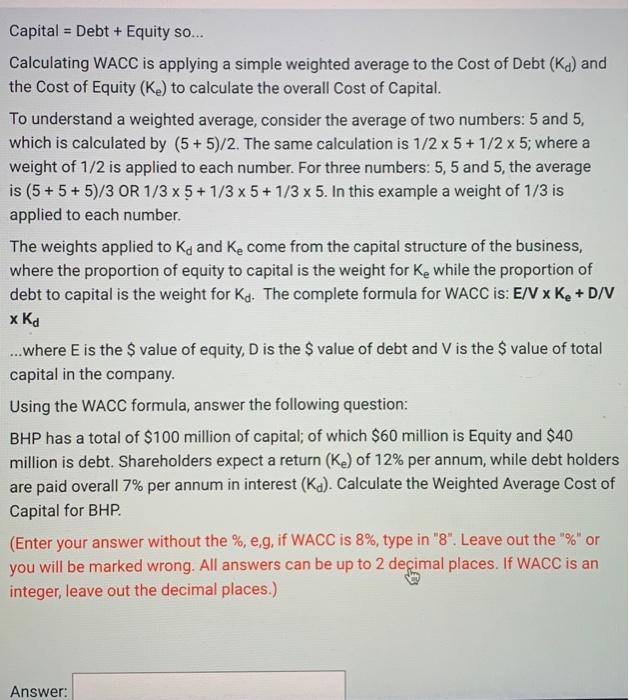
Capital = Debt + Equity so... Calculating WACC is applying a simple weighted average to the Cost of Debt (Kd) and the Cost of Equity (Ke) to calculate the overall Cost of Capital. To understand a weighted average, consider the average of two numbers: 5 and 5, which is calculated by (5 + 5)/2. The same calculation is 1/2 x 5+1/2 x 5; where a weight of 1/2 is applied to each number. For three numbers: 5, 5 and 5, the average is (5 + 5 + 5)/3 OR 1/3 x 5+1/3 x 5+1/3 x 5. In this example a weight of 1/3 is applied to each number. The weights applied to Ka and Ke come from the capital structure of the business, where the proportion of equity to capital is the weight for Ke while the proportion of debt to capital is the weight for Kd. The complete formula for WACC is: E/V x Ke + D/V x Kd ...where E is the $ value of equity, D is the $ value of debt and V is the $ value of total capital in the company. Using the WACC formula, answer the following question: BHP has a total of $100 million of capital, of which $60 million is Equity and $40 million is debt. Shareholders expect a return (Ke) of 12% per annum, while debt holders are paid overall 7% per annum in interest (Ka). Calculate the weighted Average Cost of Capital for BHP. (Enter your answer without the %, e,g, if WACC is 8%, type in "8". Leave out the "%" or you will be marked wrong. All answers can be up to 2 decimal places. If WACC is an integer, leave out the decimal places.)
Step by Step Solution
There are 3 Steps involved in it

Get step-by-step solutions from verified subject matter experts
 Study Help