







Question: CAREFULLY READ THE CASE STUDY BELOW. [100 Marks) How Business can help solve Society's sizable challenges Society's challenges are well known and fundamental issues such
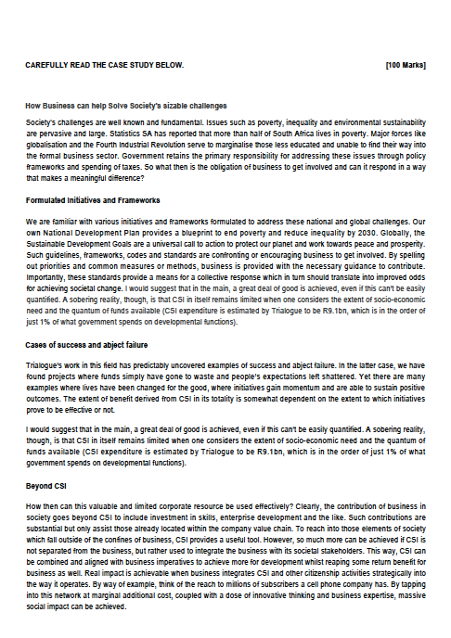
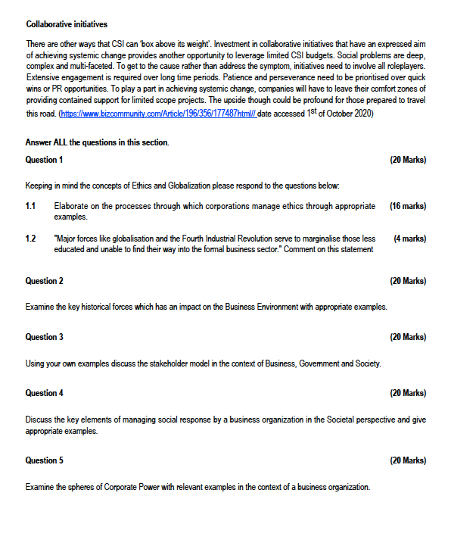
CAREFULLY READ THE CASE STUDY BELOW. [100 Marks) How Business can help solve Society's sizable challenges Society's challenges are well known and fundamental issues such as poverty, inequality and environmental sustainability are pervasive and large. Statistics SA has reported that more than half of South Africa lives in poverty. Major forces like globalisation and the Fourth Industrial Revolution serve to marginalise those less educated and unable to find their way into the formal business sector. Government retains the primary responsibility for addressing these issues through policy frameworks and spending of taxes. So what then is the obligation of business to get involved and can it respond in a way that makes a meaningful diference? Formulated Initiatives and frameworks We are familiar with various initiatives and frameworks formulated to address these national and global challenges. Our own National Development Plan provides a blueprint to end poverty and reduce inequality by 2030. Globally, the Sustainable Development Goals are a universal call to action to protect our planet and work towards peace and prosperity. Such guidelines, frameworks, codes and standards are confronting or encouraging business to get involved. By spelling out priorities and common measures or methods, business is provided with the necessary guidance to contribute Importantly, these standards provide a means for a collective response which in turn should translate into improved odds for achieving societal change. I would suggest that in the main, a great deal of good is achieved, even if this can't be easily quantified. A sobering reality, though, is that CSI in itself remains limited when one considers the extent of socio-economic need and the quantum of funds available (CSI expenditure is estimated by Trialogue to be R9.11n, which is in the order of just 1% of what government spends on developmental functions). Cases of success and abject failure Trialogue's work in this field has predictably uncovered examples of success and abject failure. In the later case, we have found projects where funds simply have gone to waste and people's expectations left shattered. Yet there are many examples where lives have been changed for the good, where initiatives gain momentum and are able to sustain positive outcomes. The extent of benefit derived from si in its totality is somewhat dependent on the extent to which initiatives prove to be efective or not I would suggest that in the main, a great deal of good is achieved, even if this can't be easily quantified. A sobering reality, though, is that si in itself remains limited when one considers the extent of socio-economic need and the quantum of funds available (CSI expenditure is estimated by Trialogue to be 9.10, which is in the order of just 15 of what government spends on developmental functions) Beyond CSI How then can this valuable and limited corporate resource be used effectively? Clearly, the contribution of business in society goes beyond CSI to include investment in skills, enterprise development and the like. Such contributions are substantial but only assist those already located within the company value chain. To reach into those elements of society which all outside of the confines of business, CSI provides a useful tool. However, so much more can be achieved if CSI is not separated from the business, but rather used to integrate the business with its societal stakeholders. This way, CSI can be combined and aligned with business imperatives to achieve more for development whist reaping some return benefit for business as well. Real impact is achievable when business integrates Csi and other citizenship activities strategically into the way operates. By way of example, mink of the reach to millions of subscribers a cell phone company has. By tapping intomis network at marginal additional cost coupled with a dose of innovative thinking and business expertise, massive social impact can be achieved. Collaborative initiatives There are other ways that I can box above its weight' Investment in collaborative initiatives that have an expressed aim of achieving systemic change provides another opportunity to leverage limited CSI budgets Social problems are deep, complex and multi-faceted. To get to the cause rather than address the symptom, initiatives need to involve all roleplayers. Extensive engagement is required over long time periods. Patience and perseverance need to be prontised over quick wins or PR opportunities. To play a part in achieving systemic change.companies will have to leave their comfort zones of providing contained support for limited scope projects. The upeide though could be profound for those prepared to travel this road. Intens://www.bizcommunity.com/Article/196356/177487html/ date accessed 15t of October 2020) Answer ALL the questions in this section Question 1 (20 Marka) Keeping in mind the concepts of Ethics and Globalization please respond to the questions below. 1.1 Elaborate on the processes through which corporation manage ethics through appropriate (16 marks) cxamples 1.2 (4 marks) Major forces like globalisation and the Fourth Industrial Revolution serve to marginalise those less educated and unable to find their way into the formal business sedot." Comment on this statement Question 2 (20 Marks) Examine the key historical forces which has an impact on the Business Environment with appropriate examples. Question 3 (20 Marks) Using your own comples discuss the stakcholder model in the context of Business, Government and Society Question 4 (20 Marks) Discuss the key elements of managing social response by a business organization in the Societal perspective and give appropriate examples Question 5 (20 Marks) Examine the spheres of Corporate Power with relevant examples in the context of a business organization. CAREFULLY READ THE CASE STUDY BELOW. [100 Marks) How Business can help solve Society's sizable challenges Society's challenges are well known and fundamental issues such as poverty, inequality and environmental sustainability are pervasive and large. Statistics SA has reported that more than half of South Africa lives in poverty. Major forces like globalisation and the Fourth Industrial Revolution serve to marginalise those less educated and unable to find their way into the formal business sector. Government retains the primary responsibility for addressing these issues through policy frameworks and spending of taxes. So what then is the obligation of business to get involved and can it respond in a way that makes a meaningful diference? Formulated Initiatives and frameworks We are familiar with various initiatives and frameworks formulated to address these national and global challenges. Our own National Development Plan provides a blueprint to end poverty and reduce inequality by 2030. Globally, the Sustainable Development Goals are a universal call to action to protect our planet and work towards peace and prosperity. Such guidelines, frameworks, codes and standards are confronting or encouraging business to get involved. By spelling out priorities and common measures or methods, business is provided with the necessary guidance to contribute Importantly, these standards provide a means for a collective response which in turn should translate into improved odds for achieving societal change. I would suggest that in the main, a great deal of good is achieved, even if this can't be easily quantified. A sobering reality, though, is that CSI in itself remains limited when one considers the extent of socio-economic need and the quantum of funds available (CSI expenditure is estimated by Trialogue to be R9.11n, which is in the order of just 1% of what government spends on developmental functions). Cases of success and abject failure Trialogue's work in this field has predictably uncovered examples of success and abject failure. In the later case, we have found projects where funds simply have gone to waste and people's expectations left shattered. Yet there are many examples where lives have been changed for the good, where initiatives gain momentum and are able to sustain positive outcomes. The extent of benefit derived from si in its totality is somewhat dependent on the extent to which initiatives prove to be efective or not I would suggest that in the main, a great deal of good is achieved, even if this can't be easily quantified. A sobering reality, though, is that si in itself remains limited when one considers the extent of socio-economic need and the quantum of funds available (CSI expenditure is estimated by Trialogue to be 9.10, which is in the order of just 15 of what government spends on developmental functions) Beyond CSI How then can this valuable and limited corporate resource be used effectively? Clearly, the contribution of business in society goes beyond CSI to include investment in skills, enterprise development and the like. Such contributions are substantial but only assist those already located within the company value chain. To reach into those elements of society which all outside of the confines of business, CSI provides a useful tool. However, so much more can be achieved if CSI is not separated from the business, but rather used to integrate the business with its societal stakeholders. This way, CSI can be combined and aligned with business imperatives to achieve more for development whist reaping some return benefit for business as well. Real impact is achievable when business integrates Csi and other citizenship activities strategically into the way operates. By way of example, mink of the reach to millions of subscribers a cell phone company has. By tapping intomis network at marginal additional cost coupled with a dose of innovative thinking and business expertise, massive social impact can be achieved. Collaborative initiatives There are other ways that I can box above its weight' Investment in collaborative initiatives that have an expressed aim of achieving systemic change provides another opportunity to leverage limited CSI budgets Social problems are deep, complex and multi-faceted. To get to the cause rather than address the symptom, initiatives need to involve all roleplayers. Extensive engagement is required over long time periods. Patience and perseverance need to be prontised over quick wins or PR opportunities. To play a part in achieving systemic change.companies will have to leave their comfort zones of providing contained support for limited scope projects. The upeide though could be profound for those prepared to travel this road. Intens://www.bizcommunity.com/Article/196356/177487html/ date accessed 15t of October 2020) Answer ALL the questions in this section Question 1 (20 Marka) Keeping in mind the concepts of Ethics and Globalization please respond to the questions below. 1.1 Elaborate on the processes through which corporation manage ethics through appropriate (16 marks) cxamples 1.2 (4 marks) Major forces like globalisation and the Fourth Industrial Revolution serve to marginalise those less educated and unable to find their way into the formal business sedot." Comment on this statement Question 2 (20 Marks) Examine the key historical forces which has an impact on the Business Environment with appropriate examples. Question 3 (20 Marks) Using your own comples discuss the stakcholder model in the context of Business, Government and Society Question 4 (20 Marks) Discuss the key elements of managing social response by a business organization in the Societal perspective and give appropriate examples Question 5 (20 Marks) Examine the spheres of Corporate Power with relevant examples in the context of a business organization
Step by Step Solution
There are 3 Steps involved in it
1 Expert Approved Answer
Step: 1 Unlock

Question Has Been Solved by an Expert!
Get step-by-step solutions from verified subject matter experts
Step: 2 Unlock
Step: 3 Unlock
 Study Help