







Question: Carefully read the following case study (Lego: Embracing Change by Combining BI with a Flexible Information System) and answer the questions. ? Explain the role
Carefully read the following case study (Lego: Embracing Change by Combining BI with a Flexible Information System) and answer the questions.
?
- Explain the role of database in SAP three-tier system.
- Why distributed architectures are flexible?
- Identify some of the business intelligence features included in SAP's business software suite.
- What are the main advantages and disadvantages of having multiple databases in a distributed architecture? Explain.
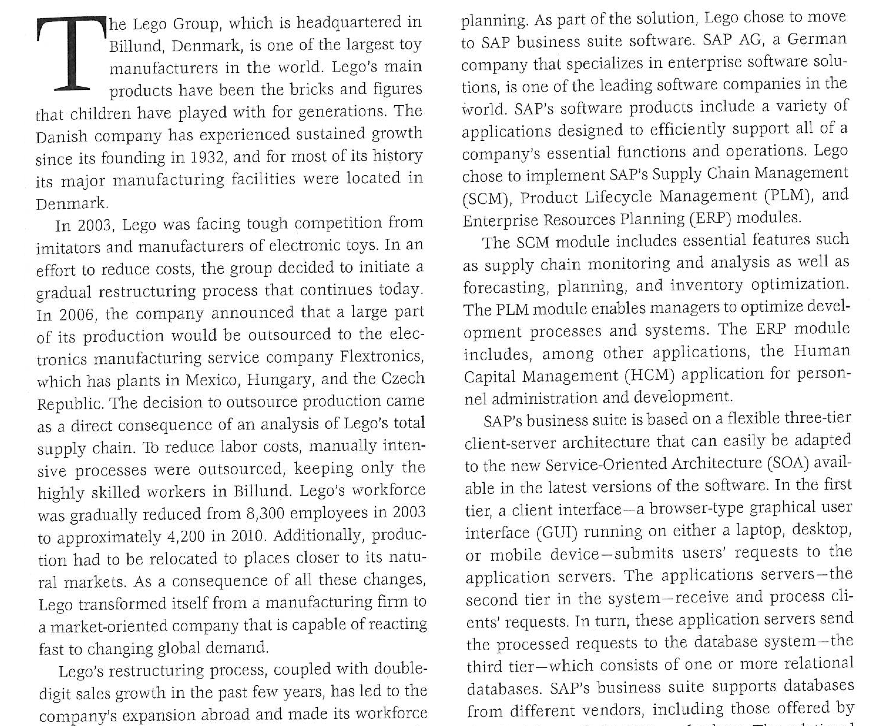
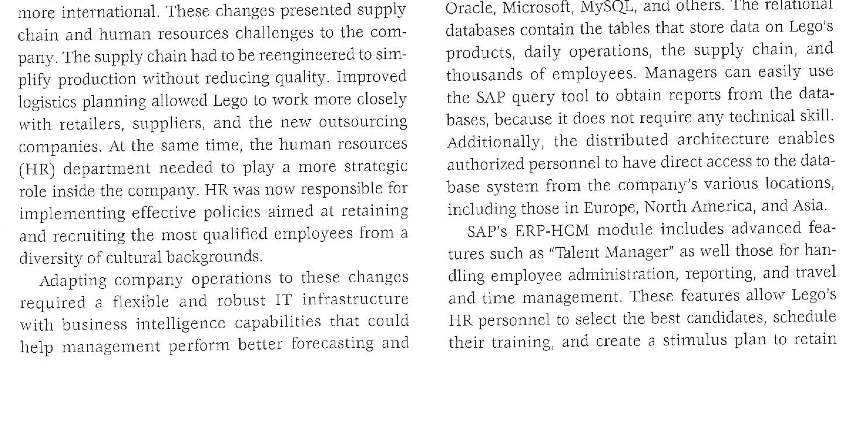
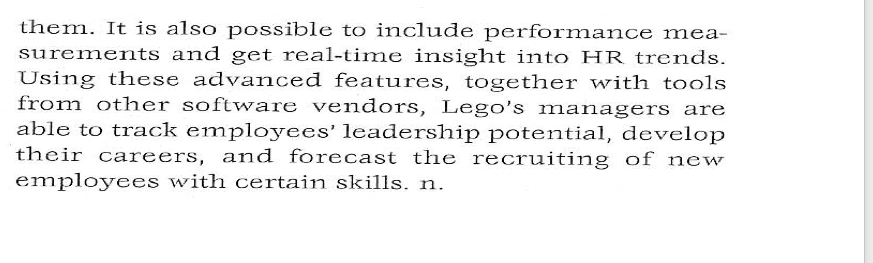
he Lego Group, which is headquartered in Eilluod, Denmark, is one of the largest toy manufacturers in the world. Lego's main products have been the bricks and figures that children have played with for generations. The Danish company has experienced sustained growth since its founding in 1932, and for most of'its history its major manufacturing facilities were located in Denmark. In 2003. Lego was facing tough competition from imitators and manufacturers of electronic toys. In an effort to reduce costs, the group decided to initiate a gradual restructuring process that continues today. In sees, the company announced that a large part of its production would be outsourced to the elec tronics manufacturing service company Flextronics, which has plants in Mei-rice, Hungary, and the Czech Republic. The decision to outsource production came as a direct consequence of an analysis ot'Trego's total supply chain. To reduce labor costs. manually inten- sive processes were outsourced, keeping only the highly skilled workers in Billund. Lego's workforce was gradually reduced from 8,300 employees in 2003 to approximately 4,200 in auto. Additionally, produc tion had to be relocated to places closer to its natu- ral markets. As a consequence of all these changes. Lego transformed itself from a ma nnfacturing rm to a market-oriented company that is capable of reacting fast to changing global demand. Legois restructuring process, coupled with double digit sales growth in the past Few years, has led to the company's expansion abroad and made its workforce planning. As pa rt of the solution, Lego chose to more to SAP business suite software. SAP AG, a German company that specializes in enterprise software. solu- tions, is one of the leading software companies in the world. ShP's software products include a variety of applications designed to efficiently support. al'. of a company's essential functions and operations. Lego chose to implement SAP's Supply Chain Management (SCM), Product hifecycle Management [FLML and Enterprise Resources Planningr [ERP]: modules. 'i he SEEM module includes essential features such as supply chain monitoring and analysis as well as Forecasting, planning, and inventory optimization. The PLM module enables managers to optimise devel- opment processes and systems. The ERP module includes, among other applications, the Human Capital Management (HEM) application for person nel administration and development SAP's business suite is based on a flexible threetier cliensseraer architecture that can easily be adapted to the new Service-Oriented Architecture [8011} availr able in the latest versions of the software. In the rst tier, a client interfacea browser-type graphical user interface [Gilt] running on either a laptop, desktop, or mobile deviceusuhmits users' requests to the application servers. The applications serversnthe second tier in the system receive and process cli- ents' requests. To turn, these application servers send the processed requests to the database systemthe third tierwhich consists of one or more relational databases. SAPJs business suite supports databases from different vendors, including those offered by . - 1 more international. These changes presented supply Oracle, Microsoft, MySQL, and others. The relational chain and human resources challenges to the com- databases contain the tables that store data on Lego's pany. The supply chain had to be reengineered to sim- products, daily operations, the supply chain, and plify production without reducing quality. Improved thousands of employees. Managers can easily use logistics planning allowed Lego to work more closely the SAP query tool to obtain reports from the data- with retailers, suppliers, and the new outsourcing bases, because it does not require any technical skill. companies. At the same time, the human resources Additionally, the distributed architecture enables (HR) department needed to play a more strategic authorized personnel to have direct access to the data- role inside the company. HR was now responsible for base system from the company's various locations, implementing effective policies aimed at retaining including those in Europe, North America, and Asia. and recruiting the most qualified employees from a SAP's ERP-HCM module includes advanced fea- diversity of cultural backgrounds. tures such as "Talent Manager" as well those for han- Adapting company operations to these changes dling employee administration, reporting, and travel required a flexible and robust IT infrastructure and time management. These features allow Lego's with business intelligence capabilities that could HR personnel to select the best candidates, schedule help management perform better forecasting and their training, and create a stimulus plan to retainthem. It is also possible to include performance mea- surements and get real-time insight into HR trends. Using these advanced features, together with tools from other software vendors, Lego's managers are able to track employees' leadership potential, develop their careers, and forecast the recruiting of new employees with certain skills. n
Step by Step Solution
There are 3 Steps involved in it

Get step-by-step solutions from verified subject matter experts
 Study Help