







Question: CASE 2 : THE LIMITED BRANDS Source: Based on: The Limited Designs Supply Chain to Begin and End with the Customer, Baseline Magazine, April 3
CASE : THE LIMITED BRANDS
Source: Based on: The Limited Designs Supply Chain to Begin and End with the Customer, Baseline Magazine,
April
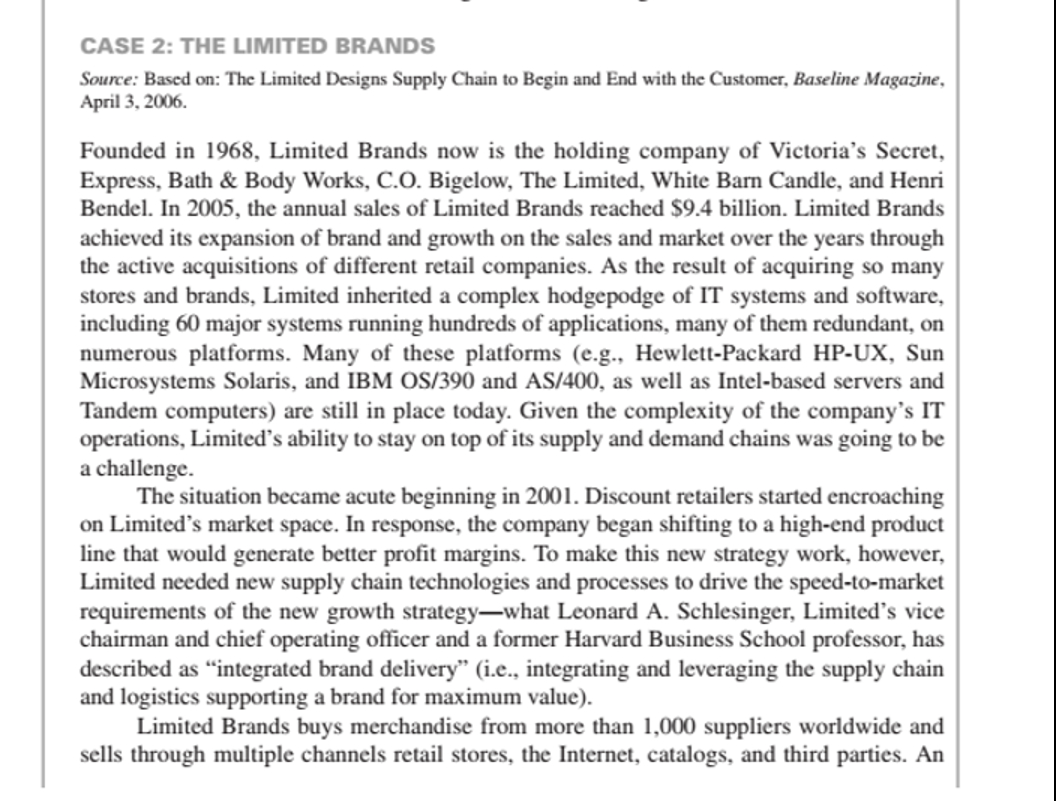
Founded in Limited Brands now is the holding company of Victoria's Secret,
Express, Bath & Body Works, CO Bigelow, The LimitCASE : ZARA Supply Chain Management Source: Based on: Zara: Taking the Lead in FastFashion, Rachel Tiplady, BusinessweekOnline, April Zara is the flagship brand of the Spanish retail group, Inditex, one of the superstars in the fashion retail industry in recent years. In Inditex reported percent sales growth to $ billion. That puts Inditex ahead of H&M the worldleading purveyor of cheapchic apparel, which posted $ billion in sales. Zara has more than stores in countries. The fashion industry is a special industry. The products they deal with are highly perishable, and they are susceptible to seasonsgross margin is meaningless if the product does not sell as planned. For many retailers, percent of the total merchandise being sold at hefty discount is quite the norm. Zara contributes around percent of group sales by concentrating on three winning formulas on which to base its fresh fashions: short lead time, lower quantities, and more styles. With an inhouse design team based in La Coruna, Spain, and a tightly controlled factory and distribution network, the company says it can take a design from drawing board to store shelf in just two weeks. That lets Zara introduce new items every week, which keeps customers coming back again and again to check out the latest styles. With new styles being developed and introduced frequently, each style would provide only around $$ of retail sales, a far lower figure than those other retailers or brands, and certainly not costefficient in terms of design and product development cost. Moreover, Zaras success is all the more surprising because at least half of its factories are in Europe, where wages are many times higher than those in Asia and Africa. To maintain its quick inventory turnover, however, the company must reduce shipping time to a minimum. The fastfashion approach also helps Zara reduce its exposure to fashion fauxpas. The company produces batches of clothing in such small quantities that even if it brings out a design that no one will buy, which happened during an unseasonably warm autumn in it can cut its losses quickly and move on to another trend. This higher cost of product development, however, is obviously more than adequately compensated by higher realized margins. The result is that Zara discounts only about percent of its product, which is roughly half the level of competitors. Information and communications technology is at the heart of Zaras business supply chain. Zaras quick response to the market and its high speed from design table to store shelf are enabled through four critical informationrelated areas. The first is constant collection of information on customer needs. Trend information flows daily and is in turn fed into the database at the companys head office. Zara outfits its store clerks with handheld computers to record sales and customer comments and then integrates the collected data with design, manufacturing, and distribution functions. Designers check the database for these dispatches as well as daily sales numbers, using the information to create new lines and modify existing ones. Thus, designers have access to realtime information when deciding with the commercial team on the fabric, cut, and price points of a new garment. As a result, the company can spot trends early ona rather critical quantity in fashion retailingand adjust stock accordingly within days. The second area is standardization of product information. Different or incomplete specifications and varying product information availability normally add several weeks to a typical retailers product design and approval process. Zara, however, stored the product information with common definitions, allowing it to prepare designs quickly and accurately, with clearcut manufacturing instructions. The third area is product and inventory management. Its inventory management system is able to manage thousands of fabric and trim specifications, design specifications, and physical inventory, which gives Zaras team the capability to design a garment with available stocks, rather than having to order material and wait for it to arrive. Zaras distribution management approach is its final advantage. Its stateoftheart distribution facility functions with minimal human intervention. Approximately kilometers of underground tracks move merchandise from Zaras manufacturing plants to the plus chutes that ensure that each order reaches its right destination. Optical reading devices sort out and distribute more than items of clothing in an hour. Zaras merchandise does not waste time waiting for human sorting.
Step by Step Solution
There are 3 Steps involved in it
1 Expert Approved Answer
Step: 1 Unlock

Question Has Been Solved by an Expert!
Get step-by-step solutions from verified subject matter experts
Step: 2 Unlock
Step: 3 Unlock
 Study Help