







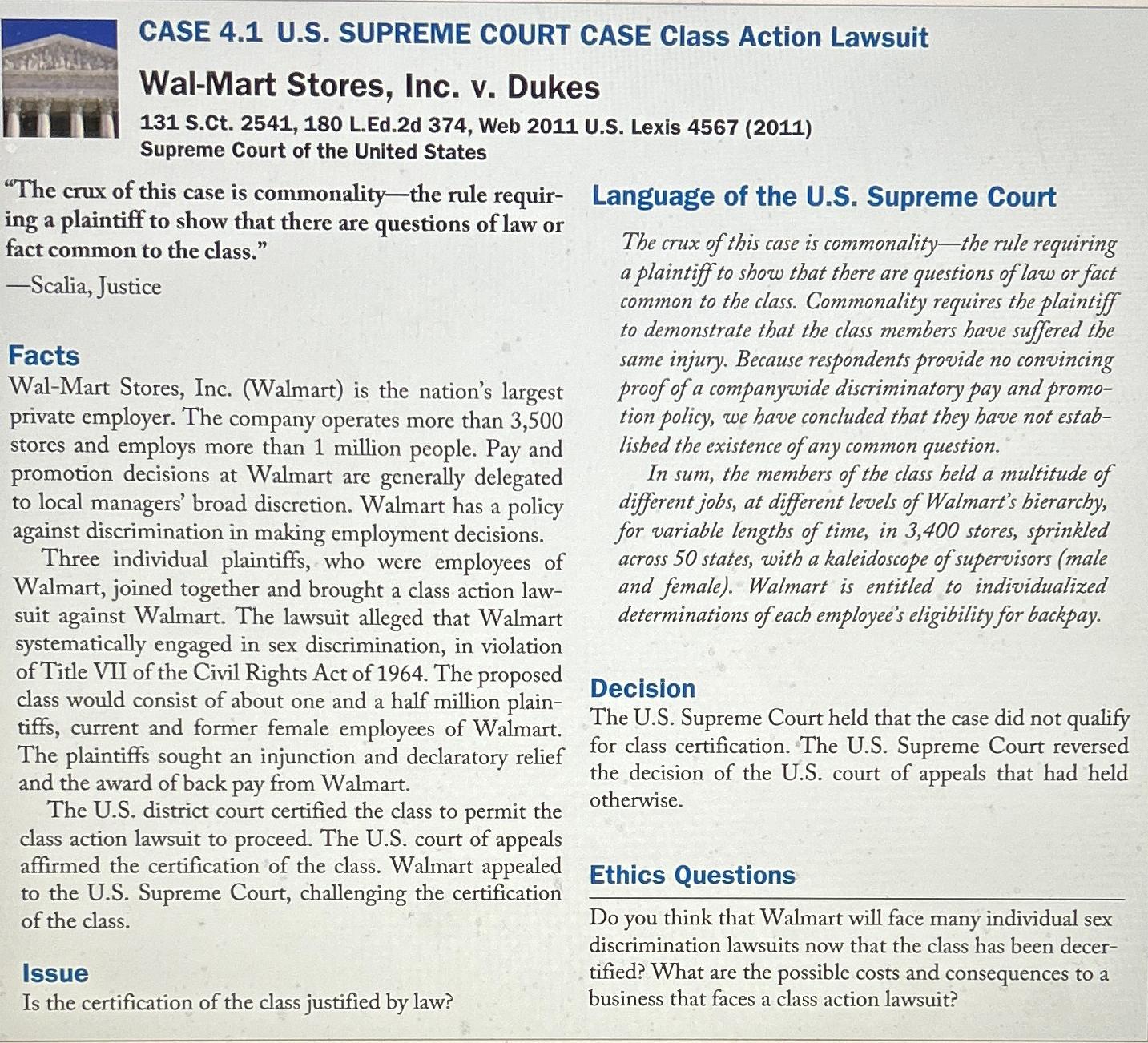
Question: CASE 4 . 1 U . S . SUPREME COURT CASE Class Action Lawsuit Wal - Mart Stores, Inc. v . Dukes 1 3 1
CASE US SUPREME COURT CASE Class Action Lawsuit
WalMart Stores, Inc. v Dukes
SCt LEdd Web US Lexis
Supreme Court of the United States
"The crux of this case is commonalitythe rule requiring a plaintiff to show that there are questions of law or fact common to the class."
Scalia, Justice
Facts
WalMart Stores, Inc. Walmart is the nation's largest private employer. The company operates more than stores and employs more than million people. Pay and promotion decisions at Walmart are generally delegated to local managers' broad discretion. Walmart has a policy against discrimination in making employment decisions.
Three individual plaintiffs, who were employees of Walmart, joined together and brought a class action lawsuit against Walmart. The lawsuit alleged that Walmart systematically engaged in sex discrimination, in violation of Title VII of the Civil Rights Act of The proposed class would consist of about one and a half million plaintiffs, current and former female employees of Walmart. The plaintiffs sought an injunction and declaratory relief and the award of back pay from Walmart.
The US district court certified the class to permit the class action lawsuit to proceed. The US court of appeals affirmed the certification of the class. Walmart appealed to the US Supreme Court, challenging the certification of the class.
Issue
Is the certification of the class justified by law?
Language of the US Supreme Court
The crux of this case is commonality the rule requiring a plaintiff to show that there are questions of law or fact common to the class. Commonality requires the plaintiff to demonstrate that the class members have suffered the same injury. Because respondents provide no convincing proof of a companywide discriminatory pay and promotion policy, we have concluded that they bave not established the existence of any common question.
In sum, the members of the class held a multitude of different jobs, at different levels of Walmart's bierarchy, for variable lengths of time, in stores, sprinkled across states, with a kaleidoscope of supervisors male and female Walmart is entitled to individualized determinations of each employee's eligibility for backpay.
Decision
The US Supreme Court held that the case did not qualify for class certification. The US Supreme Court reversed the decision of the US court of appeals that had held otherwise.
Ethics Questions
Do you think that Walmart will face many individual sex discrimination lawsuits now that the class has been decertified? What are the possible costs and consequences to a business that faces a class action lawsuit?
Step by Step Solution
There are 3 Steps involved in it
1 Expert Approved Answer
Step: 1 Unlock

Question Has Been Solved by an Expert!
Get step-by-step solutions from verified subject matter experts
Step: 2 Unlock
Step: 3 Unlock
 Study Help