







Question: CASE APPLICATION #2 The Next Big Thing Topic: Organizational change, innovative culture I Protecting Our House t all started with a simple plan to make
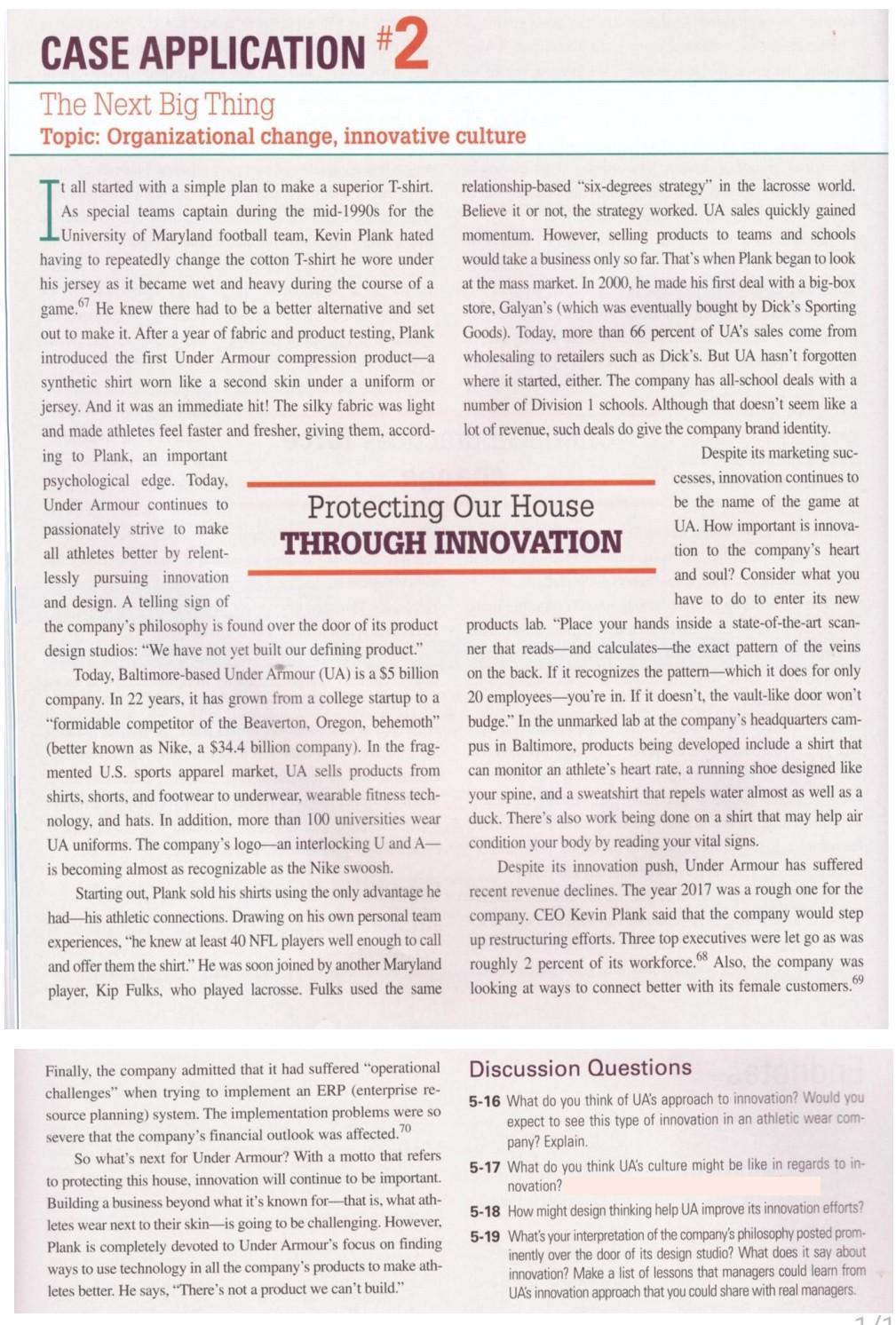
CASE APPLICATION #2 The Next Big Thing Topic: Organizational change, innovative culture I Protecting Our House t all started with a simple plan to make a superior T-shirt. relationship-based "six-degrees strategy" in the lacrosse world. As special teams captain during the mid-1990s for the Believe it or not, the strategy worked. UA sales quickly gained University of Maryland football team, Kevin Plank hated momentum. However, selling products to teams and schools having to repeatedly change the cotton T-shirt he wore under would take a business only so far. That's when Plank began to look his jersey as it became wet and heavy during the course of a at the mass market. In 2000, he made his first deal with a big-box 67 game. He knew there had to be a better alternative and set store, Galyan's (which was eventually bought by Dick's Sporting out to make it. After a year of fabric and product testing, Plank Goods). Today, more than 66 percent of UA's sales come from introduced the first Under Armour compression product-a wholesaling to retailers such as Dick's. But UA hasn't forgotten synthetic shirt worn like a second skin under a uniform or where it started, either. The company has all-school deals with a jersey. And it was an immediate hit! The silky fabric was light number of Division 1 schools. Although that doesn't seem like a and made athletes feel faster and fresher, giving them, accord- lot of revenue, such deals do give the company brand identity. ing to Plank, an important Despite its marketing suc- psychological edge. Today, cesses, innovation continues to Under Armour continues to be the name of the game at passionately strive to make UA. How important is innova- THROUGH INNOVATION all athletes better by relent- tion to the company's heart lessly pursuing innovation and soul? Consider what you and design. A telling sign of have to do to enter its new the company's philosophy is found over the door of its product products lab. "Place your hands inside a state-of-the-art scan- design studios: "We have not yet built our defining product." ner that reads and calculates the exact pattern of the veins Today, Baltimore-based Under Armour (UA) is a $5 billion on the back. If it recognizes the patternwhich it does for only company. In 22 years, it has grown from a college startup to a 20 employeesyou're in. If it doesn't, the vault-like door won't "formidable competitor of the Beaverton, Oregon, behemoth" budge." In the unmarked lab at the company's headquarters cam- (better known as Nike, a $34.4 billion company). In the frag- pus in Baltimore, products being developed include a shirt that mented U.S. sports apparel market, UA sells products from can monitor an athlete's heart rate, a running shoe designed like shirts, shorts, and footwear to underwear, wearable fitness tech- your spine, and a sweatshirt that repels water almost as well as a nology, and hats. In addition, more than 100 universities wear duck. There's also work being done on a shirt that may help air UA uniforms. The company's logo-an interlocking U and A- condition your body by reading your vital signs. is becoming almost as recognizable as the Nike swoosh. Despite its innovation push, Under Armour has suffered Starting out, Plank sold his shirts using the only advantage he recent revenue declines. The year 2017 was a rough one for the had his athletic connections. Drawing on his own personal team company. CEO Kevin Plank said that the company would step experiences, "he knew at least 40 NFL players well enough to call up restructuring efforts. Three top executives were let go as was 68 and offer them the shirt." He was soon joined by another Maryland roughly 2 percent of its workforce. Also, the company was player, Kip Fulks, who played lacrosse. Fulks used the same looking at ways to connect better with its female customers. 69 Discussion Questions Finally, the company admitted that it had suffered "operational challenges" when trying to implement an ERP (enterprise re- source planning) system. The implementation problems were so severe that the company's financial outlook was affected. 70 So what's next for Under Armour? With a motto that refers to protecting this house, innovation will continue to be important. Building a business beyond what it's known for that is, what ath- letes wear next to their skin is going to be challenging. However, Plank is completely devoted to Under Armour's focus on finding ways to use technology in all the company's products to make ath- letes better. He says, "There's not a product we can't build." 5-16 What do you think of UA's approach to innovation? Would you expect to see this type of innovation in an athletic wear com- pany? Explain 5-17 What do you think UA's culture might be like in regards to in novation? 5-18 How might design thinking help UA improve its innovation efforts? 5-19 What's your interpretation of the company's philosophy posted prom- inently over the door of its design studio? What does it say about innovation? Make a list of lessons that managers could learn from UA's innovation approach that you could share with real managers
Step by Step Solution
There are 3 Steps involved in it
1 Expert Approved Answer
Step: 1 Unlock

Question Has Been Solved by an Expert!
Get step-by-step solutions from verified subject matter experts
Step: 2 Unlock
Step: 3 Unlock
 Study Help