







Question: Case Example. Read the following short case and consider how to design an effective strategic marketing plan for the survival of Kodak in the future.
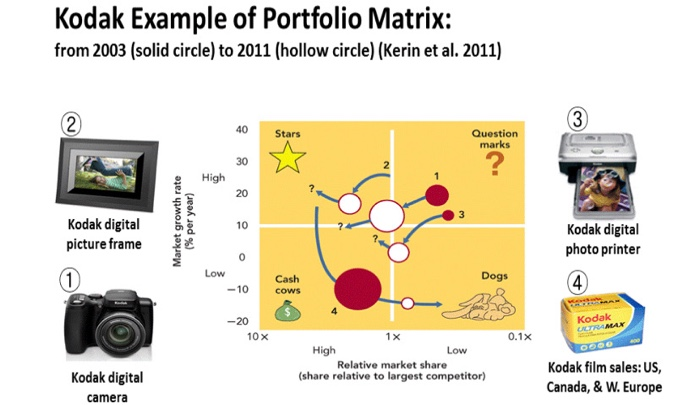
Case Example. Read the following short case and consider how to design an effective strategic marketing plan for the survival of Kodak in the future. In fact, Kodak filed the bankruptcy in 2012 driven by the unhealthiness of Kodaks business portfolio from the portfolio perspective. To upset this negative situation, Kodak needs to diagnose the effectiveness of its current business portfolio and figure out new business or product idea for the purpose of rebounding current negative situation. Regarding this issue, suggest your creative ideas.
How Kodak Failed
(By Chunka Mui January 18, 2012 in Forbes)
There are few corporate blunders as staggering as Kodaks missed opportunities in digital photography, a technology that it invented. This strategic failure was the direct cause of Kodaks decades-long decline as digital photography destroyed its film-based business model.
A new book by my Devils Advocate Group colleague, Vince Barabba, a former Kodak executive, offers insight on the choices that set Kodak on the path to bankruptcy. Barabbas book, The Decision Loom: A Design for Interactive Decision-Making in Organizations, also offers sage advice for how other organizations grappling with disruptive technologies might avoid their own Kodak moments.
Steve Sasson, the Kodak engineer who invented the first digital camera in 1975, characterized the initial corporate response to his invention this way:
But it was filmless photography, so managements reaction was, thats cutebut dont tell anyone about it. via The New York Times (5/2/2008)
Kodak managements inability to see digital photography as a disruptive technology, even as its researchers extended the boundaries of the technology, would continue for decades. As late as 2007, a Kodak marketing video felt the need to trumpet that Kodak is back and that Kodak wasnt going to play grab ass anymore with digital.
To understand how Kodak could stay in denial for so long, let me go back to a story that Vince Barabba recounts from 1981, when he was Kodaks head of market intelligence. Around the time that Sony introduced the first electronic camera, one of Kodaks largest retailer photo finishers asked him whether they should be concerned about digital photography. With the support of Kodaks CEO, Barabba conducted a very extensive research effort that looked at the core technologies and likely adoption curves around silver halide film versus digital photography
The results of the study produced both bad and good news. The bad news was that digital photography had the potential capability to replace Kodaks established film based business. The good news was that it would take some time for that to occur and that Kodak had roughly ten years to prepare for the transition.
The studys projections were based on numerous factors, including: the cost of digital photography equipment; the quality of images and prints; and the interoperability of various components, such as cameras, displays, and printers. All pointed to the conclusion that adoption of digital photography would be minimal and non-threatening for a time. History proved the studys conclusions to be remarkably accurate, both in the short and long term.
The problem is that, during its 10-year window of opportunity, Kodak did little to prepare for the later disruption. In fact, Kodak made exactly the mistake that George Eastman, its founder, avoided twice before, when he gave up a profitable dry-plate business to move to film and when he invested in color film even though it was demonstrably inferior to black and white film (which Kodak dominated).
Your Mission. Given this background, students mission for today is to diagnose the effectiveness of Kodaks current business portfolio and figure out new business or product idea for the purpose of rebounding current negative situation.
Step by Step Solution
There are 3 Steps involved in it
1 Expert Approved Answer
Step: 1 Unlock

Question Has Been Solved by an Expert!
Get step-by-step solutions from verified subject matter experts
Step: 2 Unlock
Step: 3 Unlock
 Study Help