







Question: i need help with this case. please read from following oicfures and read instructions on how to write it snd what about. I appreciate the
i need help with this case. please read from following oicfures and read instructions on how to write it snd what about. I appreciate the help. 
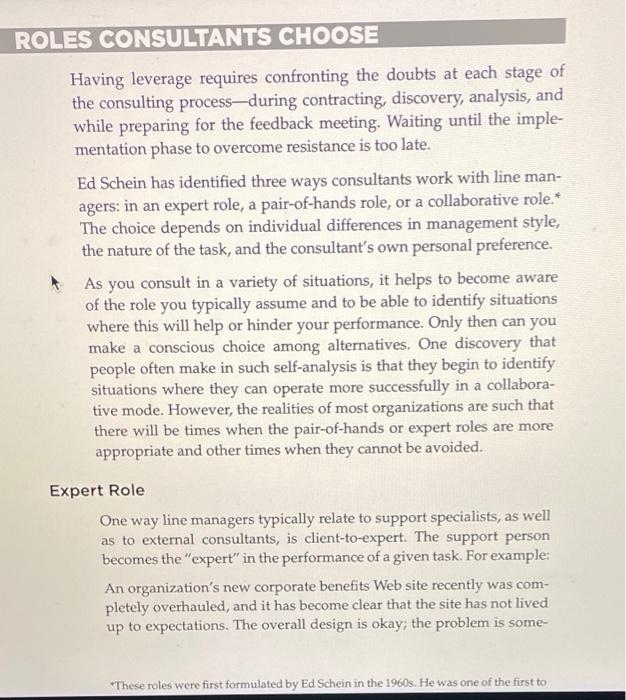
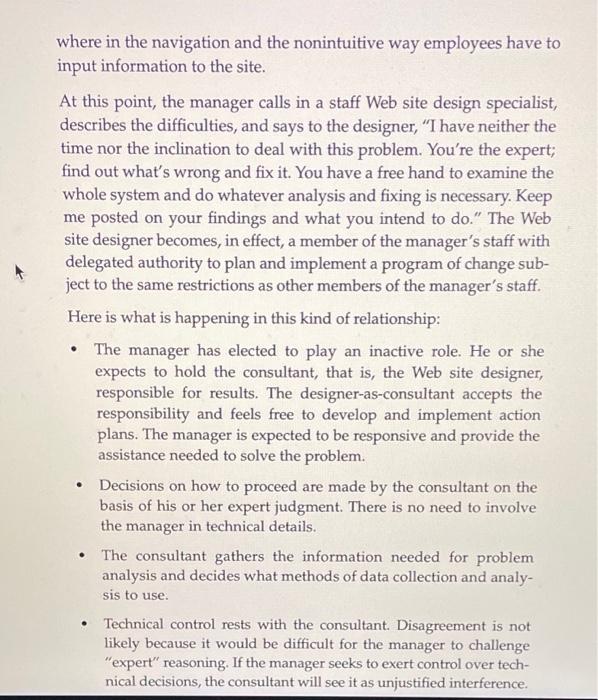
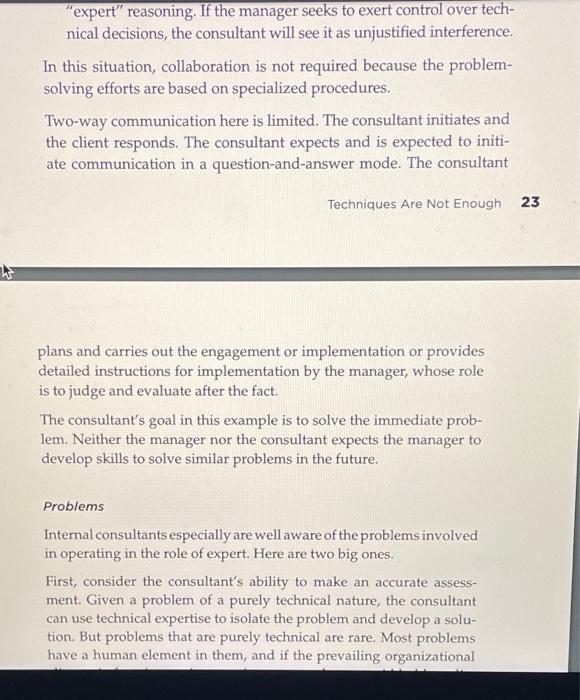
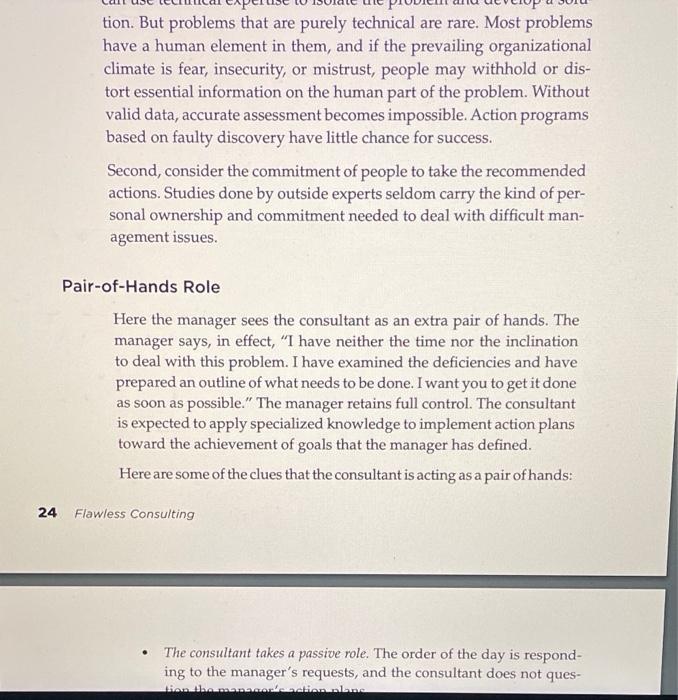
Read the "Roles Consultants Choose" section in Flawless Consulting Chapter 2 (p. 22-27). Reflect on your comfort and skill in playing each of the 3 roles: Pair-of-hands, Expert, Collaborative. Submit a short WORD document response to the following questions (maximum length=1 page): 1. Which of the 3 consultant roles appeals to you more (Expert, Pair of Hands, Collaborative), and why do you feel that way? 2. For ALL 3 roles respond to the following: What skills, knowledge, beliefs or behavioral preferences do you currently possess that will enable you to be successful when playing this role? What steps can you take to be even more successful when playing this role (e.g, skills to develop; knowledge to acquire; beliefs to shift; behaviors to change? CHOOSE Having leverage requires confronting the doubts at each stage of the consulting process-during contracting, discovery, analysis, and while preparing for the feedback meeting. Waiting until the imple- mentation phase to overcome resistance is too late. Ed Schein has identified three ways consultants work with line man- agers: in an expert role, a pair-of-hands role, or a collaborative role.* The choice depends on individual differences in management style, the nature of the task, and the consultant's own personal preference. As you consult in a variety of situations, it helps to become aware of the role you typically assume and to be able to identify situations where this will help or hinder your performance. Only then can you make a conscious choice among alternatives. One discovery that people often make in such self-analysis is that they begin to identify situations where they can operate more successfully in a collabora- tive mode. However, the realities of most organizations are such that there will be times when the pair-of-hands or expert roles are more appropriate and other times when they cannot be avoided. Expert Role One way line managers typically relate to support specialists, as well as to external consultants, is client-to-expert. The support person becomes the "expert" in the performance of a given task. For example: An organization's new corporate benefits Web site recently was com- pletely overhauled, and it has become clear that the site has not lived up to expectations. The overall design is okay; the problem is some- *These roles were first formulated by Ed Schein in the 1960s. He was one of the first to ROLES CONSULTANTS where in the navigation and the nonintuitive way employees have to input information to the site. At this point, the manager calls in a staff Web site design specialist, describes the difficulties, and says to the designer, "I have neither the time nor the inclination to deal with this problem. You're the expert; find out what's wrong and fix it. You have a free hand to examine the whole system and do whatever analysis and fixing is necessary. Keep me posted on your findings and what you intend to do." The Web site designer becomes, in effect, a member of the manager's staff with delegated authority to plan and implement a program of change sub- ject to the same restrictions as other members of the manager's staff. Here is what is happening in this kind of relationship: The manager has elected to play an inactive role. He or she expects to hold the consultant, that is, the Web site designer, responsible for results. The designer-as-consultant accepts the responsibility and feels free to develop and implement action plans. The manager is expected to be responsive and provide the assistance needed to solve the problem. Decisions on how to proceed are made by the consultant on the basis of his or her expert judgment. There is no need to involve the manager in technical details. The consultant gathers the information needed for problem analysis and decides what methods of data collection and analy- sis to use. Technical control rests with the consultant. Disagreement is not likely because it would be difficult for the manager to challenge "expert" reasoning. If the manager seeks to exert control over tech- nical decisions, the consultant will see it as unjustified interference. "expert" reasoning. If the manager seeks to exert control over tech- nical decisions, the consultant will see it as unjustified interference. In this situation, collaboration is not required because the problem- solving efforts are based on specialized procedures. Two-way communication here is limited. The consultant initiates and the client responds. The consultant expects and is expected to initi- ate communication in a question-and-answer mode. The consultant Techniques Are Not Enough 23 plans and carries out the engagement or implementation or provides detailed instructions for implementation by the manager, whose role is to judge and evaluate after the fact. The consultant's goal in this example is to solve the immediate prob- lem. Neither the manager nor the consultant expects the manager to develop skills to solve similar problems in the future. Problems Internal consultants especially are well aware of the problems involved in operating in the role of expert. Here are two big ones. First, consider the consultant's ability to make an accurate assess- ment. Given a problem of a purely technical nature, the consultant can use technical expertise to isolate the problem and develop a solu- tion. But problems that are purely technical are rare. Most problems have a human element in them, and if the prevailing organizational 24 tion. But problems that are purely technical are rare. Most problems have a human element in them, and if the prevailing organizational climate is fear, insecurity, or mistrust, people may withhold or dis- tort essential information on the human part of the problem. Without valid data, accurate assessment becomes impossible. Action programs based on faulty discovery have little chance for success. Second, consider the commitment of people to take the recommended actions. Studies done by outside experts seldom carry the kind of per- sonal ownership and commitment needed to deal with difficult man- agement issues. Pair-of-Hands Role Here the manager sees the consultant as an extra pair of hands. The manager says, in effect, "I have neither the time nor the inclination to deal with this problem. I have examined the deficiencies and have prepared an outline of what needs to be done. I want you to get it done as soon as possible." The manager retains full control. The consultant is expected to apply specialized knowledge to implement action plans toward the achievement of goals that the manager has defined. Here are some of the clues that the consultant is acting as a pair of hands: Flawless Consulting . The consultant takes a passive role. The order of the day is respond- ing to the manager's requests, and the consultant does not ques- tion the manager's action plane The consultant takes a passive role. The order of the day is respond- ing to the manager's requests, and the consultant does not ques- tion the manager's action plans. The manager makes the decisions on how to proceed. The consultant may prepare recommendations for the manager's review, but approval rests with the manager. . The manager selects the methods for discovery and analysis. The con- sultant may do the actual data collection, but only in accordance with procedures that the manager has outlined. Control rests with the manager. The consultant is expected to make suggestions, but avoids disagreement because the manager would see this as a challenge to his or her authority. Collaboration is not really necessary. The manager feels that it is his or her responsibility to specify goals and procedures. The consul- tant can ask questions for clarification. Two-way communication is limited. The manager initiates, and the consultant responds. The manager initiates in a descriptive or evaluative mode. The manager specifies change procedures for the consultant to implement. The manager's role is to judge and evaluate from a close distance. The consultant's goal is to make the system more effective by the applica- tion of specialized knowledge. Problems The major problem emerges in the discovery phase. In a pair-of-hands role, the consultant is dependent on the manager's ability to under- stand what is happening and to develop an effective action plan. If the manager's assessment is faulty, the action plan won't work, and the stand what is happening and to develop an effective action plan. If the manager's assessment is faulty, the action plan won't work, and the consultant who provided the service becomes a convenient scapegoat. To avoid this trap, the consultant may ask for time to verify the manager's assessment. And then the consultant might face another problem: managers who have a preference for consultants who take Techniques Are Not Enough 25 on the pair-of-hands role may interpret such requests as questioning their experience, their authority, or both. The consultant who assumes a collaborative role enters the rela- tionship with the notion that management issues can be dealt with effectively only by joining his or her specialized knowledge with the manager's knowledge of the organization. Problem solving becomes a joint undertaking, with equal attention to both the technical issues and the human interactions in dealing with the technical issues. When consultants work through a collaborative role, they don't solve problems for the manager. They apply their special skills to help man- agers solve problems themselves. The distinction is significant. The key assumption underlying the collaborative role is that the manager must be actively involved in data gathering and analysis, setting goals and developing action plans, and, finally, sharing responsibility for success or failure. Collaborative Role 26 and developing action plans, and, finally, sharing responsibility for success or failure. Here's what happens: The consultant and the manager work to become interdependent. They share responsibility for action planning, implementation, and results. Decision making is bilateral. It is characterized by mutual exchange and respect for the responsibilities and expertise of both parties. Data collection and analysis are joint efforts. The selection of the dis- covery process to be used is done by both the consultant and the manager. Control issues become matters for discussion and negotiation. Disagreement is expected and seen as a source of new ideas. Collaboration is considered essential. The consultant makes a special point to reach understanding and agreement on the nature and scope of mutual expectations prior to initiating problem-solving efforts. Communication is two-way. Both the consultant and the manager take the initiative, depending on the issues. Information exchange is carried on in a problem-solving mode. Flawless Consulting . Implementation responsibilities are determined by discussion and agree- ment. Assignments are made to maximize use of the available resources in line with the responsibilities appropriate to each party. The goal is to solve problems so they stay solved. That is, the con- Implementation responsibilities are determined by discussion and agree- ment. Assignments are made to maximize use of the available resources in line with the responsibilities appropriate to each party. The goal is to solve problems so they stay solved. That is, the con- sultant establishes a helping relationship designed to broaden the competence level of managers to develop and implement action plans that will make the system more effective. The next time a similar problem arises, the manager will have the skills to solve it. Problems There are also problems in trying to work collaboratively. Consultants often have special skills (for example, in information technology or budget management) that managers see as a quick answer to their problems. Managers who prefer to work with consultants in an expert role may interpret any attempts at collaboration as indifference or foot dragging. Managers with a preference for working with consultants in a pair-of-hands role may interpret moves toward collaboration as insubordination. Plus, working collaboratively takes some time. COLLABORATION AND THE FEAR OF HOLDING HANDS In a presentation on collaborative consultation, a person in the audience kept asking questions about the nature of collaboration: "Can't it be a sign of weakness? Don't you have expertise that you are denying if you operate too collab- oratively? Clients want answers, not questions, don't they?" Finally, with a lot of frustration, he said, "Well, I don't want my consultants just sit- ting around holding hands with a client!" He was pointing to an area where there is consid- erable confusion about the distinction between the expert role and the collaborative role. Techniques Are Not Enough 27
Step by Step Solution
There are 3 Steps involved in it
1 Expert Approved Answer
Step: 1 Unlock

Question Has Been Solved by an Expert!
Get step-by-step solutions from verified subject matter experts
Step: 2 Unlock
Step: 3 Unlock
 Study Help