







Question: CASE: Should Wal Mart Standardize Selection? The process for securing a management position at WalMart has seemed arbitrary to some. One observer called it a
CASE: Should Wal Mart Standardize Selection?
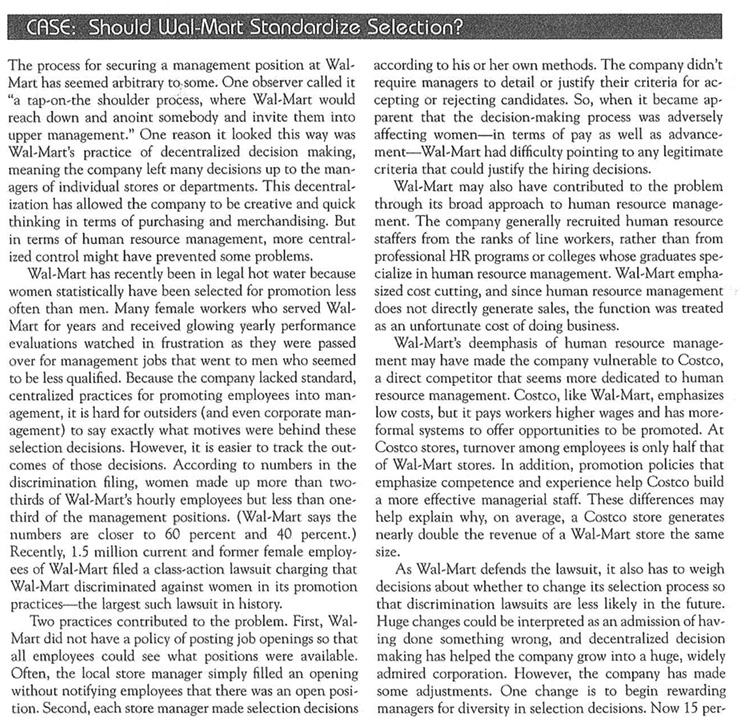
The process for securing a management position at WalMart has seemed arbitrary to some. One observer called it "a taponthe shoulder process, where WalMart would reach down and anoint somebody and invite them into upper management." One reason it looked this way was WalMart's practice of decentralized decision making, meaning the company left many decisions up to the managers of individual stores or departments. This decentralization has allowed the company to be creative and quick thinking in terms of purchasing and merchandising. But in terms of human resource management, more centralized control might have prevented some problems.
WalMart has recently been in legal hot water because women statistically have been selected for promotion less often than men. Many female workers who served WalMart for years and received glowing yearly performance evaluations watched in frustration as they were passed over for management jobs that went to men who seemed to be less qualified. Because the company lacked standard, centralized practices for promoting employees into management, it is hard for outsiders and even corporate management to say exactly what motives were behind these selection decisions. However, it is easier to track the outcomes of those decisions. According to numbers in the discrimination filing, women made up more than twothirds of WalMart's hourly employees but less than onethird of the management positions. WalMart says the numbers are closer to percent and percent. Recently, million current and former female employees of WalMart filed a classaction lawsuit charging that WalMart discriminated against women in its promotion practicesthe largest such lawsuit in history.
Two practices contributed to the problem. First, WalMart did not have a policy of posting job openings so that all employees could see what positions were available. Often, the local store manager simply filled an opening without notifying employees that there was an open position. Second, each store manager made selection decisions
according to his or her own methods. The company didn't require managers to detail or justify their criteria for accepting or rejecting candidates. So when it became apparent that the decisionmaking process was adversely affecting womenin terms of pay as well as advancementWalMart had difficulty pointing to any legitimate criteria that could justify the hiring decisions.
WalMart may also have contributed to the problem through its broad approach to human resource management. The company generally recruited human resource staffers from the ranks of line workers, rather than from professional HR programs or colleges whose graduates specialize in human resource management. WalMart emphasized cost cutting, and since human resource management does not directly generate sales, the function was treated as an unfortunate cost of doing business.
WalMart's deemphasis of human resource management may have made the company vulnerable to Costco, a direct competitor that seems more dedicated to human resource management. Costco, like WalMart, emphasizes low costs, but it pays workers higher wages and has moreformal systems to offer opportunities to be promoted. At Costco stores, turnover among employees is only half that of WalMart stores. In addition, promotion policies that emphasize competence and experience help Costco build a more effective managerial staff. These differences may help explain why, on average, a Costco store generates nearly double the revenue of a WalMart store the same size.
As WalMart defends the lawsuit, it also has to weigh decisions about whether to change its selection process so that discrimination lawsuits are less likely in the future. Huge changes could be interpreted as an admission of having done something wrong, and decentralized decision making has helped the company grow into a huge, widely admired corporation. However, the company has made some adjustments. One change is to begin rewarding managers for diversity in selection decisions. Now per
Step by Step Solution
There are 3 Steps involved in it
1 Expert Approved Answer
Step: 1 Unlock

Question Has Been Solved by an Expert!
Get step-by-step solutions from verified subject matter experts
Step: 2 Unlock
Step: 3 Unlock
 Study Help