







Question: Case study 1 7 . 1 Planning for change at Bairrada Wines Bairrada Wines ( as it will be referred to here ) is a
Case study Planning for change at Bairrada Wines
Bairrada Wines as it will be referred to here is a small familyowned Portuguese winery that uses traditional methods to produce excellent wine from its own grapes.
For many years, demand outstripped supply, so it was decided to plant more vines. It was four years later before the additional output was available for sale but, once again, all the wine was quickly sold. Encouraged by this, the founderowner acquired more land and planted more vines to increase production, and profits continued to increase until the Portuguese economy was hit by a recession and the economic downturn began to affect sales. However, although revenue fell, the winery was still making a profit and the banks were happy to continue lending to Bairrada Wines, even though they were closing their doors to many similar businesses. This created a false sense of security, but months later the founderowner and the CEO recognized that the recession was not a temporary downturn and they had to take action if they were to survive and prosper in the new hostile economic climate.
Although times were getting harder, the business was continuing to make a modest profit and had few debts, so the founderowner and the CEO decided that the situation did not call for them to impose any draconian cuts. They felt that sudden radical change could do serious damage to the winery's culture and the high level of staff commitment that, over the years, had contributed to the success of the business. Their view was that the best way forward was to involve the management team and as many employees as possible in developing a plan that would secure the longterm success of the business.
After several meetings of the management team, a plan began to emerge. It was decided that more needed to be done to secure the future market for their wine. Over per cent of output was sold within Portugal and no effort had been made to develop export markets. The per cent of the wine that had been sold for export had been sold to foreign buyers who had sought out the winery. But with the Portuguese economy in free fall, local sales were predicted to fall over the long term. So it was decided to begin exhibiting at those wine fairs that attracted foreign buyers and to do more travelling to visit buyers in selected export markets such as Germany and the UK
Attention was also given to reducing costs. Labour costs accounted for a high proportion of the company's annual spend so this was an obvious target, but because most employees had been with the company for many years, redundancy was a costly option and letting people go could undermine the commitment of those who were retained. However, one senior member of the administrative department was months off qualifying for early retirement, so a possibility was to explore her willingness to switch to a parttime contract until then. It was also decided to explore other possibilities for moving staff to parttime work.
Savings could also be made if winery and vineyard workers could be persuaded to work more flexibly. It was already accepted practice that the agricultural workers would work in the winery when, because of weather conditions or the time of the year, there was little or no work in the vineyard. But this arrangement did not work the other way round. Winery workers did not normally work outside and seasonal workers were employed at harvest and for pruning. It was anticipated that the proposal to temporarily relocate some of the winery workers to the vineyards at peak times would be resisted, but it was decided that this option needed be explored. The management team acknowledged that they would have to communicate a compelling vision of the required changes if they were to secure the support for more flexible working, an approach Dibella identified as effective when the appeal of a necessary change is low see Figure below
Opportunities for cost savings were also identified within the winery. Elaborating aged wine is a traditional process, and in the winery many of the steps in the
process, such as pump over, pressing, run off and racking, involved little mechanization, but it was decided to engage a consultant to investigate possibilities of reducing costs without affecting quality. With this exception, it was decided to curtail all capital investment, so plans to construct a new water purification plant and purchase additional land for planting new vineyards were put on hold.
The founderowner and CEO felt that the management team had helped them to develop a good plan for change that involved working on several levers for change simultaneously.
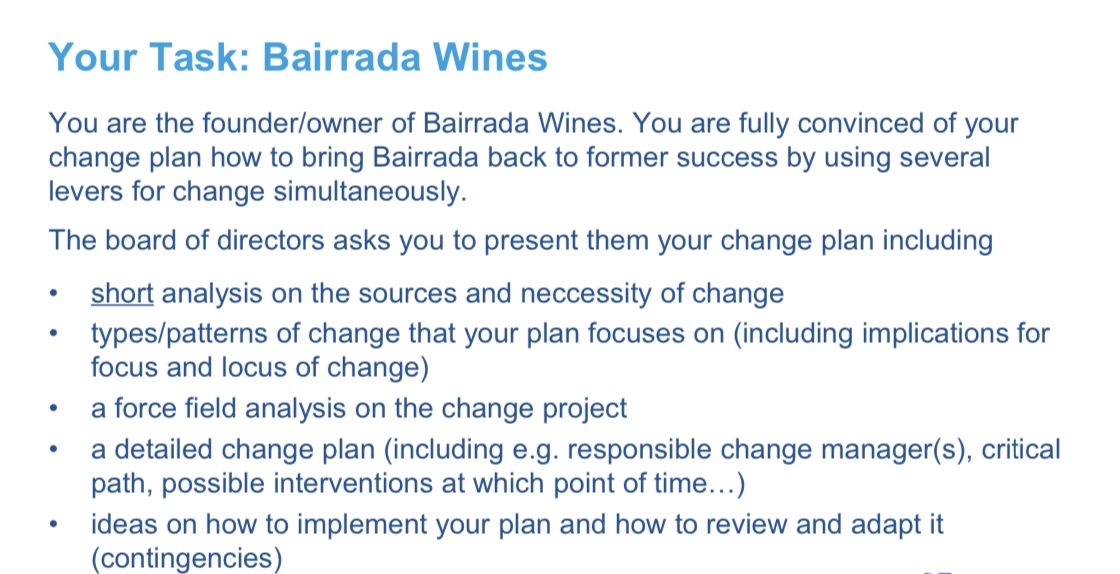
Your Task: Bairrada Wines
You are the founderowner of Bairrada Wines. You are fully convinced of your change plan how to bring Bairrada back to former success by using several levers for change simultaneously.
The board of directors asks you to present them your change plan including
Q Short analysis on the sources and neccessity of change.
Q Typespatterns of change that your plan focuses on including implications for focus and locus of change
Q A force field analysis on the change project.
Q A detailed change plan including eg responsibled change managers critical path, possible interventions at which point of time...
Q Ideas on how to implement your plan and how to review and adapt it contingencies
Step by Step Solution
There are 3 Steps involved in it
1 Expert Approved Answer
Step: 1 Unlock

Question Has Been Solved by an Expert!
Get step-by-step solutions from verified subject matter experts
Step: 2 Unlock
Step: 3 Unlock
 Study Help