Question: Case Study 1 OVERVIEW Semco was originally founded as a maker of marine pumps in Sao Paulo, Brazil, in 1953. For decades, under the leadership
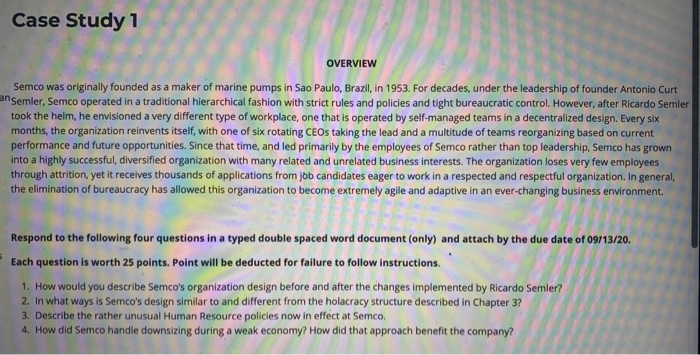
Case Study 1 OVERVIEW Semco was originally founded as a maker of marine pumps in Sao Paulo, Brazil, in 1953. For decades, under the leadership of founder Antonio Curt an Semler, Semco operated in a traditional hierarchical fashion with strict rules and policies and tight bureaucratic control. However, after Ricardo Semler took the helm, he envisioned a very different type of workplace, one that is operated by self-managed teams in a decentralized design. Every six months, the organization reinvents itself, with one of six rotating CEOs taking the lead and a multitude of teams reorganizing based on current performance and future opportunities. Since that time, and led primarily by the employees of Semco rather than top leadership, Semco has grown into a highly successful, diversified organization with many related and unrelated business interests. The organization loses very few employees through attrition, yet it receives thousands of applications from job candidates eager to work in a respected and respectful organization. In general, the elimination of bureaucracy has allowed this organization to become extremely agile and adaptive in an ever-changing business environment Respond to the following four questions in a typed double spaced word document (only) and attach by the due date of 09713/20. Each question is worth 25 points. Point will be deducted for failure to follow instructions. 1. How would you describe Semco's organization design before and after the changes implemented by Ricardo Semler? 2. In what ways is Semco's design similar to and different from the holacracy structure described in Chapter 3? 3. Describe the rather unusual Human Resource policies now in effect at Semco. 4. How did Semco handle downsizing during a weak economy? How did that approach benefit the company? Case Study 1 OVERVIEW Semco was originally founded as a maker of marine pumps in Sao Paulo, Brazil, in 1953. For decades, under the leadership of founder Antonio Curt an Semler, Semco operated in a traditional hierarchical fashion with strict rules and policies and tight bureaucratic control. However, after Ricardo Semler took the helm, he envisioned a very different type of workplace, one that is operated by self-managed teams in a decentralized design. Every six months, the organization reinvents itself, with one of six rotating CEOs taking the lead and a multitude of teams reorganizing based on current performance and future opportunities. Since that time, and led primarily by the employees of Semco rather than top leadership, Semco has grown into a highly successful, diversified organization with many related and unrelated business interests. The organization loses very few employees through attrition, yet it receives thousands of applications from job candidates eager to work in a respected and respectful organization. In general, the elimination of bureaucracy has allowed this organization to become extremely agile and adaptive in an ever-changing business environment Respond to the following four questions in a typed double spaced word document (only) and attach by the due date of 09713/20. Each question is worth 25 points. Point will be deducted for failure to follow instructions. 1. How would you describe Semco's organization design before and after the changes implemented by Ricardo Semler? 2. In what ways is Semco's design similar to and different from the holacracy structure described in Chapter 3? 3. Describe the rather unusual Human Resource policies now in effect at Semco. 4. How did Semco handle downsizing during a weak economy? How did that approach benefit the company









 Study Help