Question: Case Study 15 marks Knowledge Management at the CSO The case study organization (CSO) strategy was grounded in sustaining a capability to meet its customers

Case Study
15 marks
Knowledge Management at the CSO
The case study organization (CSO) strategy was grounded in sustaining a capability to meet its customers operational requirements. This requirement was to build and maintain significant
public assets designed for national security. The CSO provided technical advice associated with the risk management of these public assets. The CSOs structure was a bureaucratic hierarchy. It involved a head (the senior industry partner on the project), three directorates (led by executive directors who were members of the project executive committee), and ten sections doing different technical work. The CSOs organizational culture was based on three drivers people, performance, and professionalism defined by a series of signature behaviours such as Respect the contribution of each individual, Fix problems and take action, and Strengthen relationships across the organization and beyond. The signature behaviour most related to knowledge management was Communicate well and regularly. These cultural statements were officially endorsed by the CSOs most senior executive and widely disseminated to all staff.
The project was to make the CSO a learning organization. The project aimed to introduce a series of research interventions, followed by periods of implementation and reflection, over
a three-and-a-half-year period, in order to achieve its objective of learning organization capacity. The research interventions were knowledge management tools and techniques introduced by six training workshops. Each workshop covered a different aspect of knowledge management knowledge creation, knowledge sharing, knowledge usage, knowledge acquisition, knowledge
preservation, and knowledge retention and each workshop was conducted over two days every three months, for 18 months. Respondents were invited to attend a different workshop every three months, and the hope was that after 18 months all respondents would have been trained in six KM systems.
The CSO was new to knowledge management. While the CSO was part of a very large government department (the second-largest in Australia) where pockets of knowledge management operated, largely in isolation, it had no formal knowledge management prior to the project. One of the work sections included a technical library; however, the CSOs efforts at KM were limited to information technology and a knowledge repository approach, i.e. intranets and document management.
A staff presentation was held at the CSO premises on 11 July 2008, where the chief investigator (CI) explained what the project was about, its significance, the methodology, and what staff were supposed to do, i.e. their role. The following extract shows how the research interventions were explained to staff:
We want to ensure that the CSO has a critical mass necessary to be an intelligent customer of industry. It is perhaps easiest to think about the project in terms of short-term, medium-term, and long-term goals. In the short term, the project will directly focus on knowledge retention. In the medium term, the project will aim to change the
organizational culture to help people work smarter. In the long term, the project will grow the knowledge base and increase the organizations capability.
We will do this by introducing research interventions based on current best practice ideas. These exist but will be tailored to address the problems identified by an audit of the CSOs learning organization capacity. They will be discussed with the CSO management team prior to implementation. The research team will design a training package and documentation (e.g. a training manual) for each of the research interventions prior to launch. The research team will conduct training workshops for each research intervention. We will be available as a support for the CSO team during implementation but once we hand over at the end of the training workshops, the CSO will be responsible for managing the implementation of the interventions.
The selection of knowledge management tools for testing were chosen based on: (a) their use by
organizations found in KM case studies (i.e. practical examples); (b) their coverage in the literature discussing practical solutions to the KM barriers found in the pilot study; and (c) their potential to address these barriers. The generalizability of this approach was that others may make choices at the strategy phase by situating KM tools as solutions to problems and referring to the tools found to work.
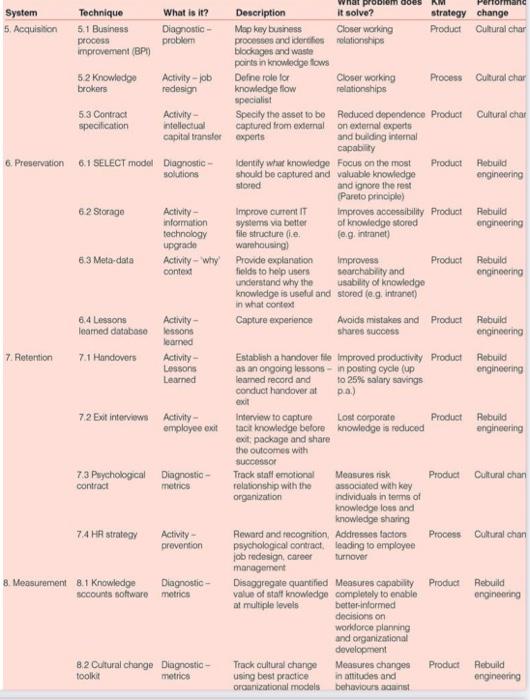
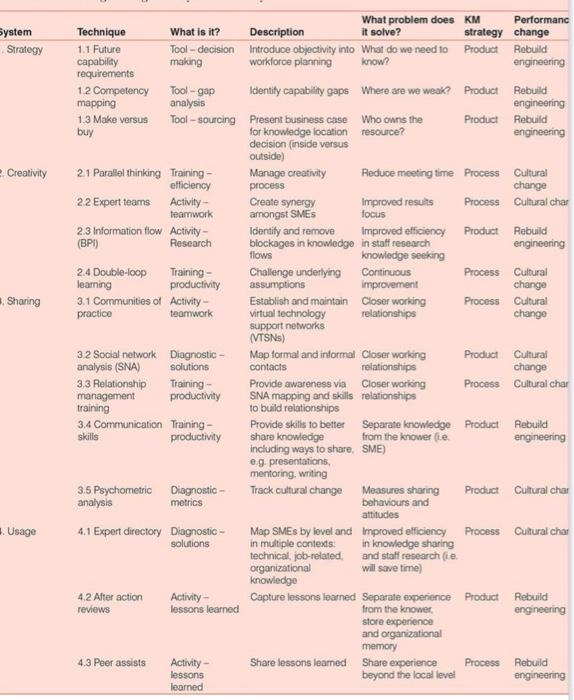
The knowledge management system introduced at the CSO was based on two systems of managing knowledge resources and then managing knowledge flows and enablers. Table 2.4 provides further details
It was clear that many CSO staff did not feel there was a problem of knowledge sharing and
therefore disagreed with their executive on the need for a project. The following was a critical
interaction between the research team and a staff member at the staff presentation: Staff: We dont need this project.
CI: Why not?
Staff: We already manage our knowledge well. We have the (organization intranet).
CI: Well, we are not talking about computers and databases here. Knowledge management is about people. It is about getting you to share the knowledge in your head with others.
Staff: We have already shared it. It is there on the (organization intranet). All you have to do is look. CI: Im sorry; I think you are missing the point.
This interaction highlights very important misunderstandings about the project on both sides. It illustrates confusion about knowledge as an object versus a process. The respondent here saw knowledge as an object, something that can be captured, stored, and shared with others via a computer. The CI saw knowledge as a process, something that can best be shared through human interaction. The critical mistake was that the CI did not ask staff at this presentation about their underlying assumptions. He did not ask them whether they felt knowledge sharing (KS) was a problem and, if so, how it could be fixed. He did not ask them how they felt about the training workshops, and how they should be conducted. He knew a contract had been signed and he and the case study executive had agreed on a research method. He assumed that the staff accepted
this because a contract had been signed stating that KS was a problem and they would help him to fix it. Therefore, the learning flows could not move along the tactical level to help participants look at why the project was useful i.e. personal and organizational gain because the CI dismissed existing methods as irrelevant.
At a barbecue held following the staff presentation, several things happened which bothered the research team. First, the barbeque was not well attended. Of the 150 staff in the study, only about 30 attended. When the apparent lack of interest in meeting the research team was questioned, excuses such as staff being busy or working elsewhere were offered. Second, in discussions with staff, many seemed to have almost no idea what the project was about or why they were involved. Third, when the CI raised his concern that staff needed to be persuaded to engage with the study, senior management told him not to get involved.
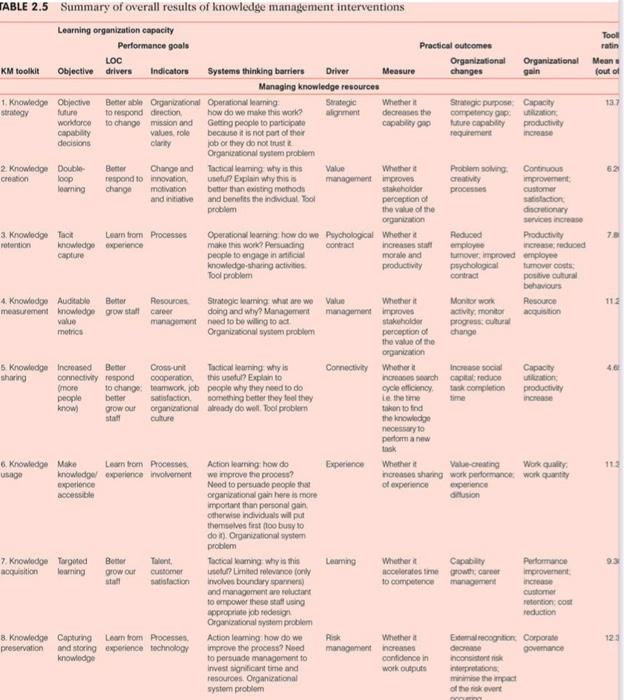
The success of the KM system introduced at the CSO three years later was summarized in Table 2.5.
Case Study Questions
1. Use the framework provided in Table 2.5 to explain the type of knowledge management introduced at the CSO.
2. What type of knowledge management should have been introduced at the CSO? Why? Use concepts, theories and models learned in class.
3. Evaluate the implementation of knowledge management at the CSO. Why did it work? Or why didnt it work?
Important Instructions:
The assignment should be typed on a word document using Times New Roman, Font size 12, word count 1500-2000 words. You should use in-text citation and provide a list of references following Harvard referencing style.
Hand in date: 31.5.2021 midnight. Late submission will be marked Zero
Submit through e-learning submission link
Submission will be checked for plagiarism. If a document shows a similarity higher
than 30%, it will receive a zero.
Cheating will not be tolerated and university regulations will be applied.
Case Study 15 marks Knowledge Management at the
Tool ratin Mean fout of 137 TABLE 2.5 Summary of overall results of knowledge management interventions Learning organization capacity Performance goals Practical outcomes LOC Organizational Organizational KM toolkit Objective drivers Indicators Systems thinking barriers Driver Measure changes gain Managing knowledge resources 1. Knowledge Objective Beter able Organizational Operational teening Strategie Whether it Strategic purpose Capacity strategy future to respond direction how do we make this work? alignment decreases the competency option workforce to change mission and Geting people to participate capability future capability productivity capability values, role because it is not part of their requirement increase decisions clarity job or they do not trust Organizational system problem 2 Knowodge Double Better Change and Tactical learning why is this Value Whether Problem solving. Continuous creation loop respond to innovation ful? Explain why this is management improves creativity Improvement learning change motivation better than existing mothods stakeholder proostes customer and initiative and benefits the individual Tool perception of satisfaction problem the value of the discretionary Organization services increase 3. Knowledge Tact Learn from Processes Operational learning how do we Psychological. Whether Reduced Productivity retention knowledge experience make this work persuading contract increases statt employee increase reduced capture people to engage in antic morale and tumover improved employee knowledge sharing activities productivity psychological fumover Tool problem contract positive cultural behaviours 4. Knowledge Auditable Better Resources Strategic learning what are we Value Whether it Monitor work Resource measurement knowledge grow statt career doing and why? Management management improves activity, monitor acquisition value management need to be willing to act stakeholder progress cut motrics Organizational system problem perception of change the value of the organization 5 Knowledge increased Better Cross unit Tactical learning why is Connectivity Whether Inco Capacity sharing connectivity respond cooperation this setur? Explain to nors search capital: reduction (more to change work, job people why they need to do cycle officiency. Task completion productivity people better Satisfaction something better they feel they le the time Time increase know grow our Organizational ready do well. Tool problem taken to find culture the knowledge necessary to performan 112 40 Experience Whether Valcresting Wok Gality increase sharing work performance work quantity of experience experience Gusion Thent Leaming 6. Knowledge Mike Learn from Processes Action loring how do usage knowledge experience involvement we improve the process? experience Need to persuade people that accessible organizational gain here is more important than personal gan otherwise individuals will put themselves first loobusy to do in Organizational system problem 7. Knowledge Tooted Better Tactical aming why is this acquisition Journing grow our customer soul? Limited relevance only satisfaction involves boundary sparners) and management are reluctant to empower these staff using appropriate ob redesign Organizational system problem 8. Knowledge Capturing Learn from Processes Action Teaming how do we preservation and storing experience technology improve the process Need knowledge to persuade management to invest significat time and SOUTOOS. Organizational system problem Whether Capability accelerates time growthree to competence management Performance improvement inch customer Totention on reduction Risk Whether management increases confidence in work outputs Este recognition Corporate dec govomance nconsistentisk tortions me the impact of the overt inar problem does Performand System Technique What is it? Description It solve? strategy change 5. Acquisition 5.1 Business Diagnostic Mep kay business Closer working Product Cultural char process problem processes and identifies relationships improvement (BPN) blackages and waste points in knowledge fows 52 Knowledge Activity - job Defne role for Closer working Process Cultural char brokers redesign knowledge flow relationships specialist 5.3 Contract Activity - Specify the asset to be Reduced dependence Product Cultural char specification intellectual captured from extemal on external experts capital transfer experts and building internal capability 6. Preservation 6.1 SELECT model Diagnostic Identity what knowledge Focus on the most Product Rebuild solutions should be captured and valuable knowledge engineering stored and ignore the rest Pareto principle) 62 Storage Activity- Improve current IT improves accessibility Product Rebuild information systems via better of knowledge stored engineering technology file structure de (eg intranet) upgrade warehousing) 6.3 Meta-data Activity - Why Provide explanation Improves Product Rebuild context fields to help users searchablity and engineering understand why the usability of knowledge knowledge is useful and stored (eg. intranet) in what contest 6.4 Lessons Activity - Capture experience Avoide mistakes and Product Rebuild Teamed database lessons shares success engineering learned 7. Retention 7.1 Handovers Activity - Establish a handover tile improved productivity Product Rebuild Lessons as an ongoing lessons - in posting cycle (up engineering Learned learned record and to 25% salary savings conduct handover at p.a.) exit 7.2 Ext interview Activity Interview to capture Los corporate Product Rebuild employee exit tact knowledge before knowledge is reduced engineering exit package and share the outcomes with SUCCESSO 7.3 Psychological Diagnostic Track staff emotional Measures risk Product Cultural chan contract metrics relationship with the associated with key organization individuals in terms of knowledge loss and knowledge sharing 7.4 HR Strategy Activity Reward and recognition Addresses factors Process Cultural chan prevention psychological contract leading to employee job redesign, career turnover management 8. Measurement 8.1 Knowledge Diagnostic - Disaggregate quantified Measures capability Product Rebuild accounts noftware metrics value of staff knowledge completely to enable engineering af multiple levels better informed decisions on workforce planning and organizational development 8.2 Cultural change Diagnostic - Track cultural change Measures changes Product Rebuild toolkit metrics using best practice in attitudes and engineering organizational models behaviours against System Strategy Tool - gap buy Creativity Sharing What problem does KM Performanc Technique What is it? Description it solve? strategy change 1.1 Future Tool - decision Introduce objectivity into What do we need to Product Rebuild capability making workforce planning know? engineering requirements 12 Competency Identity capability gaps Where are we weak? Product Rebuild mapping analysis engineering 1.3 Make versus Tool -sourcing Present business case who owns the Product Rebuild for knowledge location resource? engineering decision (inside versus outside) 21 Parallel thinking Training - Manage creativity Reduce meeting time Process Cultural efficiency process change 22 Expert teams Activity - Create synergy Improved results Process Cultural char teamwork amongst SMEs focus 2.3 Information flow Activity Identify and remove Improved efficiency Product Rebuild (BPI) Research blockages in knowledge in staff research engineering flows knowledge seeking 24 Double-loop Training - Challenge underlying Continuous Process Cultural learning productivity assumptions improvement change 3.1 Communities of Activity - Establish and maintain Closer working Process Cultural practice teamwork virtual technology relationships change support networks (VTSNS) 32 Social network Diagnostic - Map formal and informal Closer working Product Cultural analysis (SNA) solutions contacts relationships change 3.3 Relationship Training - Provide awareness via Closer working Process Cultural char management productivity SNA mapping and skills relationships training to build relationships 3.4 Communication Training - Provide skills to better Separate knowledge Product Rebuild skills productivity share knowledge from the knower (ie engineering including ways to share, SME) eg presentations, mentoring, writing 3.5 Psychometric Diagnostic - Track cultural change Measures sharing Product Cultural chas analysis metrics behaviours and attitudes 4.1 Expert directory Diagnostic - Map SMEs by level and improved efficiency Process Cultural char solutions in multiple contexts in knowledge sharing technical job-related and staff research die organizational will save time) knowledge 4.2 After action Activity - Capture lessons learned Separate experience Product Rebuild reviews lessons learned from the knower engineering store experience and organizational memory 4.3 Peer assists Activity - Share lessons learned Share experience Process Rebuild lessons beyond the local level engineering learned Usage

Step by Step Solution

There are 3 Steps involved in it

1 Expert Approved Answer
Step: 1 Unlock blur-text-image

Question Has Been Solved by an Expert!

Get step-by-step solutions from verified subject matter experts

Step: 2 Unlock
Step: 3 Unlock

Students Have Also Explored These Related General Management Questions!