Question: Case Study 2 (20%) AEB Mortgage Services, by Nigel Slack 'It is quite difficult to know exactly how long operators should be spending on each
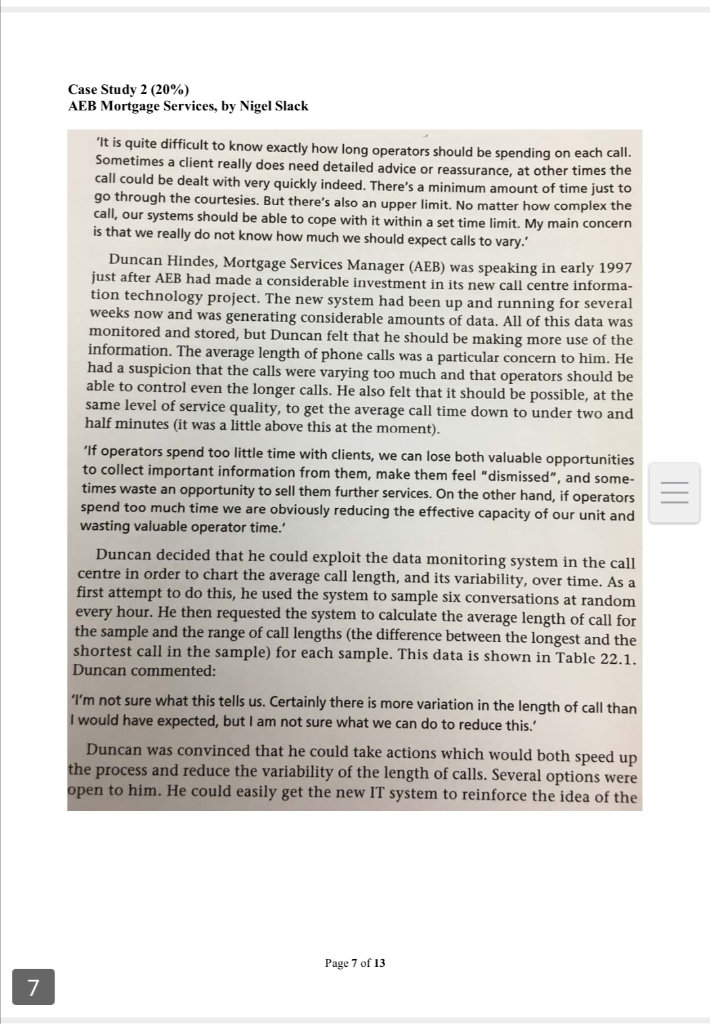
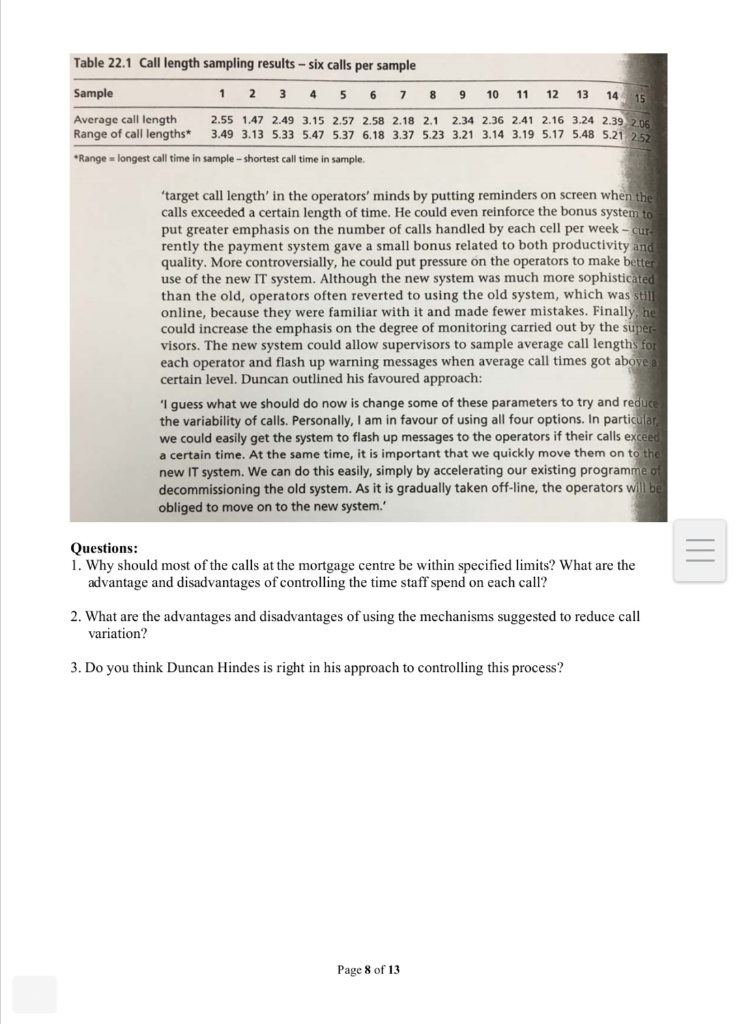
Case Study 2 (20%) AEB Mortgage Services, by Nigel Slack 'It is quite difficult to know exactly how long operators should be spending on each call. Sometimes a client really does need detailed advice or reassurance, at other times the call could be dealt with very quickly indeed. There's a minimum amount of time just to go through the courtesies. But there's also an upper limit. No matter how complex the call, our systems should be able to cope with it within a set time limit. My main concern is that we really do not know how much we should expect calls to vary.' Duncan Hindes, Mortgage Services Manager (AEB) was speaking in early 1997 just after AEB had made a considerable investment in its new call centre informa- tion technology project. The new system had been up and running for several weeks now and was generating considerable amounts of data. All of this data was monitored and stored, but Duncan felt that he should be making more use of the information. The average length of phone calls was a particular concern to him. He had a suspicion that the calls were varying too much and that operators should be able to control even the longer calls. He also felt that it should be possible, at the same level of service quality, to get the average call time down to under two and half minutes (it was a little above this at the moment). 'If operators spend too little time with clients, we can lose both valuable opportunities to collect important information from them, make them feel "dismissed", and some- times waste an opportunity to sell them further services. On the other hand, if operators spend too much time we are obviously reducing the effective capacity of our unit and wasting valuable operator time.' Duncan decided that he could exploit the data monitoring system in the call centre in order to chart the average call length, and its variability, over time. As a first attempt to do this, he used the system to sample six conversations at random every hour. He then requested the system to calculate the average length of call for the sample and the range of call lengths (the difference between the longest and the shortest call in the sample) for each sample. This data is shown in Table 22.1. Duncan commented: I'm not sure what this tells us. Certainly there is more variation in the length of call than I would have expected, but I am not sure what we can do to reduce this.' Duncan was convinced that he could take actions which would both speed up the process and reduce the variability of the length of calls. Several options were open to him. He could easily get the new IT system to reinforce the idea of the Page 7 of 13 7 Table 22.1 Call length sampling results - six calls per sample Sample 1 2 3 4 5 6 7 8 9 10 11 12 13 14 15 Average call length 2.55 1.47 2.49 3.15 2.57 2.58 2.18 2.1 2.34 2.36 2.41 2.16 3.24 2.39 2.06 Range of call lengths* 3.49 3.13 5.33 5.47 5.37 6.18 3.37 5.23 3.21 3.14 3.19 5.17 5.48 5.21 252 *Range = longest call time in sample - shortest call time in sample. 'target call length' in the operators' minds by putting reminders on screen when the calls exceeded a certain length of time. He could even reinforce the bonus system to put greater emphasis on the number of calls handled by each cell per week - Cur rently the payment system gave a small bonus related to both productivity and quality. More controversially, he could put pressure on the operators to make better use of the new IT system. Although the new system was much more sophisticated than the old, operators often reverted to using the old system, which was still online, because they were familiar with it and made fewer mistakes. Finally, he could increase the emphasis on the degree of monitoring carried out by the super- visors. The new system could allow supervisors to sample average call lengths for each operator and flash up warning messages when average call times got above a certain level. Duncan outlined his favoured approach: 'I guess what we should do now is change some of these parameters to try and reduce the variability of calls. Personally, I am in favour of using all four options. In particular, we could easily get the system to flash up messages to the operators if their calls exceed a certain time. At the same time, it is important that we quickly move them on to the new IT system. We can do this easily, simply by accelerating our existing programme of decommissioning the old system. As it is gradually taken off-line, the operators will be obliged to move on to the new system.' III Questions: 1. Why should most of the calls at the mortgage centre be within specified limits? What are the advantage and disadvantages of controlling the time staff spend on each call? 2. What are the advantages and disadvantages of using the mechanisms suggested to reduce call variation? 3. Do you think Duncan Hindes is right in his approach to controlling this process? Page 8 of 13









 Study Help