Question: Case study 3.2, Case Question is in the photo/image CASE STUDY 3.2 First Cuban Products Sold in the United States The first iconic Cuban product
Case study 3.2, Case Question is in the photo/image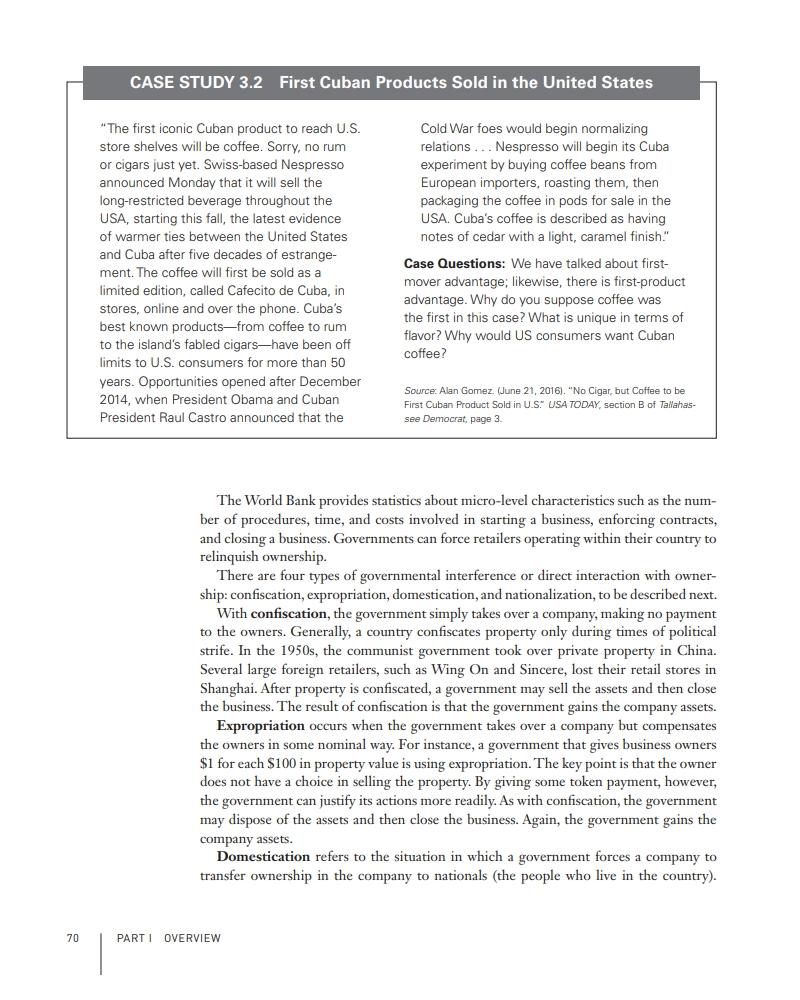
CASE STUDY 3.2 First Cuban Products Sold in the United States "The first iconic Cuban product to reach U.S. store shelves will be coffee. Sorry, no rum or cigars just yet. Swiss-based Nespresso announced Monday that it will sell the long-restricted beverage throughout the USA, starting this fall, the latest evidence of warmer ties between the United States and Cuba after five decades of estrange- ment. The coffee will first be sold as a limited edition, called Cafecito de Cuba, in stores, online and over the phone. Cuba's best known productsfrom coffee to rum to the island's fabled cigarshave been off limits to U.S. consumers for more than 50 years. Opportunities opened after December 2014, when President Obama and Cuban President Raul Castro announced that the Cold War foes would begin normalizing relations... Nespresso will begin its Cuba experiment by buying coffee beans from European importers, roasting them, then packaging the coffee in pods for sale in the USA. Cuba's coffee is described as having notes of cedar with a light, caramel finish." Case Questions: We have talked about first- mover advantage; likewise, there is first-product advantage. Why do you suppose coffee was the first in this case? What is unique in terms of flavor? Why would US consumers want Cuban coffee? Source: Alan Gomez (June 21, 2016). "No Cigar, but Coffee to be First Cuban Product Sold in U.S. USA TODAY, section B of Tallahas- see Democrat, page 3 The World Bank provides statistics about micro-level characteristics such as the num- ber of procedures, time, and costs involved in starting a business, enforcing contracts, and closing a business. Governments can force retailers operating within their country to relinquish ownership There are four types of governmental interference or direct interaction with owner- ship: confiscation, expropriation, domestication, and nationalization, to be described next. With confiscation, the government simply takes over a company, making no payment to the owners. Generally, a country confiscates property only during times of political strife. In the 1950s, the communist government took over private property in China. Several large foreign retailers, such as Wing On and Sincere, lost their retail stores in Shanghai. After property is confiscated, a government may sell the assets and then close the business. The result of confiscation is that the government gains the company assets. Expropriation occurs when the government takes over a company but compensates the owners in some nominal way. For instance, a government that gives business owners $1 for each $100 in property value is using expropriation. The key point is that the owner does not have a choice in selling the property. By giving some token payment, however, the government can justify its actions more readily. As with confiscation, the government may dispose of the assets and then close the business. Again, the government gains the company assets. Domestication refers to the situation in which a government forces a company to transfer ownership in the company to nationals (the people who live in the country). 70 PARTI OVERVIEW









 Study Help