







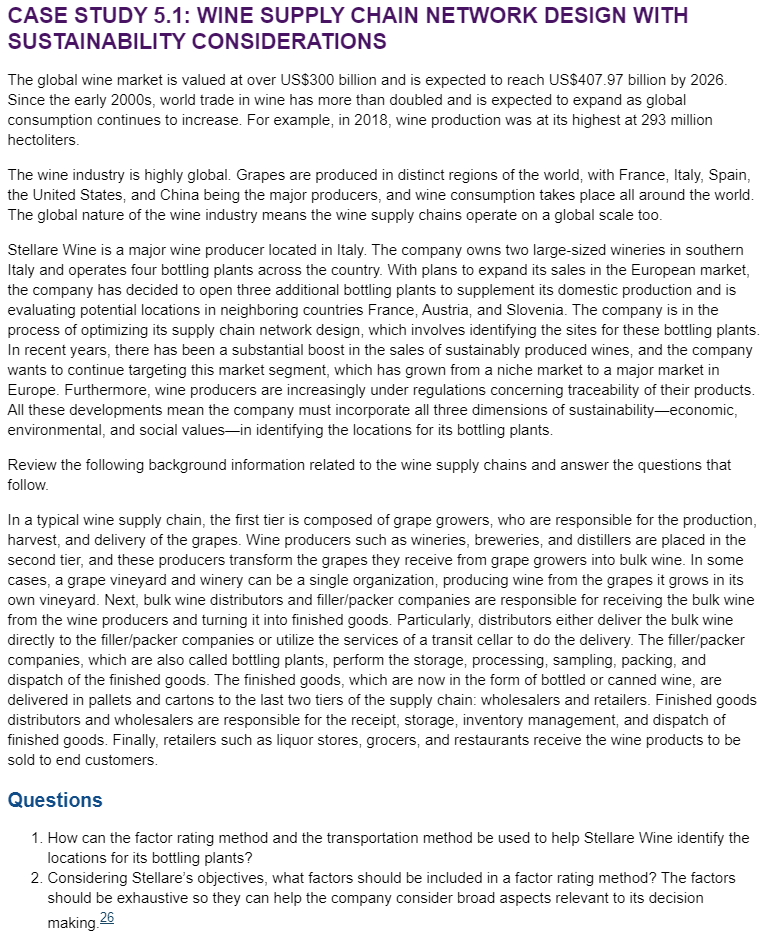
Question: CASE STUDY 5 . 1 : WINE SUPPLY CHAIN NETWORK DESIGN WITH SUSTAINABILITY CONSIDERATIONS The global wine market is valued at over US $ 3
CASE STUDY : WINE SUPPLY CHAIN NETWORK DESIGN WITH
SUSTAINABILITY CONSIDERATIONS
The global wine market is valued at over US $ billion and is expected to reach US $ billion by
Since the early s world trade in wine has more than doubled and is expected to expand as global
consumption continues to increase. For example, in wine production was at its highest at million
hectoliters.
The wine industry is highly global. Grapes are produced in distinct regions of the world, with France, Italy, Spain,
the United States, and China being the major producers, and wine consumption takes place all around the world.
The global nature of the wine industry means the wine supply chains operate on a global scale too.
Stellare Wine is a major wine producer located in Italy. The company owns two largesized wineries in southern
Italy and operates four bottling plants across the country. With plans to expand its sales in the European market,
the company has decided to open three additional bottling plants to supplement its domestic production and is
evaluating potential locations in neighboring countries France, Austria, and Slovenia. The company is in the
process of optimizing its supply chain network design, which involves identifying the sites for these bottling plants.
In recent years, there has been a substantial boost in the sales of sustainably produced wines, and the company
wants to continue targeting this market segment, which has grown from a niche market to a major market in
Europe. Furthermore, wine producers are increasingly under regulations concerning traceability of their products.
All these developments mean the company must incorporate all three dimensions of sustainabilityeconomic,
environmental, and social valuesin identifying the locations for its bottling plants.
Review the following background information related to the wine supply chains and answer the questions that
follow.
In a typical wine supply chain, the first tier is composed of grape growers, who are responsible for the production,
harvest, and delivery of the grapes. Wine producers such as wineries, breweries, and distillers are placed in the
second tier, and these producers transform the grapes they receive from grape growers into bulk wine. In some
cases, a grape vineyard and winery can be a single organization, producing wine from the grapes it grows in its
own vineyard. Next, bulk wine distributors and fillerpacker companies are responsible for receiving the bulk wine
from the wine producers and turning it into finished goods. Particularly, distributors either deliver the bulk wine
directly to the fillerpacker companies or utilize the services of a transit cellar to do the delivery. The fillerpacker
companies, which are also called bottling plants, perform the storage, processing, sampling, packing, and
dispatch of the finished goods. The finished goods, which are now in the form of bottled or canned wine, are
delivered in pallets and cartons to the last two tiers of the supply chain: wholesalers and retailers. Finished goods
distributors and wholesalers are responsible for the receipt, storage, inventory management, and dispatch of
finished goods. Finally, retailers such as liquor stores, grocers, and restaurants receive the wine products to be
sold to end customers.
Questions
How can the factor rating method and the transportation method be used to help Stellare Wine identify the
locations for its bottling plants?
Considering Stellare's objectives, what factors should be included in a factor rating method? The factors
should be exhaustive so they can help the company consider broad aspects relevant to its decision
making.
Step by Step Solution
There are 3 Steps involved in it
1 Expert Approved Answer
Step: 1 Unlock

Question Has Been Solved by an Expert!
Get step-by-step solutions from verified subject matter experts
Step: 2 Unlock
Step: 3 Unlock
 Study Help