







Question: Case study Question: 1. By refering online and offline resource, update information about 7-Eleven and its supply chain. Elaborate members participating in 7-Eleven's supply chain.
Case study
Question: 1. By refering online and offline resource, update information about 7-Eleven and its supply chain. Elaborate members participating in 7-Eleven's supply chain.
2. Which distribution network does 7-Eleven apply? How do distribution center and cross docking technique support 7-Eleven distribution network?
3. Analyze benefits and drawbacks of transporting by trucks. Why does 7-Eleven choose truck to transport in their distribution? Support your answer with proper reasoning.
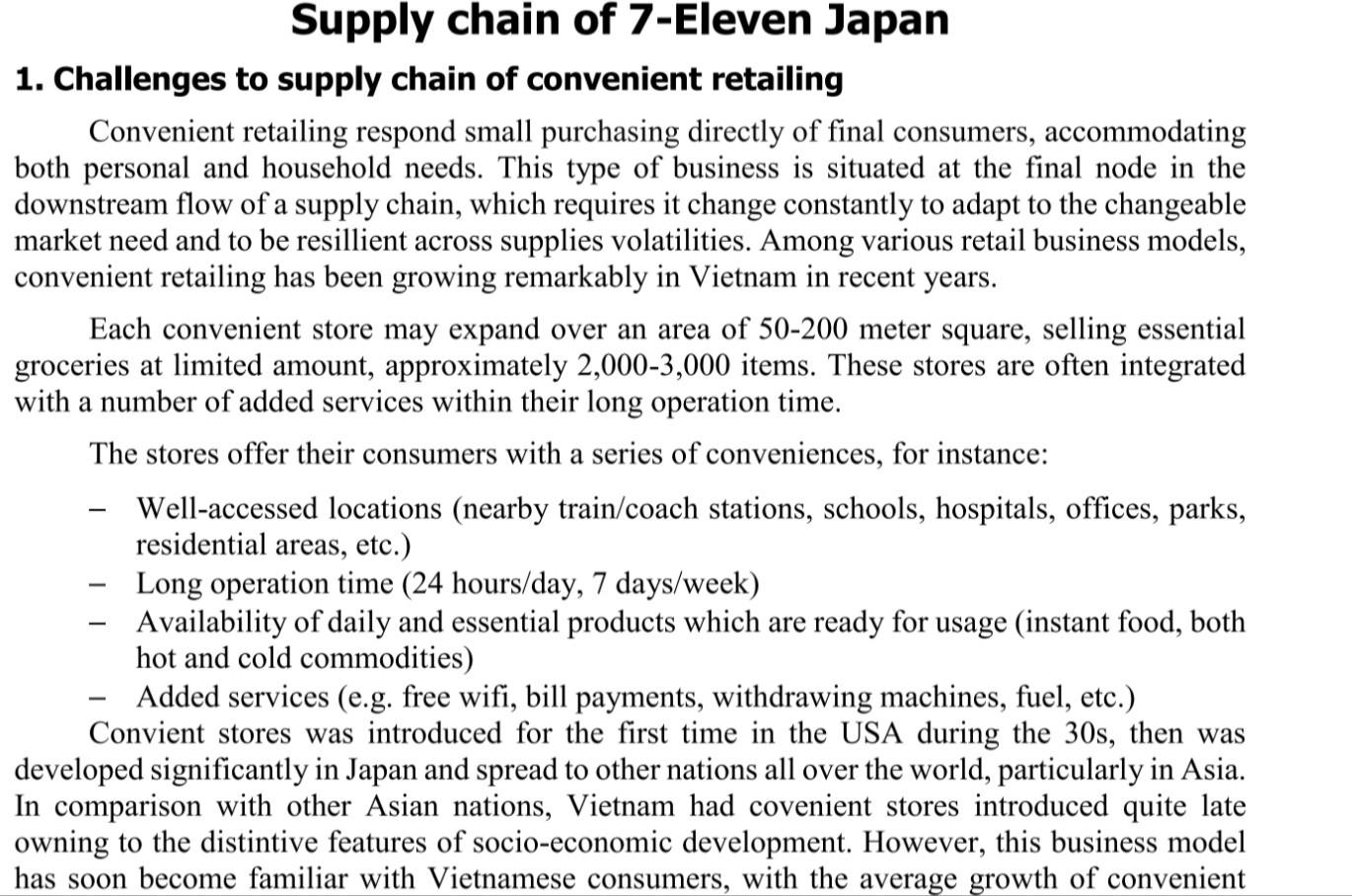
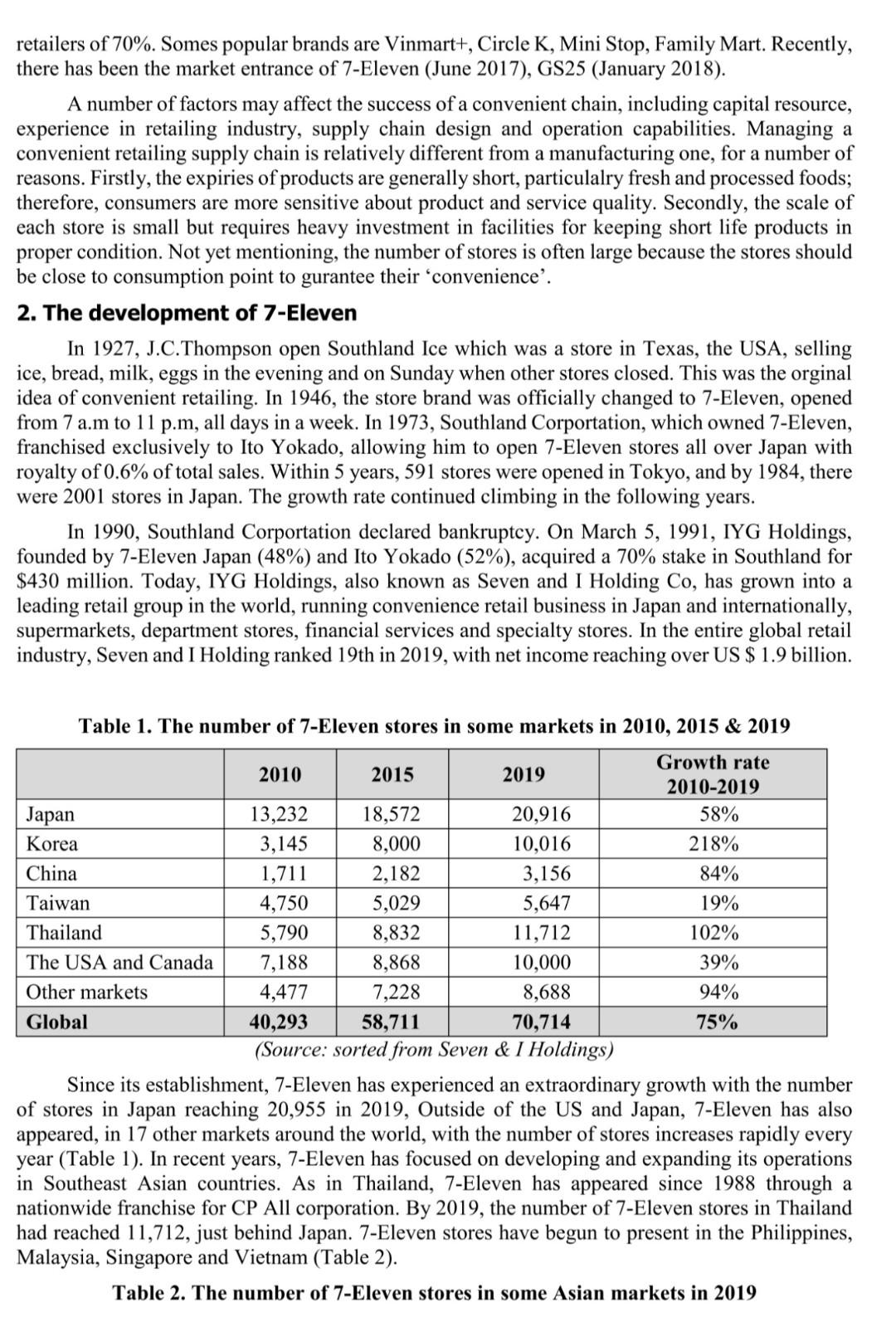
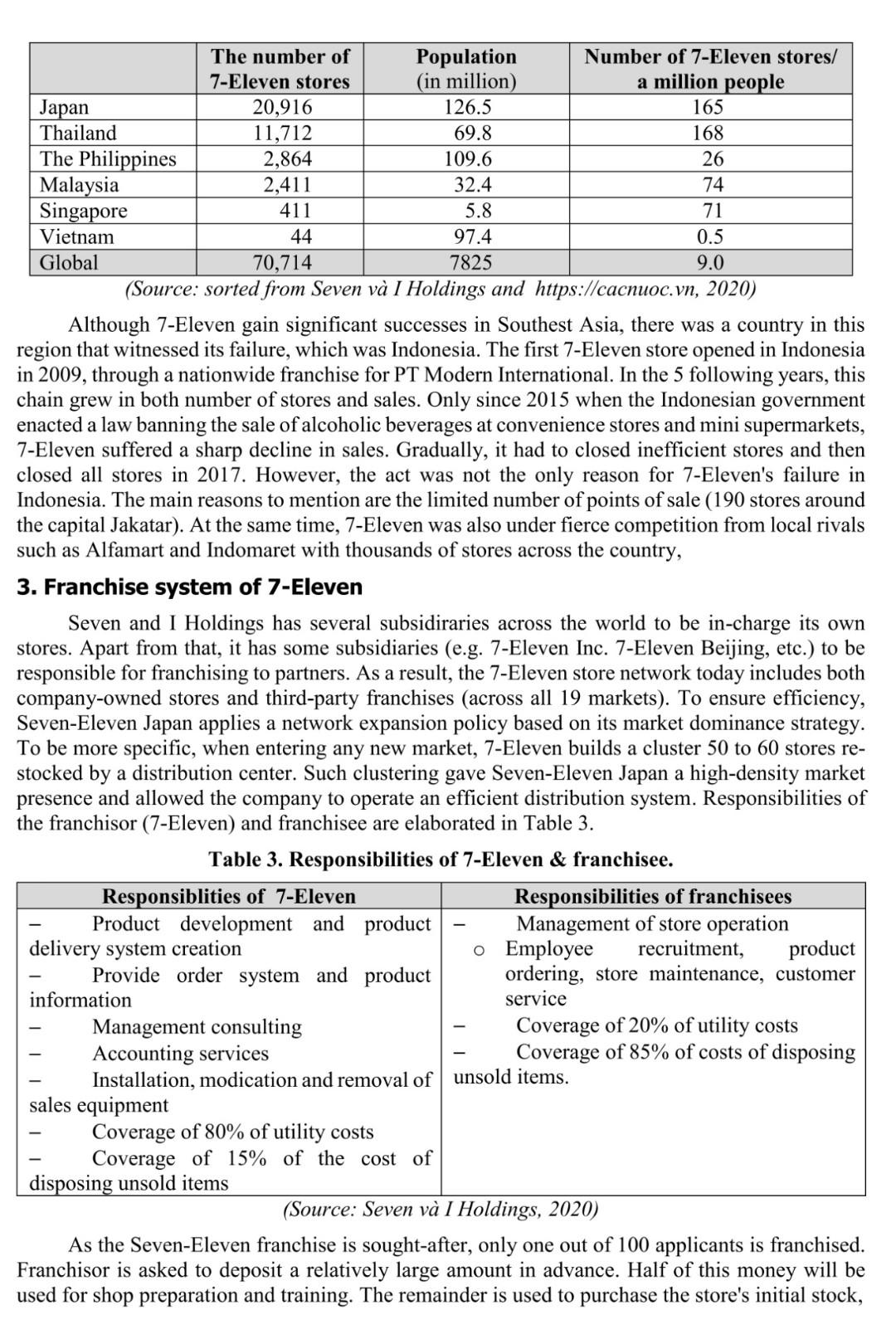
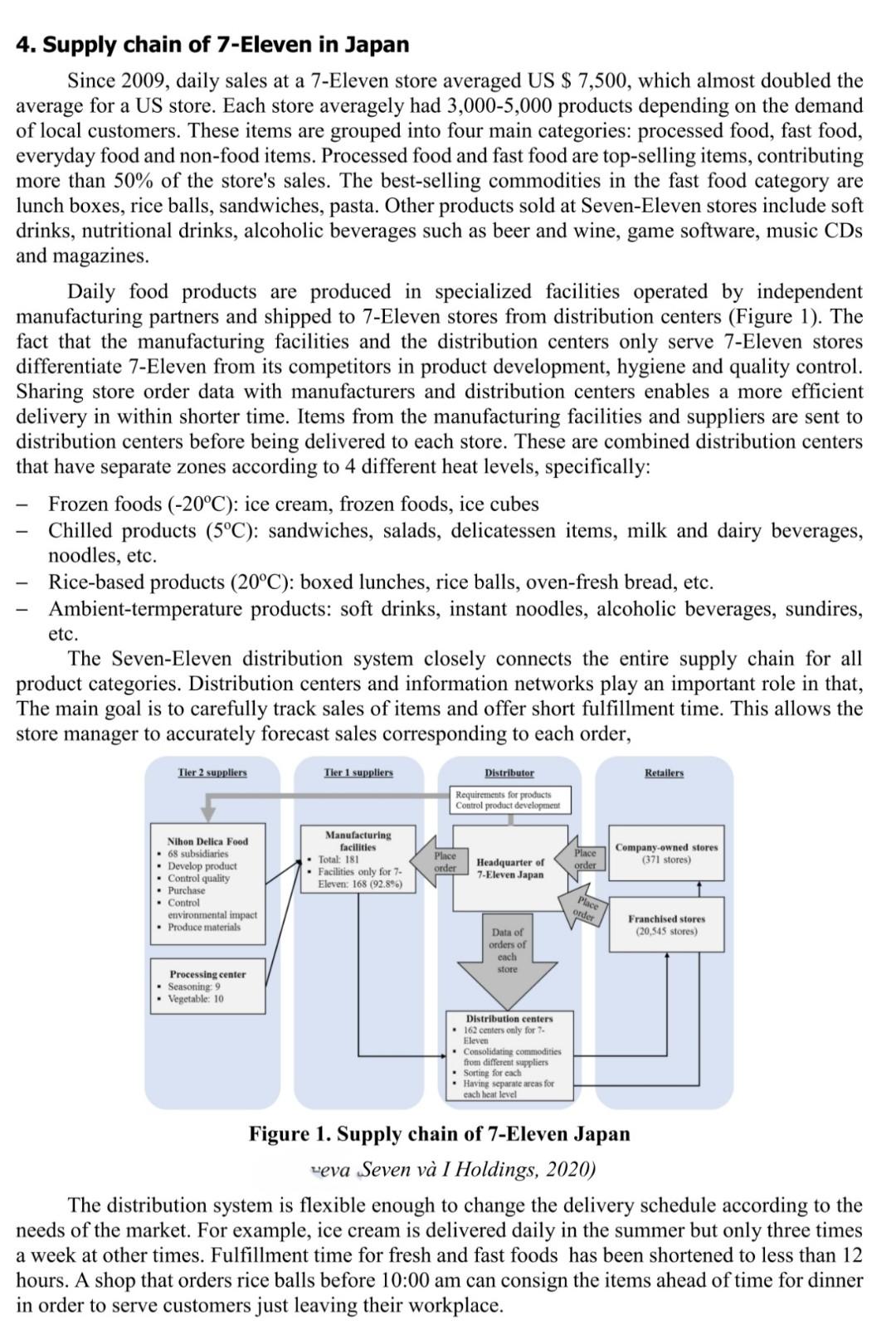
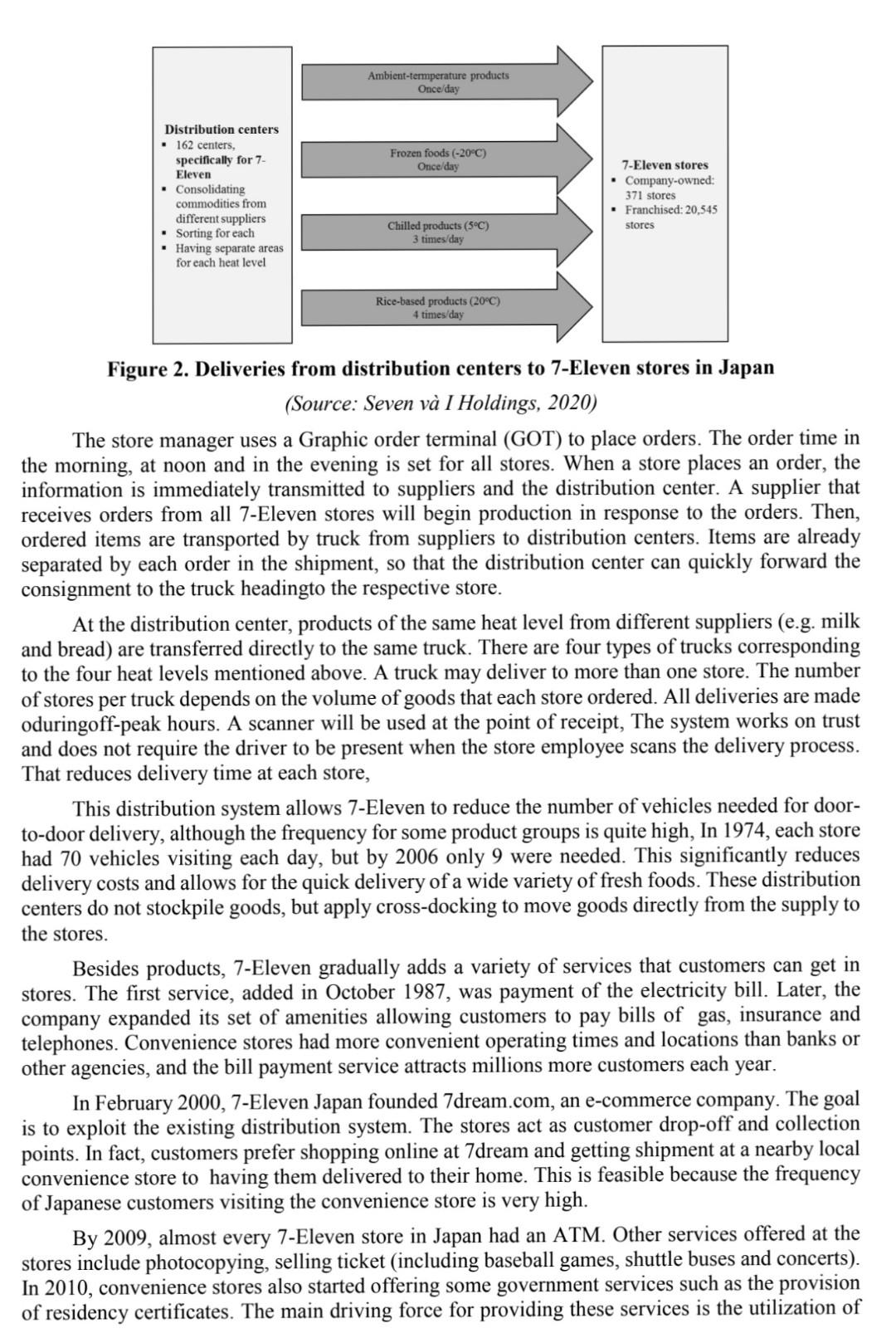
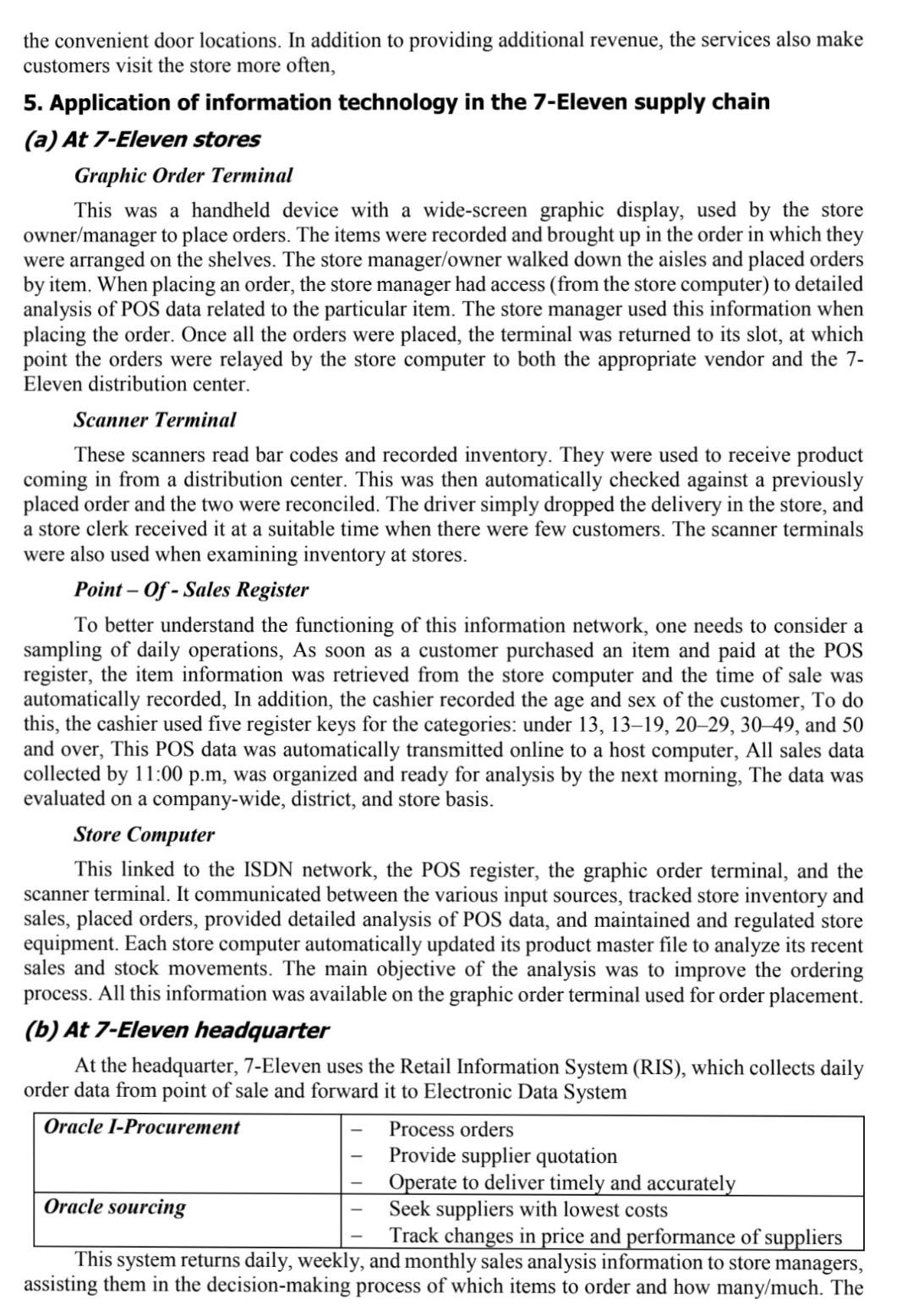
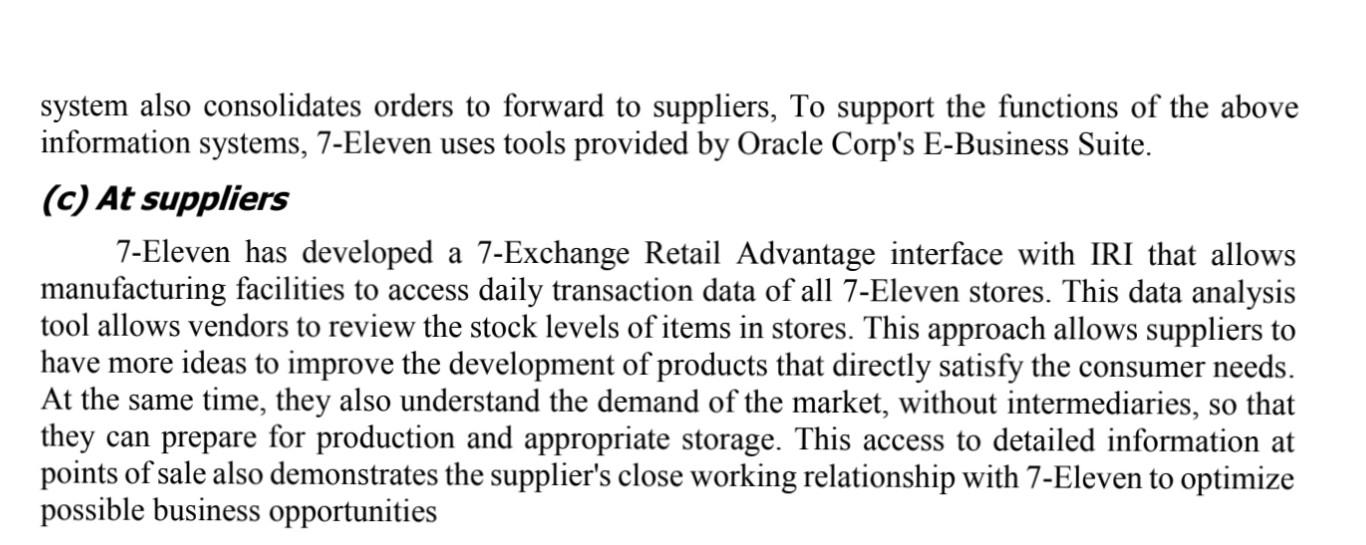
Supply chain of 7-Eleven Japan 1. Challenges to supply chain of convenient retailing Convenient retailing respond small purchasing directly of final consumers, accommodating both personal and household needs. This type of business is situated at the final node in the downstream flow of a supply chain, which requires it change constantly to adapt to the changeable market need and to be resillient across supplies volatilities. Among various retail business models, convenient retailing has been growing remarkably in Vietnam in recent years. Each convenient store may expand over an area of 50-200 meter square, selling essential groceries at limited amount, approximately 2,0003,000 items. These stores are often integrated with a number of added services within their long operation time. The stores offer their consumers with a series of conveniences, for instance: - Well-accessed locations (nearby train/coach stations, schools, hospitals, offices, parks, residential areas, etc.) - Long operation time (24 hours/day, 7 days/week) - Availability of daily and essential products which are ready for usage (instant food, both hot and cold commodities) - Added services (e.g. free wifi, bill payments, withdrawing machines, fuel, etc.) Convient stores was introduced for the first time in the USA during the 30 s, then was developed significantly in Japan and spread to other nations all over the world, particularly in Asia. In comparison with other Asian nations, Vietnam had covenient stores introduced quite late owning to the distintive features of socio-economic development. However, this business model has soon become familiar with Vietnamese consumers, with the average growth of convenient retailers of 70%. Somes popular brands are Vinmart+, Circle K, Mini Stop, Family Mart. Recently, there has been the market entrance of 7-Eleven (June 2017), GS25 (January 2018). A number of factors may affect the success of a convenient chain, including capital resource, experience in retailing industry, supply chain design and operation capabilities. Managing a convenient retailing supply chain is relatively different from a manufacturing one, for a number of reasons. Firstly, the expiries of products are generally short, particulalry fresh and processed foods; therefore, consumers are more sensitive about product and service quality. Secondly, the scale of each store is small but requires heavy investment in facilities for keeping short life products in proper condition. Not yet mentioning, the number of stores is often large because the stores should be close to consumption point to gurantee their 'convenience'. 2. The development of 7-Eleven In 1927, J.C.Thompson open Southland Ice which was a store in Texas, the USA, selling ice, bread, milk, eggs in the evening and on Sunday when other stores closed. This was the orginal idea of convenient retailing. In 1946, the store brand was officially changed to 7-Eleven, opened from 7 a.m to 11 p.m, all days in a week. In 1973, Southland Corportation, which owned 7-Eleven, franchised exclusively to Ito Yokado, allowing him to open 7-Eleven stores all over Japan with royalty of 0.6% of total sales. Within 5 years, 591 stores were opened in Tokyo, and by 1984 , there were 2001 stores in Japan. The growth rate continued climbing in the following years. In 1990, Southland Corportation declared bankruptcy. On March 5, 1991, IYG Holdings, founded by 7-Eleven Japan (48\%) and Ito Yokado (52\%), acquired a 70% stake in Southland for $430 million. Today, IYG Holdings, also known as Seven and I Holding Co, has grown into a leading retail group in the world, running convenience retail business in Japan and internationally, supermarkets, department stores, financial services and specialty stores. In the entire global retail industry, Seven and I Holding ranked 19th in 2019, with net income reaching over US \$ 1.9 billion. Table 1. The number of 7-Eleven stores in some markets in 2010, 2015&2019 Since its establishment, 7-Eleven has experienced an extraordinary growth with the number of stores in Japan reaching 20,955 in 2019, Outside of the US and Japan, 7-Eleven has also appeared, in 17 other markets around the world, with the number of stores increases rapidly every year (Table 1). In recent years, 7-Eleven has focused on developing and expanding its operations in Southeast Asian countries. As in Thailand, 7-Eleven has appeared since 1988 through a nationwide franchise for CP All corporation. By 2019, the number of 7-Eleven stores in Thailand had reached 11,712, just behind Japan. 7-Eleven stores have begun to present in the Philippines, Malaysia, Singapore and Vietnam (Table 2). Table 2. The number of 7-Eleven stores in some Asian markets in 2019 Although 7-Eleven gain significant successes in Southest Asia, there was a country in this region that witnessed its failure, which was Indonesia. The first 7-Eleven store opened in Indonesia in 2009 , through a nationwide franchise for PT Modern International. In the 5 following years, this chain grew in both number of stores and sales. Only since 2015 when the Indonesian government enacted a law banning the sale of alcoholic beverages at convenience stores and mini supermarkets, 7-Eleven suffered a sharp decline in sales. Gradually, it had to closed inefficient stores and then closed all stores in 2017. However, the act was not the only reason for 7-Eleven's failure in Indonesia. The main reasons to mention are the limited number of points of sale (190 stores around the capital Jakatar). At the same time, 7-Eleven was also under fierce competition from local rivals such as Alfamart and Indomaret with thousands of stores across the country, 3. Franchise system of 7-Eleven Seven and I Holdings has several subsidiraries across the world to be in-charge its own stores. Apart from that, it has some subsidiaries (e.g. 7-Eleven Inc. 7-Eleven Beijing, etc.) to be responsible for franchising to partners. As a result, the 7-Eleven store network today includes both company-owned stores and third-party franchises (across all 19 markets). To ensure efficiency, Seven-Eleven Japan applies a network expansion policy based on its market dominance strategy. To be more specific, when entering any new market, 7-Eleven builds a cluster 50 to 60 stores restocked by a distribution center. Such clustering gave Seven-Eleven Japan a high-density market presence and allowed the company to operate an efficient distribution system. Responsibilities of the franchisor (7-Eleven) and franchisee are elaborated in Table 3. Table 3. Responsibilities of 7-Eleven \& franchisee. (Source: Seven v I Holdings, 2020) As the Seven-Eleven franchise is sought-after, only one out of 100 applicants is franchised. Franchisor is asked to deposit a relatively large amount in advance. Half of this money will be used for shop preparation and training. The remainder is used to purchase the store's initial stock, 4. Supply chain of 7-Eleven in Japan Since 2009, daily sales at a 7-Eleven store averaged US \$ 7,500, which almost doubled the average for a US store. Each store averagely had 3,000-5,000 products depending on the demand of local customers. These items are grouped into four main categories: processed food, fast food, everyday food and non-food items. Processed food and fast food are top-selling items, contributing more than 50% of the store's sales. The best-selling commodities in the fast food category are lunch boxes, rice balls, sandwiches, pasta. Other products sold at Seven-Eleven stores include soft drinks, nutritional drinks, alcoholic beverages such as beer and wine, game software, music CDs and magazines. Daily food products are produced in specialized facilities operated by independent manufacturing partners and shipped to 7-Eleven stores from distribution centers (Figure 1). The fact that the manufacturing facilities and the distribution centers only serve 7-Eleven stores differentiate 7-Eleven from its competitors in product development, hygiene and quality control. Sharing store order data with manufacturers and distribution centers enables a more efficient delivery in within shorter time. Items from the manufacturing facilities and suppliers are sent to distribution centers before being delivered to each store. These are combined distribution centers that have separate zones according to 4 different heat levels, specifically: - Frozen foods (20C) : ice cream, frozen foods, ice cubes - Chilled products (5C) : sandwiches, salads, delicatessen items, milk and dairy beverages, noodles, etc. - Rice-based products (20C) : boxed lunches, rice balls, oven-fresh bread, etc. - Ambient-termperature products: soft drinks, instant noodles, alcoholic beverages, sundires, etc. The Seven-Eleven distribution system closely connects the entire supply chain for all product categories. Distribution centers and information networks play an important role in that, The main goal is to carefully track sales of items and offer short fulfillment time. This allows the store manager to accurately forecast sales corresponding to each order, Figure 1. Supply chain of 7-Eleven Japan veva Seven v I Holdings, 2020) The distribution system is flexible enough to change the delivery schedule according to the needs of the market. For example, ice cream is delivered daily in the summer but only three times a week at other times. Fulfillment time for fresh and fast foods has been shortened to less than 12 hours. A shop that orders rice balls before 10:00 am can consign the items ahead of time for dinner in order to serve customers just leaving their workplace. (Source: Seven v I Holdings, 2020) The store manager uses a Graphic order terminal (GOT) to place orders. The order time in the morning, at noon and in the evening is set for all stores. When a store places an order, the information is immediately transmitted to suppliers and the distribution center. A supplier that receives orders from all 7-Eleven stores will begin production in response to the orders. Then, ordered items are transported by truck from suppliers to distribution centers. Items are already separated by each order in the shipment, so that the distribution center can quickly forward the consignment to the truck headingto the respective store. At the distribution center, products of the same heat level from different suppliers (e.g. milk and bread) are transferred directly to the same truck. There are four types of trucks corresponding to the four heat levels mentioned above. A truck may deliver to more than one store. The number of stores per truck depends on the volume of goods that each store ordered. All deliveries are made oduringoff-peak hours. A scanner will be used at the point of receipt, The system works on trust and does not require the driver to be present when the store employee scans the delivery process. That reduces delivery time at each store, This distribution system allows 7-Eleven to reduce the number of vehicles needed for doorto-door delivery, although the frequency for some product groups is quite high, In 1974, each store had 70 vehicles visiting each day, but by 2006 only 9 were needed. This significantly reduces delivery costs and allows for the quick delivery of a wide variety of fresh foods. These distribution centers do not stockpile goods, but apply cross-docking to move goods directly from the supply to the stores. Besides products, 7-Eleven gradually adds a variety of services that customers can get in stores. The first service, added in October 1987, was payment of the electricity bill. Later, the company expanded its set of amenities allowing customers to pay bills of gas, insurance and telephones. Convenience stores had more convenient operating times and locations than banks or other agencies, and the bill payment service attracts millions more customers each year. In February 2000, 7-Eleven Japan founded 7dream.com, an e-commerce company. The goal is to exploit the existing distribution system. The stores act as customer drop-off and collection points. In fact, customers prefer shopping online at 7 dream and getting shipment at a nearby local convenience store to having them delivered to their home. This is feasible because the frequency of Japanese customers visiting the convenience store is very high. By 2009, almost every 7-Eleven store in Japan had an ATM. Other services offered at the stores include photocopying, selling ticket (including baseball games, shuttle buses and concerts). In 2010 , convenience stores also started offering some government services such as the provision the convenient door locations. In addition to providing additional revenue, the services also make customers visit the store more often, 5. Application of information technology in the 7-Eleven supply chain (a) At 7-Eleven stores Graphic Order Terminal This was a handheld device with a wide-screen graphic display, used by the store owner/manager to place orders. The items were recorded and brought up in the order in which they were arranged on the shelves. The store manager/owner walked down the aisles and placed orders by item. When placing an order, the store manager had access (from the store computer) to detailed analysis of POS data related to the particular item. The store manager used this information when placing the order. Once all the orders were placed, the terminal was returned to its slot, at which point the orders were relayed by the store computer to both the appropriate vendor and the 7Eleven distribution center. Scanner Terminal These scanners read bar codes and recorded inventory. They were used to receive product coming in from a distribution center. This was then automatically checked against a previously placed order and the two were reconciled. The driver simply dropped the delivery in the store, and a store clerk received it at a suitable time when there were few customers. The scanner terminals were also used when examining inventory at stores. Point-Of-Sales Register To better understand the functioning of this information network, one needs to consider a sampling of daily operations, As soon as a customer purchased an item and paid at the POS register, the item information was retrieved from the store computer and the time of sale was automatically recorded, In addition, the cashier recorded the age and sex of the customer, To do this, the cashier used five register keys for the categories: under 13,1319,2029,3049, and 50 and over, This POS data was automatically transmitted online to a host computer, All sales data collected by 11:00 p.m, was organized and ready for analysis by the next morning, The data was evaluated on a company-wide, district, and store basis. Store Computer This linked to the ISDN network, the POS register, the graphic order terminal, and the scanner terminal. It communicated between the various input sources, tracked store inventory and sales, placed orders, provided detailed analysis of POS data, and maintained and regulated store equipment. Each store computer automatically updated its product master file to analyze its recent sales and stock movements. The main objective of the analysis was to improve the ordering process. All this information was available on the graphic order terminal used for order placement. (b) At 7-Eleven headquarter At the headquarter, 7-Eleven uses the Retail Information System (RIS), which collects daily order data from point of sale and forward it to Electronic Data System I nis system returns daily, weekly, and monthly sales analysis information to store managers, assisting them in the decision-making process of which items to order and how many/much. The system also consolidates orders to forward to suppliers, To support the functions of the above information systems, 7-Eleven uses tools provided by Oracle Corp's E-Business Suite. (c) At suppliers 7-Eleven has developed a 7-Exchange Retail Advantage interface with IRI that allows manufacturing facilities to access daily transaction data of all 7-Eleven stores. This data analysis tool allows vendors to review the stock levels of items in stores. This approach allows suppliers to have more ideas to improve the development of products that directly satisfy the consumer needs. At the same time, they also understand the demand of the market, without intermediaries, so that they can prepare for production and appropriate storage. This access to detailed information at points of sale also demonstrates the supplier's close working relationship with 7-Eleven to optimize possible business opportunitiesStep by Step Solution
There are 3 Steps involved in it
1 Expert Approved Answer
Step: 1 Unlock

Question Has Been Solved by an Expert!
Get step-by-step solutions from verified subject matter experts
Step: 2 Unlock
Step: 3 Unlock
 Study Help