







Question: case study 5 please i only need answers to questions thanks you and God blessed no to ar allor CASE STUDY 5 TRANSFORMING COMMUNITY HEALTH
case study 5
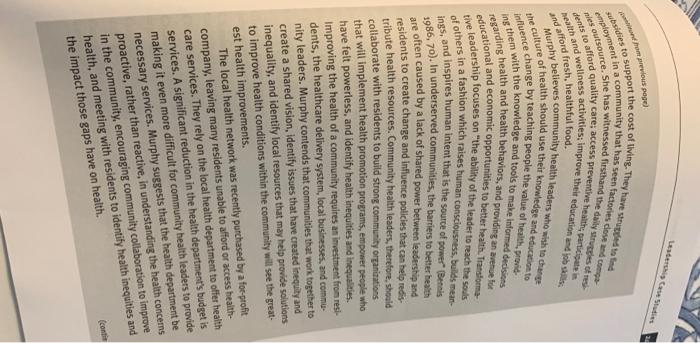
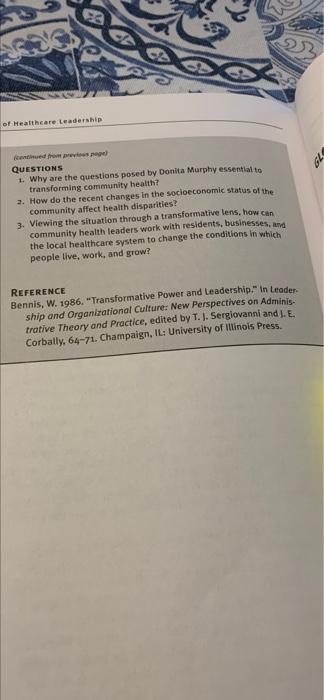
no to ar allor CASE STUDY 5 TRANSFORMING COMMUNITY HEALTH Due wa Mur Justin Beaupre ier r ws VE Donita Murphy is a primary care physician at a local community pre tice clinic. She was recently asked to consult with the local health department to help develop programs that will improve the health of community residents. In the past decade, community organizations health departments, and healthcare systems have begun to transform and reevaluate health and healthcare. A significant rise in the cou of healthcare services has community health leaders focused on the importance of health promotion programs that engage community members to participate in programs that will foster a culture of health, Affordability and quality care should be synonymous as community health leaders determine ways to provide preventive health services to the local community. At the first meeting with health department leaders, Murphy is. tened intently as officials discussed what they believed to be the most serious health disparities and concerns in the community. Some of the responses included a recent rise in crime rates, obesity. Smoking. diabetes, substance and drug abuse, poverty, and lack of funding for services. After a half hour of discussion, no one had yet asked Murphy, a physician who has been treating residents for nearly 30 years, what she thought about the health of the community. When she finally had the chance to speak, she asked everyone in the room several ques. tions, to which none of the other attendees had clear answers: 1. What do the residents of this community feel are the most important factors positively or negatively affecting health? 2. How do you perceive or value your own health? What does health mean to you, and what experiences have shaped your interpretation of health? 3. How does community leadership support improving the quality of health? Murphy's patients are predominantly residents of low-income housing, receiving financial assistance for medical care government (contir Les Case Studies de vous page) und afford fresh, healthful food. mies outsource. She has witnessed firsthand the day of employment in a community that has seen factores des subsidies to support the cost of living. They have tested health and wellness activities: Improve their education and is dents to afford quality care, access preventive health artidos Murphy believes community health leaders who wish to change the culture of health should use their knowledge and education to Influence change by teaching people the value of health, ing them with the knowledge and tools to make informed decisions regarding health and health behaviors, and providing an avenue educational and economic opportunities to better health. Transform tive leadership focuses on the ability of the leader to reach the souls of others in a fashion which raises human consciousness, builds mean ings, and inspires human intent that is the source of power Bennis 1986, 70). In underserved communities, the barriers to better health are often caused by a lack of shared power between leadership and residents to create change and influence policies that can help redis- tribute health resources. Community health leaders, therefore, should collaborate with residents to build strong community organizations that will implement health promotion programs, empower people who have felt powerless, and identify health inequities and inequalities. Improving the health of a community requires an investment from resi- dents, the healthcare delivery system, local businesses, and commu. nity leaders. Murphy contends that communities that work together to create a shared vision, identify issues that have created inequity and inequality, and identify local resources that may help provide solutions to improve health conditions within the community will see the great- est health improvements. The local health network was recently purchased by a for-profit company, leaving many residents unable to afford or access health- care services. They rely on the local health department to offer health services. A significant reduction in the health department's budget is making it even more difficult for community health leaders to provide necessary services. Murphy suggests that the health department de proactive, rather than reactive, in understanding the health concerns in the community, encouraging community collaboration to improve health, and meeting with residents to identify health inequities and the impact those gaps have on health. con 22 of Healthcare Leadership ned from previse QUESTIONS 1. Why are the questions posed by Donita Murphy essential to transforming community health? 2. How do the recent changes in the socioeconomic status of the community affect health disparities? 3. Viewing the situation through a transformative lens, how can community health leaders work with residents, businesses, and the local healthcare system to change the conditions in which people live, work, and grow? REFERENCE Bennis, W. 1986. "Transformative Power and Leadership. In Leader ship and Organizational Culture: New Perspectives on Adminis trative Theory and Practice, edited by T.J. Sergiovanni and I.E. Corbally, 64-71. Champaign, IL: University of Illinois Press
please i only need answers to questions
thanks you and God blessed 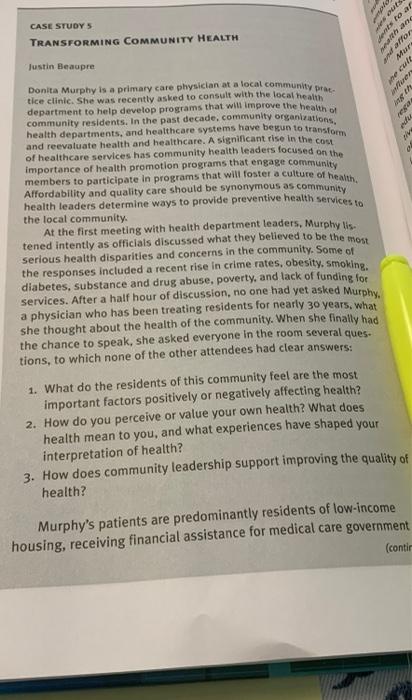
Step by Step Solution
There are 3 Steps involved in it
1 Expert Approved Answer
Step: 1 Unlock

Question Has Been Solved by an Expert!
Get step-by-step solutions from verified subject matter experts
Step: 2 Unlock
Step: 3 Unlock
 Study Help