







Question: Case Study: Aligning Human Resource Management with Organizational Strategy - Success Stories from XYZ Enterprises Introduction: XYZ Enterprises is a well-established multinational corporation operating in
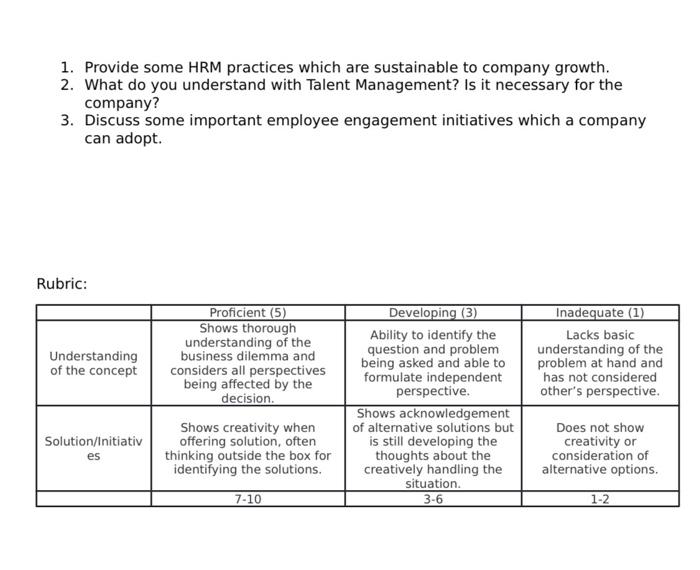
Case Study: Aligning Human Resource Management with Organizational Strategy Success Stories from XYZ Enterprises Introduction: XYZ Enterprises is a well-established multinational corporation operating in the technology sector. With a diverse range of products and services, the company has been a leader in the industry for over three decades. One of the critical factors contributing to its success is its strategic approach to human resource management (HRM). This case study examines the HRM practices implemented by XYZ Enterprises, highlighting the alignment of HR strategies with the company's organizational goals. Section 1: Identifying HRM Challenges at XYZ Enterprises 1.1 Talent Acquisition and Retention: As XYZ Enterprises expanded globally, it faced challenges in recruiting top talent and retaining skilled employees. Competition for technical professionals was intense, making it difficult to attract suitable candidates and retain them long-term. 1.2 Training and Skill Development: The rapid advancements in technology required continuous upskilling of the workforce. However, XYZ Enterprises struggled to develop effective training programs that kept pace with the evolving industry standards. 1.3 Performance Management and Goal Alignment: The existing performance management system lacked clarity, with ambiguous goal-setting and limited feedback. This impacted employee motivation and hindered the realization of individual and organizational objectives. 1.4 Employee Engagement and Workplace Culture: Despite its reputation, XYZ Enterprises faced concerns about employee engagement and workplace culture. Some employees felt disconnected from the company's mission and values, leading to reduced productivity and an increase in tumover. Section 2: Analyzing HRM Strategies at XYZ Enterprises 2.1 Strategic Workforce Planning: To address talent acquisition and retention challenges, XYZ Enterprises adopted strategic workforce planning. The HR team collaborated with department heads to forecast future talent needs, identifying key skills required for the organization's growth. The company invested in employer branding initiatives and implemented targeted recruitment campaigns, resulting in a \20 increase in quality candidate applications. 2.2 Comprehensive Training and Development Programs: Recognizing the importance of upskilling, XYZ Enterprises revamped its training and development programs. The HR team partnered with subject matter experts to design relevant and engaging courses. Additionally, the company encouraged employees to participate in external training and offered financial support for certifications. As a result, employee skill proficiency improved, leading to a \15 reduction in skill gaps. 2.3 Performance Management Redesign: XYZ Enterprises restructured its performance management system to focus on goal alignment and regular feedback. Clear and measurable objectives were set for each employee, aligning individual efforts with organizational goals. Managers were trained to conduct regular performance discussions, fostering a culture of continuous improvement. Consequently, employee satisfaction with the performance management process increased by \25. 2.4 Employee Engagement Initiatives: To enhance employee engagement and foster a positive workplace culture, XYZ Enterprises implemented various initiatives. These included regular employee surveys to gather feedback, establishing cross-functional employee-led committees to address concerns, and promoting work-life balance through flexible work arrangements. As a result, employee engagement scores rose by \30, and the company experienced a \10 decrease in voluntary tumover. Section 3: Measuring HRM Outcomes and Organizational Impact 3.1 Key Performance Indicators (KPIs) Tracking: XYZ Enterprises closely monitored several HRM KPIs to assess the effectiveness of its strategies. These included employee satisfaction scores, employee turnover rates, time-to-fill positions, training completion rates, and performance ratings. The company also tracked financial indicators such as revenue per employee and profitability to evaluate the overall impact of HRM initiatives. 3.2 Talent Management Succession: With strategic workforce planning in place, XYZ Enterprises identified high-potential employees for critical roles and developed succession plans. As a result, the company experienced a smooth transition of key positions, reducing disruptions and ensuring continuity. 3.3 Enhanced Organizational Agility: The alignment of HRM strategies with organizational goals contributed to improved agility at XYZ Enterprises. The company was better equipped to respond to market changes, and its workforce was adaptable to new challenges and opportunities. Conclusion: XYZ Enterprises' success story in human resource management exemplifies the importance of aligning HR strategies with organizational goals. By addressing talent acquisition, training. performance management, and employee engagement, the company achieved improved workforce efficiency, reduced tumover, and enhanced organizational performance. This case study emphasizes that effective HRM practices are integral to a company's sustainable growth and competitive advantage. Businesses can learn from XYZ Enterprises' experience and implement similar HRM strategies to strengthen their workforce, increase productivity, and foster a positive work environment. 1. Provide some HRM practices which are sustainable to company growth. 2. What do you understand with Talent Management? Is it necessary for the company? 3. Discuss some important employee engagement initiatives which a company can adopt. Rubric
Step by Step Solution
There are 3 Steps involved in it

Get step-by-step solutions from verified subject matter experts
 Study Help