Question: case study and answer Established in 1918, the consumer electronics giant Matsushita was at the forefront of the rise of Japan to the status of
case study and answer
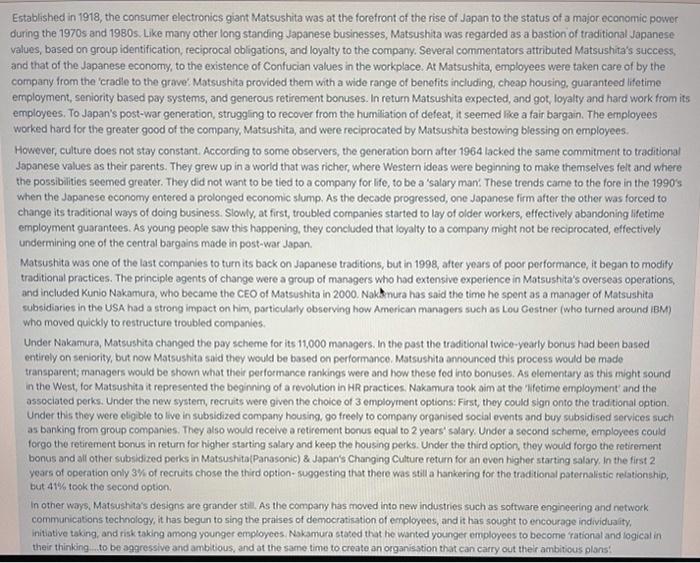
Established in 1918, the consumer electronics giant Matsushita was at the forefront of the rise of Japan to the status of a major economic power during the 1970s and 1980s. Like many other tong standing Japanese businesses, Matsushita was regarded as a bastion of traditional Japanese values, based on group identification, reciprocal obligations, and loyalty to the company. Several commentators attributed Matsushita's success, and that of the Japanese economy, to the existence of Confucian values in the workplace. At Matsushita, employees were taken care of by the company from the 'cradle to the grave Matsushita provided them with a wide range of benefits including cheap housing, guaranteed lifetime employment, seniority based pay systems, and generous retirement bonuses. In return Matsushita expected, and got, loyalty and hard work from its employees. To Japan's post-war generation, struggling to recover from the humiliation of defeat, it seemed like a fair bargain. The employees worked hard for the greater good of the company, Matsushita, and were reciprocated by Matsushita bestowing blessing on employees. However, culture does not stay constant. According to some observers , the generation born after 1964 lacked the same commitment to traditional Japanese values as their parents. They grew up in a world that was richer, where Western ideas were beginning to make themselves felt and where the possibilities seemed greater. They did not want to be tied to a company for life, to be a 'salary many: These trends came to the fore in the 1990's when the Japanese economy entered a prolonged economic slump. As the decade progressed, one Japanese firm after the other was forced to change its traditional ways of doing business. Slowly, at first, troubled companies started to lay of older workers, effectively abandoning lifetime employment guarantees. As young people saw this happening, they concluded that loyalty to a company might not be reciprocated, effectively undermining one of the central bargains made in post-war Japan. Matsushita was one of the last companies to turn its back on Japanese traditions, but in 1998, after years of poor performance, it began to modify traditional practices. The principle agents of change were a group of managers who had extensive experience in Matsushita's overseas operations, and included Kunio Nakamura, who became the CEO of Matsushita in 2000. Nak@nura has said the time he spent as a manager of Matsushita subsidiaries in the USA had a strong impact on him, particularly observing how American managers such as Lou Gostner (who turned around IBM) who moved quickly to restructure troubled companies. Under Nakamura, Matsushita changed the pay scheme for its 11,000 managers. In the past the traditional twice-yearly bonus had been based entirely on seniority, but now Matsushita said they would be based on performance. Matsushita announced this process would be made transparent; managers would be shown what their performance rankings were and how these fod into bonuses. As elementary as this might sound in the West, for Matsushita it represented the beginning of a revolution in HR practices. Nakamura took aim at the 'lfetime employment and the associated perks. Under the new system, recruits were given the choice of 3 employment options: First, they could sign onto the traditional option. Under this they were eligible to live in subsidized company housing, so freely to company organised social events and buy subsidised services such as banking from group companies. They also would receive a retirement bonus equal to 2 years' salary. Under a second scheme, employees could forgo the retirement bonus in return for higher starting salary and keep the housing perks. Under the third option, they would forgo the retirement bonus and all other subsidized porks in Matsushita(Panasonic) & Japan's Changing Culture return for an even higher starting salary. In the first 2 years of operation only 3% of recruits chose the third option- suggesting that there was still a hankering for the traditional paternalistic relationship, but 41% took the second option In other ways, Matsushita's designs are grander still. As the company has moved into new industries such as software engineering and network communications technology, it has begun to sing the praises of democratisation of employees, and it has sought to encourage individuality, Initiative taking, and risk taking among younger employees. Nakamura stated that he wanted younger employees to become 'rational and logical in their thinking to be aggressive and ambitious, and at the same time to create an organisation that can carry out their ambitious plans OTO COETUSTUA POLUSTOTI OPET Gorgy TCTTTTTT OTTEITTOTO Tory BOT years of operation only 3% of recruits chose the third option- suggesting that there was still a hankering for the traditional paternalistic relationship but 41% took the second option In other ways, Matsushita's designs are grander still. As the company has moved into new industries such as software engineering and network communications technology, it has begun to sing the praises of democratisation of employees, and it has sought to encourage individuality. initiative taking, and risk taking among younger employees. Nakamura stated that he wanted younger employees to become 'rational and logical in their thinking...to be aggressive and ambitious, and at the same time to create an organisation that can carry out their ambitious plans! But while such changes might be easy to articulate, they are hard to implement. For all its talk, Matsushita was slow to dismantle its lifetime employment commitment to those hired under the traditional system. This was underlined early in Nakamura's tenure when in response to continued poor performance, Matsushita announced it would close 30 factories in Japan, cut 13,000 jobs including 1,000 management jobs, and sell a 'huge amount of assets' over the next 3 years. While this seemed to indicate a final break with the lifetime employment system-it represented the first layoffs in the company's history- the company also said unneeded management staff would not be fired but transferred to higher growth areas such as health care With so many of its managers a product of the old way of doing things, a sceptic might question the ability of the company to turn its intentions into reality. As growth slowed, Matsushita had to cut back on its hiring, but its continued commitment to longstanding employees means that the average age of the workforce is rising. In the 1960's it was around 25, in the early 2000's it was 35, a trend that might counteract Matsushita's attempt to revolutionise the workplace, as surely those who benefited from the old system will not give way to the introduction of the new system. Still, by the mid 2000's Matsushita was making some progress. After significant losses in 2002, the company broke even in 2003 and by 2004 was making a profit. New growth drivers, such as sales of DVD equipment and flat screen TVs certainly did help, but so did the cultural and organisational changes that enabled the company to better exploit these new growth opportunities Case Questions 1. What were the triggers of cultural change in Japan during the 1990s? How is cultural change starting to affect traditional values in Japan? 2. How might Japan's changing culture influence the way Japanese businesses operate in the future? What are the potential implications of such changes for the Japanese economy? 3. How did traditional Japanese culture benefit Matsushita during the 1950s - 1980s? Did traditional values become more of alability during the 1990s and early 2000s? How so









 Study Help