







Question: Case Study Assignment 3 The case to be analyzed in this assignment is Geeks to the Rescue . You can find the case on page
Case Study Assignment 3
The case to be analyzed in this assignment is Geeks to the Rescue.
You can find the case on page 355 of the textbook. After reading the case please answer the following questions:
Do you think a geek squad could work in highly socially sensitive areas like policing or protective services for families and children? Why? Why not?
What do you think of the ideanow being championed in some government units-of putting large data sets up for analysis by anyone (inside or outside the organization) and offering prizes for the best solution?
Do you think governments should resort to prize incentives to find solutions for public problems? Why? Why not?
Do you think this data should be made available to everyone? Why? Why not?
Research your local government and find out if they have a similar program to MODA. Has it been effective in resolving public issues? Explain. If you can not find anything in your local government expand your research to include other local governments throughout the US.
Instructions
The following requirements must be met to ensure full credit for this discussion:
Read the textbook chapter and the PowerPoints for the specific week.
Read the case assigned for analysis.
Answer the questions provided for the assignment.
Your original answer to the case study questions should be around 500 words total.
Respond to one other students answer.
Your response to fellow students should be around 200 words each.
These comments add something to the discussion and/ or provide constructive criticism. Comments that simply agree with other students responses without an argument to back up the agreement will not be read or graded.
Include in-text citations and references in APA style.
PICTURES OF THE TEXTBOOK MATERIAL REQUIRED ARE ATTACHED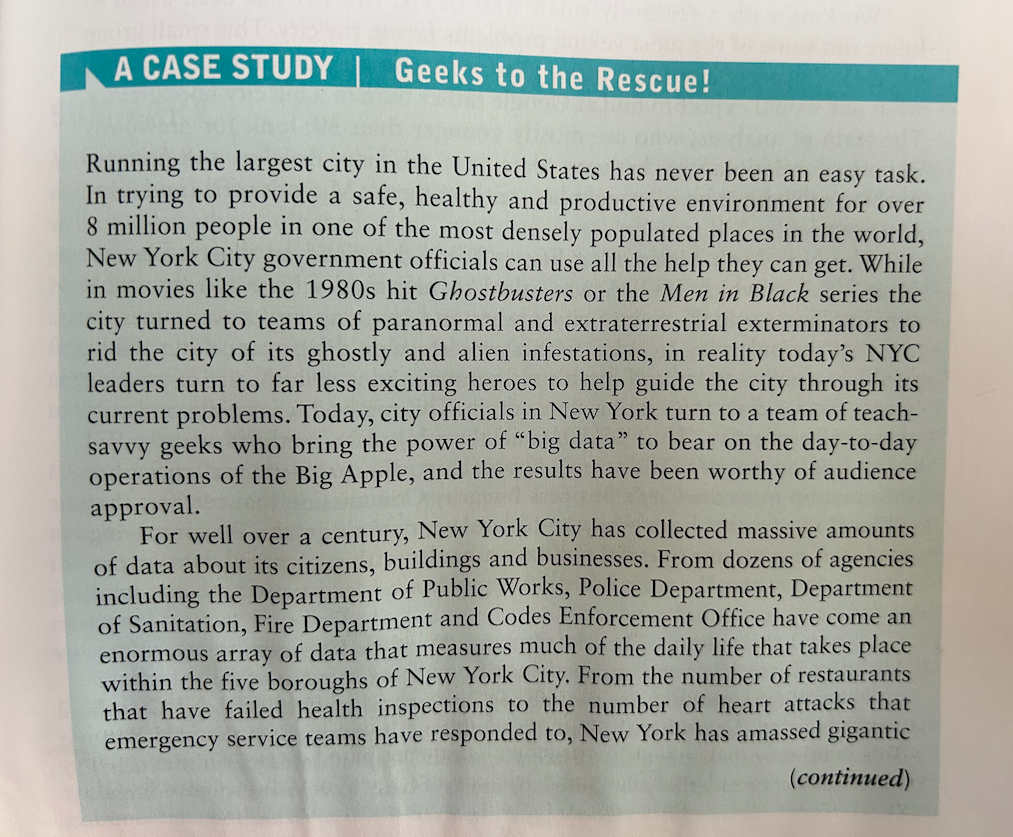
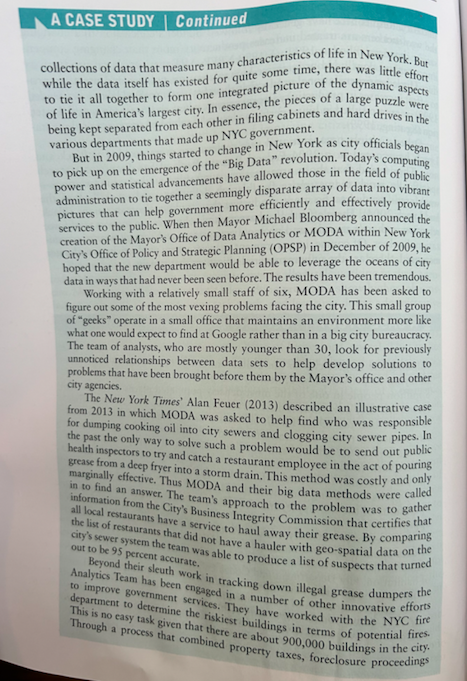
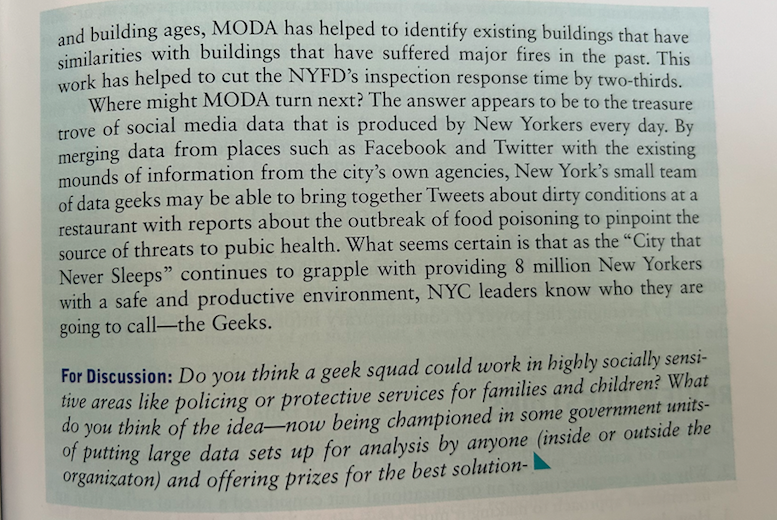
Running the largest city in the United States has never been an easy task. In trying to provide a safe, healthy and productive environment for over 8 million people in one of the most densely populated places in the world, New York City government officials can use all the help they can get. While in movies like the 1980s hit Ghostbusters or the Men in Black series the city turned to teams of paranormal and extraterrestrial exterminators to rid the city of its ghostly and alien infestations, in reality today's NYC leaders turn to far less exciting heroes to help guide the city through its current problems. Today, city officials in New York turn to a team of teachsavvy geeks who bring the power of "big data" to bear on the day-to-day operations of the Big Apple, and the results have been worthy of audience approval. For well over a century, New York City has collected massive amounts of data about its citizens, buildings and businesses. From dozens of agencies including the Department of Public Works, Police Department, Department of Sanitation, Fire Department and Codes Enforcement Office have come an enormous array of data that measures much of the daily life that takes place within the five boroughs of New York City. From the number of restaurants that have failed health inspections to the number of heart attacks that emergency service teams have responded to, New York has amassed gigantic (continued) Hections of data that measure many characteristics of life in New York. But hile the data itself has existed for quite some time, there was little effort tie it all together to form one integrated picture of the dynamic aspects f life in America's largest city. In essence, the pieces of a large puzzle were eing kept separated from each other in filing cabinets and hard drives in the rarious departments that made up NYC government. But in 2009, things started to change in New York as city officials began to pick up on the emergence of the "Big Data" revolution. Today's computing power and statistical advancements have allowed those in the field of public administration to tie together a seemingly disparate array of data into vibrant pictures that can help government more efficiently and effectively provide services to the public. When then Mayor Michael Bloomberg announced the creation of the Mayor's Office of Data Analytics or MODA within New York City's Office of Policy and Strategic Planning (OPSP) in December of 2009, he hoped that the new department would be able to leverage the oceans of city data in ways that had never been seen before. The results have been tremendous. Working with a relatively small staff of six, MODA has been asked to figure out some of the most vexing problems facing the city. This small group of "geeks" operate in a small office that maintains an environment more like what one would expect to find at Google rather than in a big city bureaucracy. The team of analysts, who are mostly younger than 30 , look for previously unnoticed relationships between data sets to help develop solutions to problems that have been brought before them by the Mayor's office and other city agencies. The New York Times' Alan Feuer (2013) described an illustrative case from 2013 in which MODA was asked to help find who was responsible for dumping cooking oil into city sewers and clogging city sewer pipes. In the past the only way to solve such a problem would be to send out public health inspectors to try and catch a restaurant employee in the act of pouring grease from a deep fryer into a storm drain. This method was costly and only marginally effective. Thus MODA and their big data methods were called in to find an answer. The team's approach to the problem was to gather information from the City's Business Integrity Commission that certifies that all local restaurants have a service to haul away their grease. By comparing city's sewer system the teat did not have a hauler with geo-spatial data on the out to be 95 percent accurate. Beyond their sleuth to produce a list of suspects that turned Analytics Team has been work in tracking down illegal grease dumpers the to improve government engaged in a number of other innovative efforts department to determine services. They have worked with the NYC fire This is no easy task given the riskiest buildings in terms of potential fires. Through a process that com there are about 900,000 buildings in the city. and building ages, MODA has helped to identify existing buildings that have similarities with buildings that have suffered major fires in the past. This work has helped to cut the NYFD's inspection response time by two-thirds. Where might MODA turn next? The answer appears to be to the treasure trove of social media data that is produced by New Yorkers every day. By merging data from places such as Facebook and Twitter with the existing mounds of information from the city's own agencies, New York's small team of data geeks may be able to bring together Tweets about dirty conditions at a restaurant with reports about the outbreak of food poisoning to pinpoint the source of threats to pubic health. What seems certain is that as the "City that Never Sleeps" continues to grapple with providing 8 million New Yorkers with a safe and productive environment, NYC leaders know who they are going to call-the Geeks. For Discussion: Do you think a geek squad could work in highly socially sensitive areas like policing or protective services for families and children? What do you think of the idea - now being championed in some government unitsof putting large data sets up for analysis by anyone (inside or outside the organizaton) and offering prizes for the best solution
Step by Step Solution
There are 3 Steps involved in it

Get step-by-step solutions from verified subject matter experts
 Study Help