



Question: case study Case Study 1.3: Jewellery Design and Manufacture Operations: Delivery Delays Solutions Brian Lawrence Overview AUTHOR BIOGRAPHY BRIAN LAWRENCE is Lecturer in the School
case study 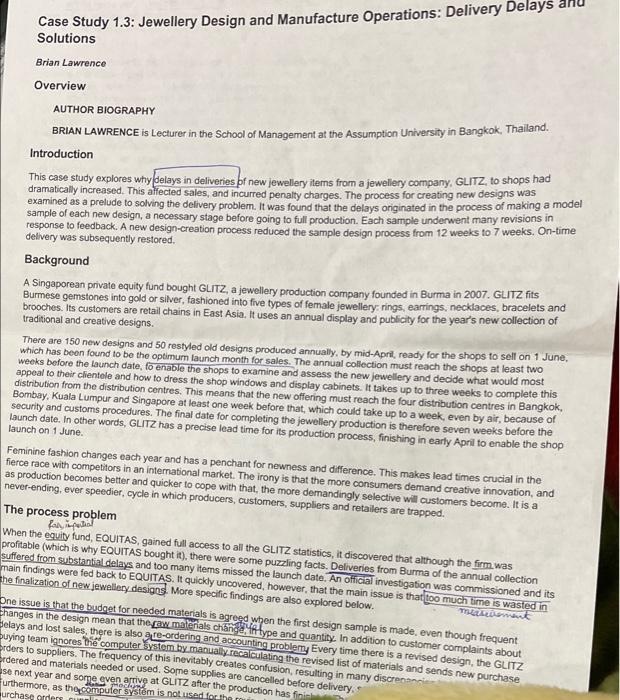
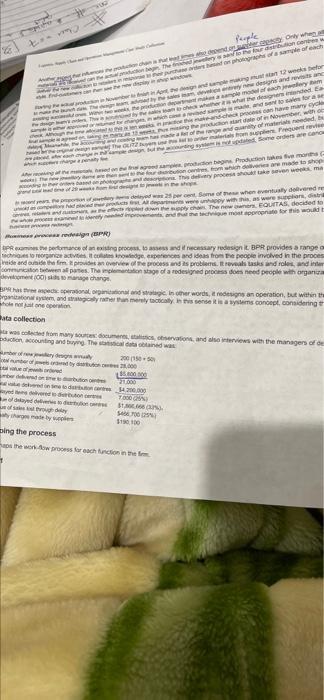
Case Study 1.3: Jewellery Design and Manufacture Operations: Delivery Delays Solutions Brian Lawrence Overview AUTHOR BIOGRAPHY BRIAN LAWRENCE is Lecturer in the School of Management at the Assumption University in Bangkok, Thailand. Introduction dramatically increased. This affected sales, and incurred penalty charges. The process for creating new designs was This case study explores why delays in deliveries pt new jewellery items from a jewellery company, GLITZ, to shops had examined as a prelude to solving the delivery problem. It was found that the delays originated in the process of making a model sample of each new design, a necessary stage before going to full production. Each sample underwent many revisions in delivery was subsequently restored. response to feedback. A new design-creation process reduced the sample design process from 12 weeks to 7 weeks. On-time Background A Singaporean private equity fund bought GLITZ, a jewellery production company founded in Burma in 2007. GLITZ fits Burmese gemstones into gold or silver, fashioned into five types of female jewellery, rings, earrings, necklaces, bracelets and brooches. Its customers are retail chains in East Asia. It uses an annual display and publicity for the year's new collection of traditional and creative designs. There are 150 new designs and 50 restyled old designs produced annually, by mid-April, ready for the shops to sell on 1 June, which has been found to be the optimum launch month for sales. The annual collection must reach the shops at least two weeks before the launch date, fo enable the shops to examine and assess the new jewellery and decide what would most appeal to their clientele and how to dress the shop windows and display cabinets. It takes up to three weeks to complete this distribution from the distribution centres. This means that the new offering must reach the four distribution centres in Bangkok, Bombay, Kuala Lumpur and Singapore at least one week before that, which could take up to a week, even by air, because of security and customs procedures. The final date for completing the jewellery production is therefore seven weeks before the launch date. In other words, GLITZ has a precise lead time for its production process, finishing in early April to enable the shop launch on 1 June Feminine fashion changes each year and has a penchant for newness and difference. This makes lead times crucial in the fierce race with competitors in an international market. The irony is that the more consumers demand creative innovation, and as production becomes better and quicker to cope with that, the more demandingly selective will customers become. It is a never-ending, ever speedier, cycle in which producers, customers, suppliers and retailers are trapped. The process problem When the equity fund, EQUITAS, gained full access to all the GLITZ statistics, it discovered that although the firm was profitable (which is why EQUITAS bought it), there were some puzzling facts. Deliveries from Burma of the annual collection suffered from substantial delays and too many items missed the launch date. An official investigation was commissioned and its main findings were fed back to EQUITAS. It quickly uncovered, however, that the main issue is that too much time is wasted in the finalization of new jewellery designs. More specific findings are also explored below. TERED One issue is that the budget for needed materials is agreed when the first design sample is made, even though frequent Shanges in the design mean that the raw materials change type and quantity. In addition to customer complaints about Belays and lost sales, there is also a re-ordering and accounting problem, Every time there is a revised design, the GLITZ buying team ignores The computer System by manually recalculating the revised list of materials and sends new purchase Srders to suppliers. The frequency of this inevitably creates confusion, resulting in many discrepan Ordered and materials needed or used. Some supplies are cancelled before delivery se next year and some even arrive at GLITZ after the production has foi urthermore, as the computer der System is not used for the re urchase orders People Only w - www kepada mewah ham and They whers where - can have any November rada ferofermended. - Speed Sear Prodowe ne mine made to shop and the process om the www2.cont. Someone when eventually delivered A weboy with as were super, hy The new car. EQUITAS, decided to andre most pronate for this would (PR) Propertomance of an existing proces, to dessary redesign it. BPR provides a range aches to more widge, experiences and from the people involved in the proces cocowapates. The meaning of a redesigned processos need prople with organ ide and other overview de process and as problems. It reveals tasks and roles and inter deve some charge Personalitation and age. In other words, designs an operation, but within the Bronsondere merely tactically in this sense is a wisconcept, considering hoone person data collection was com documentation and is the managers of declining and buying the data and was frowy 200 1500 oby obtinute 2000 36 00 wately 3150100 sing the process the worlow rooms for con 200.000 Case Study 1.3: Jewellery Design and Manufacture Operations: Delivery Delays Solutions Brian Lawrence Overview AUTHOR BIOGRAPHY BRIAN LAWRENCE is Lecturer in the School of Management at the Assumption University in Bangkok, Thailand. Introduction dramatically increased. This affected sales, and incurred penalty charges. The process for creating new designs was This case study explores why delays in deliveries pt new jewellery items from a jewellery company, GLITZ, to shops had examined as a prelude to solving the delivery problem. It was found that the delays originated in the process of making a model sample of each new design, a necessary stage before going to full production. Each sample underwent many revisions in delivery was subsequently restored. response to feedback. A new design-creation process reduced the sample design process from 12 weeks to 7 weeks. On-time Background A Singaporean private equity fund bought GLITZ, a jewellery production company founded in Burma in 2007. GLITZ fits Burmese gemstones into gold or silver, fashioned into five types of female jewellery, rings, earrings, necklaces, bracelets and brooches. Its customers are retail chains in East Asia. It uses an annual display and publicity for the year's new collection of traditional and creative designs. There are 150 new designs and 50 restyled old designs produced annually, by mid-April, ready for the shops to sell on 1 June, which has been found to be the optimum launch month for sales. The annual collection must reach the shops at least two weeks before the launch date, fo enable the shops to examine and assess the new jewellery and decide what would most appeal to their clientele and how to dress the shop windows and display cabinets. It takes up to three weeks to complete this distribution from the distribution centres. This means that the new offering must reach the four distribution centres in Bangkok, Bombay, Kuala Lumpur and Singapore at least one week before that, which could take up to a week, even by air, because of security and customs procedures. The final date for completing the jewellery production is therefore seven weeks before the launch date. In other words, GLITZ has a precise lead time for its production process, finishing in early April to enable the shop launch on 1 June Feminine fashion changes each year and has a penchant for newness and difference. This makes lead times crucial in the fierce race with competitors in an international market. The irony is that the more consumers demand creative innovation, and as production becomes better and quicker to cope with that, the more demandingly selective will customers become. It is a never-ending, ever speedier, cycle in which producers, customers, suppliers and retailers are trapped. The process problem When the equity fund, EQUITAS, gained full access to all the GLITZ statistics, it discovered that although the firm was profitable (which is why EQUITAS bought it), there were some puzzling facts. Deliveries from Burma of the annual collection suffered from substantial delays and too many items missed the launch date. An official investigation was commissioned and its main findings were fed back to EQUITAS. It quickly uncovered, however, that the main issue is that too much time is wasted in the finalization of new jewellery designs. More specific findings are also explored below. TERED One issue is that the budget for needed materials is agreed when the first design sample is made, even though frequent Shanges in the design mean that the raw materials change type and quantity. In addition to customer complaints about Belays and lost sales, there is also a re-ordering and accounting problem, Every time there is a revised design, the GLITZ buying team ignores The computer System by manually recalculating the revised list of materials and sends new purchase Srders to suppliers. The frequency of this inevitably creates confusion, resulting in many discrepan Ordered and materials needed or used. Some supplies are cancelled before delivery se next year and some even arrive at GLITZ after the production has foi urthermore, as the computer der System is not used for the re urchase orders People Only w - www kepada mewah ham and They whers where - can have any November rada ferofermended. - Speed Sear Prodowe ne mine made to shop and the process om the www2.cont. Someone when eventually delivered A weboy with as were super, hy The new car. EQUITAS, decided to andre most pronate for this would (PR) Propertomance of an existing proces, to dessary redesign it. BPR provides a range aches to more widge, experiences and from the people involved in the proces cocowapates. The meaning of a redesigned processos need prople with organ ide and other overview de process and as problems. It reveals tasks and roles and inter deve some charge Personalitation and age. In other words, designs an operation, but within the Bronsondere merely tactically in this sense is a wisconcept, considering hoone person data collection was com documentation and is the managers of declining and buying the data and was frowy 200 1500 oby obtinute 2000 36 00 wately 3150100 sing the process the worlow rooms for con 200.000 Step by Step Solution
There are 3 Steps involved in it
1 Expert Approved Answer
Step: 1 Unlock

Question Has Been Solved by an Expert!
Get step-by-step solutions from verified subject matter experts
Step: 2 Unlock
Step: 3 Unlock