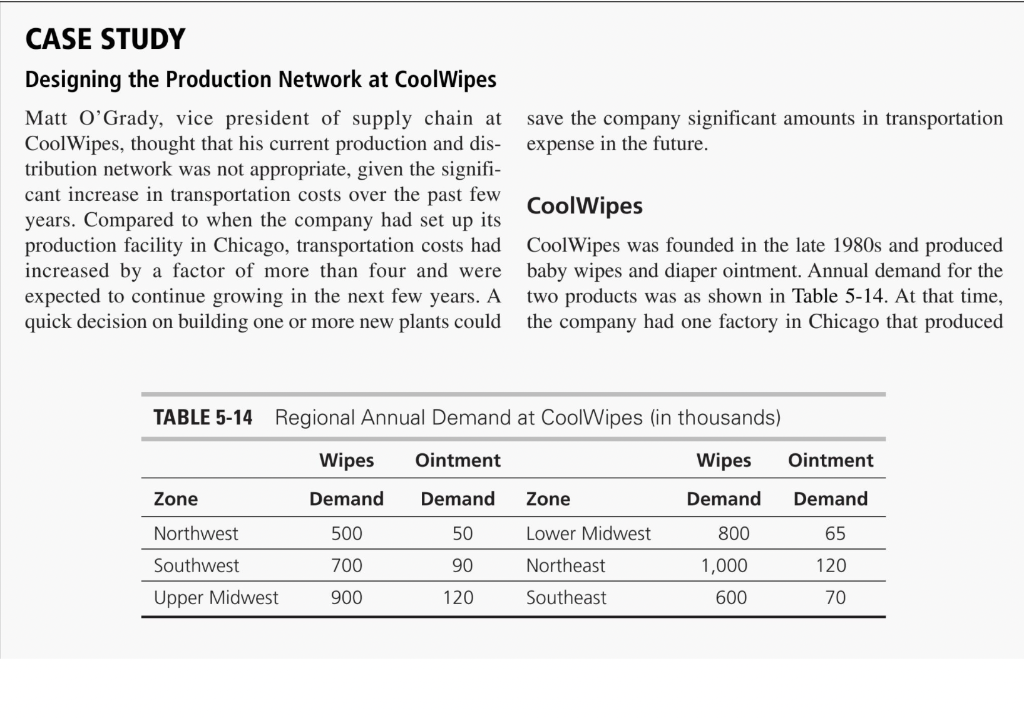
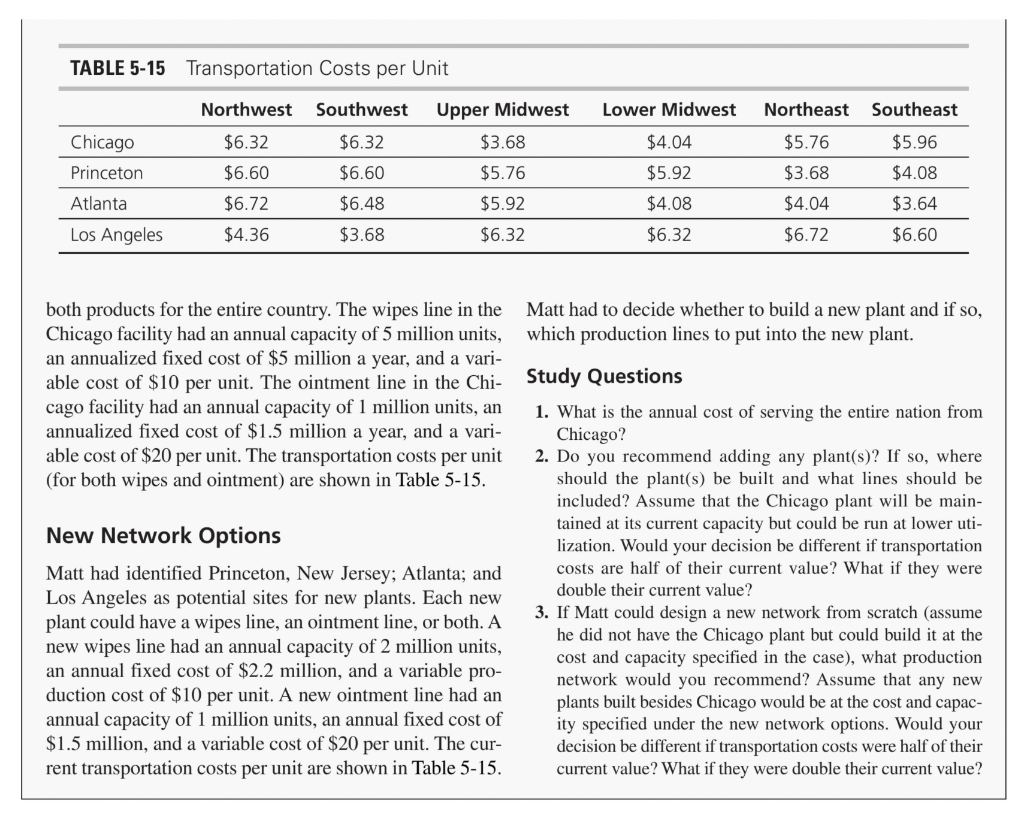
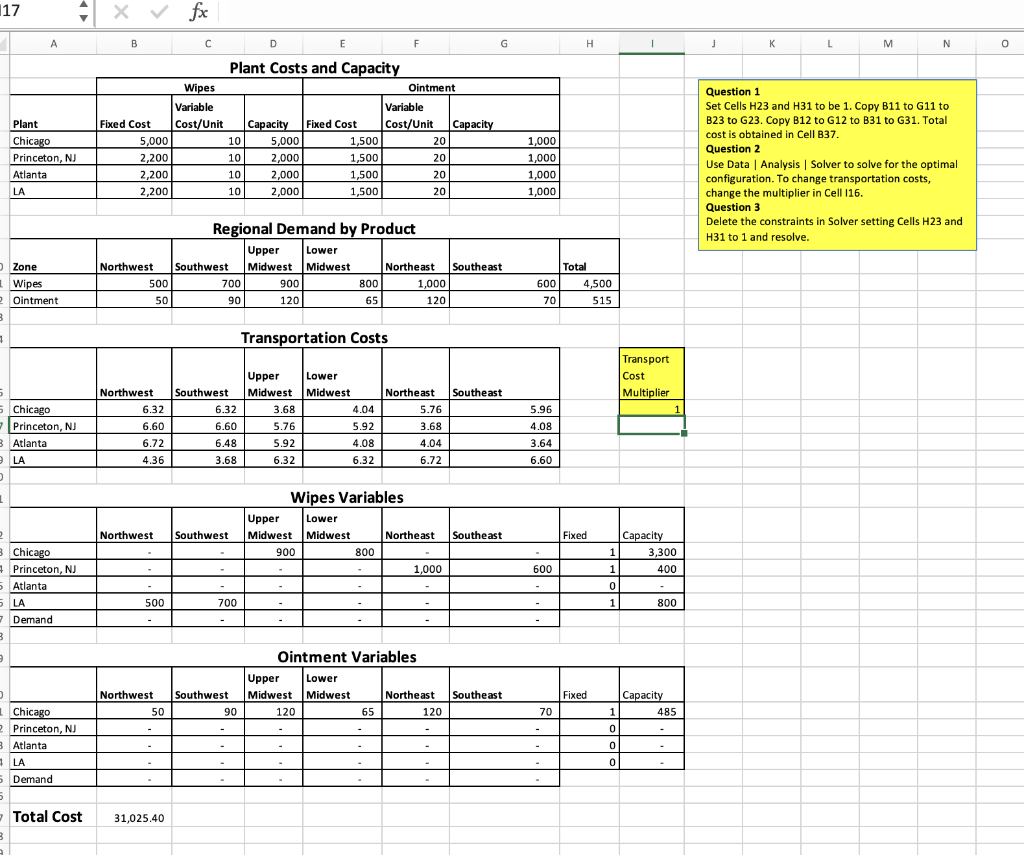
CASE STUDY Designing the Production Network at Cool Wipes Matt O'Grady, vice president of supply chain at save the company significant amounts in transportation CoolWipes, thought that his current production and dis- expense in the future. tribution network was not appropriate, given the signifi- cant increase in transportation costs over the past few Cool Wipes years. Compared to when the company had set up its production facility in Chicago, transportation costs had CoolWipes was founded in the late 1980s and produced increased by a factor of more than four and were baby wipes and diaper ointment. Annual demand for the expected to continue growing in the next few years. A two products was as shown in Table 5-14. At that time, quick decision on building one or more new plants could the company had one factory in Chicago that produced TABLE 5-14 Regional Annual Demand at CoolWipes (in thousands) Wipes Ointment Wipes Ointment Zone Demand Demand Zone Demand Demand 500 50 800 65 Northwest Southwest Upper Midwest 700 90 Lower Midwest Northeast Southeast 1,000 120 900 120 600 70 TABLE 5-15 Transportation Costs per Unit Northwest Southwest Lower Midwest Northeast Southeast Upper Midwest $3.68 $6.32 $6.32 $4.04 $5.76 Chicago Princeton $6.60 $6.60 $5.92 $3.68 $5.96 $4.08 $3.64 Atlanta $6.72 $5.76 $5.92 $6.32 $6.48 $4.08 $4.04 Los Angeles $4.36 $3.68 $6.32 $6.72 $6.60 both products for the entire country. The wipes line in the Matt had to decide whether to build a new plant and if so, Chicago facility had an annual capacity of 5 million units, which production lines to put into the new plant. an annualized fixed cost of $5 million a year, and a vari- able cost of $10 per unit. The ointment line in the Chi- Study Questions cago facility had an annual capacity of 1 million units, an 1. What is the annual cost of serving the entire nation from annualized fixed cost of $1.5 million a year, and a vari- Chicago? able cost of $20 per unit. The transportation costs per unit 2. Do you recommend adding any plant(s)? If so, where (for both wipes and ointment) are shown in Table 5-15. should the plant(s) be built and what lines should be included? Assume that the Chicago plant will be main- tained at its current capacity but could be run at lower uti- New Network Options lization. Would your decision be different if transportation Matt had identified Princeton, New Jersey; Atlanta; and costs are half of their current value? What if they were Los Angeles as potential sites for new plants. Each new double their current value? plant could have a wipes line, an ointment line, or both. A 3. If Matt could design a new network from scratch (assume new wipes line had an annual capacity of 2 million units, he did not have the Chicago plant but could build it at the cost and capacity specified in the case), what production an annual fixed cost of $2.2 million, and a variable pro- network would you recommend? Assume that any new duction cost of $10 per unit. A new ointment line had an plants built besides Chicago would be at the cost and capac- annual capacity of 1 million units, an annual fixed cost of ity specified under the new network options. Would your $1.5 million, and a variable cost of $20 per unit. The cur- decision be different if transportation costs were half of their rent transportation costs per unit are shown in Table 5-15. current value? What if they were double their current value? 117 4 x Xv fx A H K L M N 0 Plant Chicago Princeton, NJ Atlanta B D E F G Plant Costs and Capacity Wipes Ointment Variable Variable Fixed Cost Cost/Unit Capacity Fixed Cost Cost/Unit Capacity 5,000 10 5,000 1,500 20 2,200 10 2,000 1,500 20 2,200 10 2,000 1,500 20 2,200 10 2,000 1,500 20 1,000 1,000 1,000 1,000 Question 1 Set Cells H23 and H31 to be 1. Copy B11 to G11 to B23 to G23. Copy B12 to G12 to B31 to G31. Total cost is obtained in Cell B37. Question 2 Use Data Analysis Solver to solve for the optimal configuration. To change transportation costs, change the multiplier in Cell 116. Question 3 Delete the constraints in Solver setting Cells H23 and H31 to 1 and resolve. LA Lower Zone 1 Wipes 2 Ointment 3 Regional Demand by Product Upper Northwest Southwest Midwest Midwest Northeast Southeast 500 700 900 800 1,000 50 90 120 65 120 Total 600 70 4,500 515 1 Transportation Costs Transport Cost Multiplier 1 Southeast Northwest 6.32 6.60 Chicago Princeton, NJ 3 Atlanta LA Southwest 6.32 6.60 6.48 3.68 Upper Lower Midwest Midwest 3.68 4.04 5.76 5.92 5.92 4.08 6.32 6.32 Northeast 5.76 3.68 4.04 6.72 5.96 4.08 3.64 6.60 6.72 4.36 1 Northwest Southwest Wipes Variables Upper Lower Midwest Midwest Northeast 900 800 1,000 Southeast Fixed 2 B Chicago Princeton, NJ 5 Atlanta 5 LA 7 Demand 3 Capacity 1 3,300 1 400 0 600 500 700 1 800 Ointment Variables Upper Lower Southwest Midwest Midwest Northeast 90 120 65 120 Southeast Fixed Northwest 50 Capacity 1 485 70 0 Chicago Princeton, NJ 3 Atlanta # LA 5 Demand 0 0 Total Cost 31,025.40 3




