Question: Case study : How developments in electronic sensors create destruction in the disposable nappy industry, from the book Trott, P. (2017). Innovation management and new
Case study : How developments in electronic sensors create destruction in the disposable nappy industry, from the book Trott, P. (2017). Innovation management and new product development(6th ed). ISBN: 978-1-292-13342-3 ; Chapter 11 : Open innovation and technology transfer.
I need answer for below questions
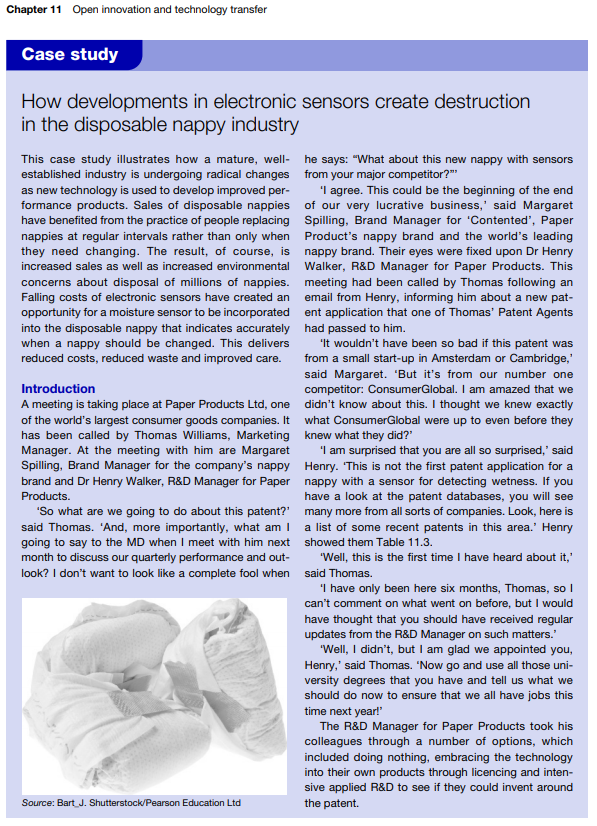
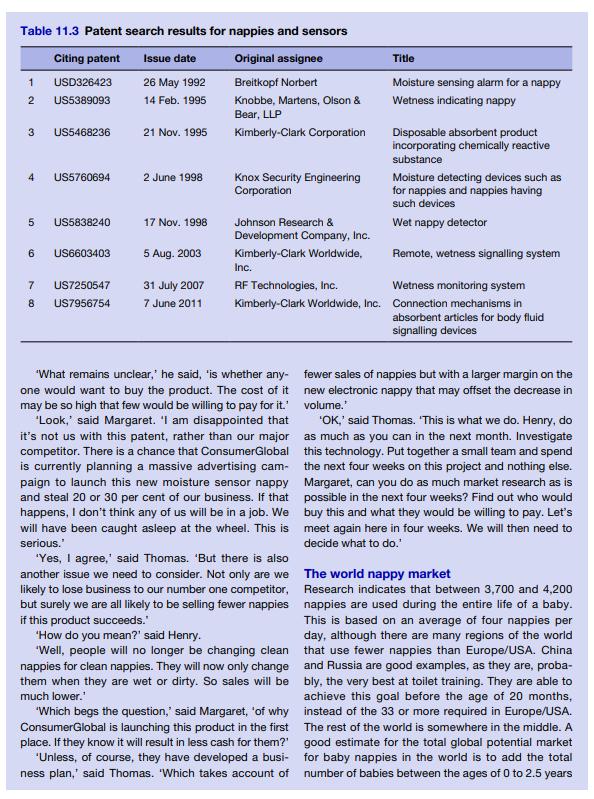
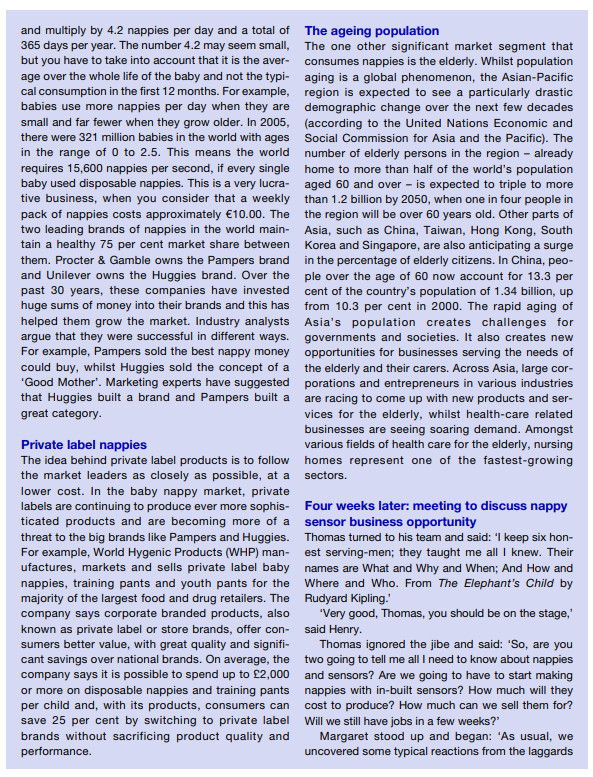
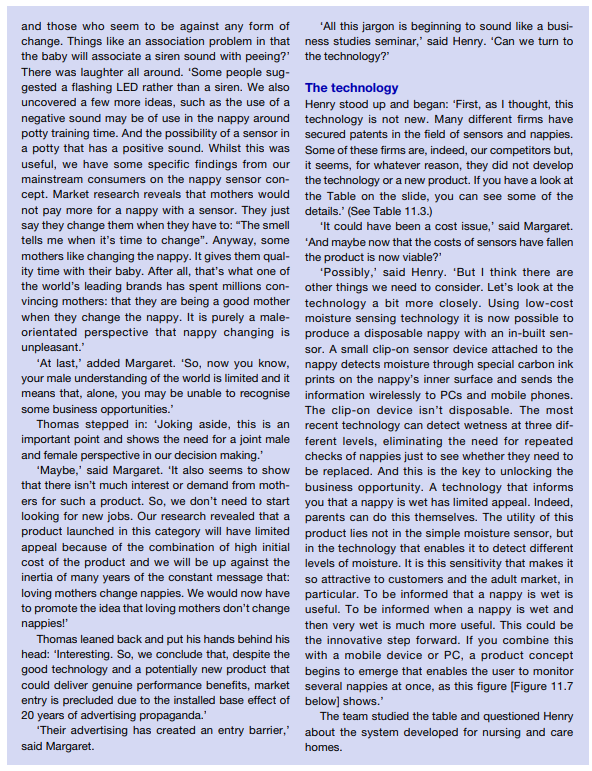
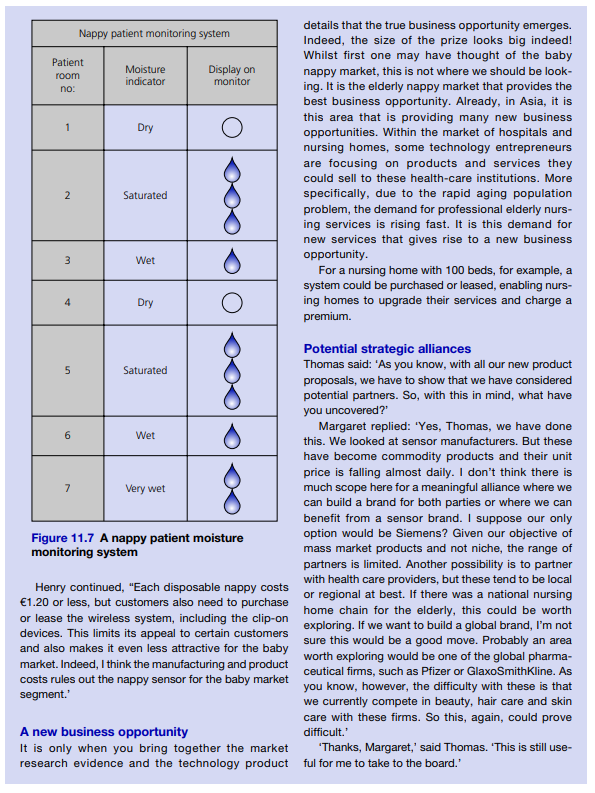
Chapter 11 Open innovation and technology transfer Case study How developments in electronic sensors create destruction in the disposable nappy industry This case study illustrates how a mature, well- he says: "What about this new nappy with sensors established industry is undergoing radical changes from your major competitor?" as new technology is used to develop improved per- 'I agree. This could be the beginning of the end formance products. Sales of disposable nappies of our very lucrative business,' said Margaret have benefited from the practice of people replacing Spilling, Brand Manager for 'Contented', Paper nappies at regular intervals rather than only when Product's nappy brand and the world's leading they need changing. The result, of course, is nappy brand. Their eyes were fixed upon Dr Henry increased sales as well as increased environmental Walker, R&D Manager for Paper Products. This concerns about disposal of millions of nappies. meeting had been called by Thomas following an Falling costs of electronic sensors have created an email from Henry, informing him about a new pat- opportunity for a moisture sensor to be incorporated ent application that one of Thomas' Patent Agents into the disposable nappy that indicates accurately had passed to him. when a nappy should be changed. This delivers It wouldn't have been so bad if this patent was reduced costs, reduced waste and improved care. from a small start-up in Amsterdam or Cambridge,' said Margaret. 'But it's from our number one Introduction competitor: ConsumerGlobal. I am amazed that we A meeting is taking place at Paper Products Ltd, one didn't know about this. I thought we knew exactly of the world's largest consumer goods companies. It what Consumer Global were up to even before they has been called by Thomas Williams, Marketing knew what they did?' Manager. At the meeting with him are Margaret 'I am surprised that you are all so surprised,' said Spilling, Brand Manager for the company's nappy Henry. This is not the first patent application for a brand and Dr Henry Walker, R&D Manager for Paper nappy with a sensor for detecting wetness. If you Products. have a look at the patent databases, you will see 'So what are we going to do about this patent?' many more from all sorts of companies. Look, here is said Thomas. 'And, more importantly, what am I a list of some recent patents in this area.' Henry going to say to the MD when I meet with him next showed them Table 11.3. month to discuss our quarterly performance and out- 'Well, this is the first time I have heard about it,' look? I don't want to look like a complete fool when said Thomas. 'I have only been here six months, Thomas, so I can't comment on what went on before, but I would have thought that you should have received regular updates from the R&D Manager on such matters.' 'Well, I didn't, but I am glad we appointed you, Henry,' said Thomas. "Now go and use all those uni- versity degrees that you have and tell us what we should do now to ensure that we all have jobs this time next year! The R&D Manager for Paper Products took his colleagues through a number of options, which included doing nothing, embracing the technology into their own products through licencing and inten- sive applied R&D to see if they could invent around Source: Bart J. Shutterstock/Pearson Education Ltd the patent Table 11.3 Patent search results for nappies and sensors Citing patent Issue date Original assignee Title 1 USD326423 26 May 1992 Breitkopf Norbert Moisture sensing alarm for a nappy 2 US5389093 14 Feb. 1995 Knobbe, Martens, Olson & Wetness indicating nappy Bear, LLP 3 US5468236 21 Nov. 1995 Kimberly-Clark Corporation Disposable absorbent product incorporating chemically reactive substance US5760694 2 June 1998 Knox Security Engineering Moisture detecting devices such as Corporation for nappies and nappies having such devices 5 US5838240 17 Nov. 1998 Johnson Research & Wet nappy detector Development Company, Inc. 6 US6603403 5 Aug. 2003 Kimberly-Clark Worldwide Remote, wetness signalling system Inc. 7 US7250547 31 July 2007 RF Technologies, Inc. Wetness monitoring system US7956754 7 June 2011 Kimberly-Clark Worldwide, Inc. Connection mechanisms in absorbent articles for body fluid signalling devices 4 8 "What remains unclear," he said, 'is whether any- fewer sales of nappies but with a larger margin on the one would want to buy the product. The cost of it new electronic nappy that may offset the decrease in may be so high that few would be willing to pay for it.' volume.' 'Look,' said Margaret. 'I am disappointed that OK,' said Thomas. 'This is what we do. Henry, do it's not us with this patent, rather than our major as much as you can in the next month. Investigate competitor. There is a chance that Consumer Global this technology. Put together a small team and spend is currently planning a massive advertising cam- the next four weeks on this project and nothing else. paign to launch this new moisture sensor nappy Margaret, can you do as much market research as is and steal 20 or 30 per cent of our business. If that possible in the next four weeks? Find out who would happens, I don't think any of us will be in a job. We buy this and what they would be willing to pay. Let's will have been caught asleep at the wheel. This is meet again here in four weeks. We will then need to serious.' decide what to do. 'Yes, I agree,' said Thomas. 'But there is also another issue we need to consider. Not only are we The world nappy market likely to lose business to our number one competitor, Research indicates that between 3,700 and 4,200 but surely we are all likely to be selling fewer nappies nappies are used during the entire life of a baby. if this product succeeds. This is based on an average of four nappies per "How do you mean?' said Henry. day, although there are many regions of the world 'Well, people will no longer be changing clean that use fewer nappies than Europe/USA. China nappies for clean nappies. They will now only change and Russia are good examples, as they are, proba- them when they are wet or dirty. So sales will be bly, the very best at toilet training. They are able to much lower.' achieve this goal before the age of 20 months, 'Which begs the question,' said Margaret, 'of why instead of the 33 or more required in Europe/USA. Consumer Global is launching this product in the first the rest of the world is somewhere in the middle. A place. If they know it will result in less cash for them?' good estimate for the total global potential market "Unless, of course, they have developed a busi- for baby nappies in the world is to add the total ness plan,' said Thomas. "Which takes account of number of babies between the ages of 0 to 2.5 years and multiply by 4.2 nappies per day and a total of The ageing population 365 days per year. The number 4.2 may seem small, The one other significant market segment that but you have to take into account that it is the aver- consumes nappies is the elderly. Whilst population age over the whole life of the baby and not the typi- aging is a global phenomenon, the Asian Pacific cal consumption in the first 12 months. For example, region is expected to see a particularly drastic babies use more nappies per day when they are demographic change over the next few decades small and far fewer when they grow older. In 2005, (according to the United Nations Economic and there were 321 million babies in the world with ages Social Commission for Asia and the Pacific). The in the range of 0 to 2.5. This means the world number of elderly persons in the region - already requires 15,600 nappies per second, if every single home to more than half of the world's population baby used disposable nappies. This is a very lucra- aged 60 and over - is expected to triple to more tive business, when you consider that a weekly than 1.2 billion by 2050, when one in four people in pack of nappies costs approximately 10.00. The the region will be over 60 years old. Other parts of two leading brands of nappies in the world main- Asia, such as China, Taiwan, Hong Kong, South tain a healthy 75 per cent market share between Korea and Singapore, are also anticipating a surge them. Procter & Gamble owns the Pampers brand in the percentage of elderly citizens. In China, peo- and Unilever owns the Huggies brand. Over the ple over the age of 60 now account for 13.3 per past 30 years, these companies have invested cent of the country's population of 1.34 billion, up huge sums of money into their brands and this has from 10.3 per cent in 2000. The rapid aging of helped them grow the market. Industry analysts Asia's population creates challenges for argue that they were successful in different ways. governments and societies. It also creates new For example, Pampers sold the best nappy money opportunities for businesses serving the needs of could buy, whilst Huggies sold the concept of a the elderly and their carers. Across Asia, large cor- 'Good Mother'. Marketing experts have suggested porations and entrepreneurs in various industries that Huggies built a brand and Pampers built a are racing to come up with new products and ser- great category. vices for the elderly, whilst health-care related businesses are seeing soaring demand. Amongst Private label nappies various fields of health care for the elderly, nursing The idea behind private label products is to follow homes represent one of the fastest-growing the market leaders as closely as possible, at a sectors. lower cost. In the baby nappy market, private labels are continuing to produce ever more sophis- Four weeks later: meeting to discuss nappy ticated products and are becoming more of a sensor business opportunity threat to the big brands like Pampers and Huggies. Thomas turned to his team and said: 'I keep six hon- For example, World Hygenic Products (WHP) man- est serving-men; they taught me all I knew. Their ufactures, markets and sells private label baby names are What and Why and When; And How and nappies, training pants and youth pants for the Where and Who. From The Elephant's Child by majority of the largest food and drug retailers. The Rudyard Kipling.' company says corporate branded products, also "Very good, Thomas, you should be on the stage,' known as private label or store brands, offer con- said Henry. sumers better value, with great quality and signifi- Thomas ignored the jibe and said: 'So, are you cant savings over national brands. On average, the two going to tell me all I need to know about nappies company says it is possible to spend up to 2,000 and sensors? Are we going to have to start making or more on disposable nappies and training pants nappies with in-built sensors? How much will they per child and, with its products, consumers can cost to produce? How much can we sell them for? save 25 per cent by switching to private label Will we still have jobs in a few weeks?' brands without sacrificing product quality and Margaret stood up and began: 'As usual, we performance. uncovered some typical reactions from the laggards and those who seem to be against any form of 'All this jargon is beginning to sound like a busi- change. Things like an association problem in that ness studies seminar,' said Henry. 'Can we turn to the baby will associate a siren sound with peeing?' the technology?' There was laughter all around. 'Some people sug- gested a flashing LED rather than a siren. We also The technology uncovered a few more ideas, such as the use of a Henry stood up and began: 'First, as I thought, this negative sound may be of use in the nappy around technology is not new. Many different firms have potty training time. And the possibility of a sensor in secured patents in the field of sensors and nappies. a potty that has a positive sound. Whilst this was Some of these firms are, indeed, our competitors but, useful, we have some specific findings from our it seems, for whatever reason, they did not develop mainstream consumers on the nappy sensor con- the technology or a new product. If you have a look at cept. Market research reveals that mothers would the Table on the slide, you can see some of the not pay more for a nappy with a sensor. They just details.' (See Table 11.3.) say they change them when they have to: "The smell 'It could have been a cost issue,' said Margaret. tells me when it's time to change". Anyway, some 'And maybe now that the costs of sensors have fallen mothers like changing the nappy. It gives them qual- the product is now viable?' ity time with their baby. After all, that's what one of 'Possibly,' said Henry. 'But I think there are the world's leading brands has spent millions con- other things we need to consider. Let's look at the vincing mothers: that they are being a good mother technology a bit more closely. Using low-cost when they change the nappy. It is purely a male- moisture sensing technology it is now possible to orientated perspective that nappy changing is produce a disposable nappy with an in-built sen- unpleasant. sor. A small clip-on sensor device attached to the "At last,' added Margaret. 'So, now you know, nappy detects moisture through special carbon ink your male understanding of the world is limited and it prints on the nappy's inner surface and sends the means that, alone, you may be unable to recognise information wirelessly to PCs and mobile phones. some business opportunities.' The clip-on device isn't disposable. The most Thomas stepped in: 'Joking aside, this is an recent technology can detect wetness at three dif- important point and shows the need for a joint male ferent levels, eliminating the need for repeated and female perspective in our decision making.' checks of nappies just to see whether they need to "Maybe,' said Margaret. 'It also seems to show be replaced. And this is the key to unlocking the that there isn't much interest or demand from moth- business opportunity. A technology that informs ers for such a product. So, we don't need to start you that a nappy is wet has limited appeal. Indeed, looking for new jobs. Our research revealed that a parents can do this themselves. The utility of this product launched in this category will have limited product lies not in the simple moisture sensor, but appeal because of the combination of high initial in the technology that enables it to detect different cost of the product and we will be up against the levels of moisture. It is this sensitivity that makes it inertia of many years of the constant message that: so attractive to customers and the adult market, in loving mothers change nappies. We would now have particular. To be informed that a nappy is wet is to promote the idea that loving mothers don't change useful. To be informed when a nappy is wet and nappies! then very wet is much more useful. This could be Thomas leaned back and put his hands behind his the innovative step forward. If you combine this head: 'Interesting. So, we conclude that, despite the with a mobile device or PC, a product concept good technology and a potentially new product that begins to emerge that enables the user to monitor could deliver genuine performance benefits, market several nappies at once, as this figure [Figure 11.7 entry is precluded due to the installed base effect of below] shows.' 20 years of advertising propaganda.' The team studied the table and questioned Henry 'Their advertising has created an entry barrier,' about the system developed for nursing and care said Margaret. homes. Nappy patient monitoring system Patient room no: Moisture indicator Display on monitor 1 Dry O details that the true business opportunity emerges. Indeed, the size of the prize looks big indeed! Whilst first one may have thought of the baby nappy market, this is not where we should be look- ing. It is the elderly nappy market that provides the best business opportunity. Already, in Asia, it is this area that is providing many new business opportunities. Within the market of hospitals and nursing homes, some technology entrepreneurs are focusing on products and services they could sell to these health-care institutions. More specifically, due to the rapid aging population problem, the demand for professional elderly nurs- ing services is rising fast. It is this demand for new services that gives rise to a new business opportunity. For a nursing home with 100 beds, for example, a system could be purchased or leased, enabling nurs- ing homes to upgrade their services and charge a premium 2 Saturated 3 3 Wet 4 Dry 5 6 Wet Potential strategic alliances Saturated Thomas said: 'As you know, with all our new product proposals, we have to show that we have considered potential partners. So, with this in mind, what have you uncovered? Margaret replied: 'Yes, Thomas, we have done this. We looked at sensor manufacturers. But these have become commodity products and their unit price is falling almost daily. I don't think there is 7 Very wet much scope here for a meaningful alliance where we can build a brand for both parties or where we can benefit from a sensor brand. I suppose our only Figure 11.7 A nappy patient moisture option would be Siemens? Given our objective of monitoring system mass market products and not niche, the range of partners is limited. Another possibility is to partner Henry continued, "Each disposable nappy costs with health care providers, but these tend to be local 1.20 or less, but customers also need to purchase or regional at best. If there was a national nursing or lease the wireless system, including the clip-on home chain for the elderly, this could be worth devices. This limits its appeal to certain customers exploring. If we want to build a global brand, I'm not and also makes it even less attractive for the baby sure this would be a good move. Probably an area market. Indeed, I think the manufacturing and product worth exploring would be one of the global pharma- costs rules out the nappy sensor for the baby market you know, however, the difficulty with these is that ceutical firms, such as Pfizer or GlaxoSmithKline. As segment. we currently compete in beauty, hair care and skin care with these firms. So this, again, could prove A new business opportunity difficult.' It is only when you bring together the market 'Thanks, Margaret,' said Thomas. 'This is still use- research evidence and the technology product ful for me to take to the board.' Conclusions lucrative service-based businesses. This is just such Thomas addressed his team again: 'This is great a business. Wish me luck." news, guys. You have done amazing work. I will take As Thomas left the room with a spring in his step, this proposal to the new ventures board and propose Margaret turned to Henry and said, 'I don't know a 10 million investment for the next two years to about this idea. I think the competition is fierce. There launch this new business. It is exactly what this com- are lots of small technology-based businesses in pany has been trying to do. That is, move into more Korea and China. I am not sure I would invest my own money.' Henry replied: 'Let's see what the board says.' Questions 1 Explain why baby nappy producers, such as P&G and Unilever, may have dismissed this product idea? And then explain why this may have been short sighted? 2 Sketch the range of business models available and their advantages. 3 What changes in the external environment has led to this new business opportunity? 4 Use the cyclic model of innovation to show how key decisions led to this innovation. 5 What potential strategic alliances should the business explore? 6 Was the team correct to dismiss the baby nappy market so readily? 7 Discuss the different types of services that can be developed around the core technology concept. 8 Explain why you would or would not invest 10,000 of your own money in this new business? Chapter summary Technology transfer has a significant impact on the management of innovation. The process is concerned with facilitating and promoting innovation. The increasing use of strategic alliances means that its importance is set to increase. This chapter has introduced the subject of technology transfer and examined various models of the process. Most models of technology transfer emphasise access to technology rather than trying to understand the receptivity issues of the receiving organisation. The case study showed how effective technology transfer can be in contributing to a firm's success in very competitive conditions









 Study Help