Question: CASE STUDY Process Control Inc. Background as Father Christmas and the Easter Bunny at the Process Control Inc. (PCI) is the European manufac appropriate time
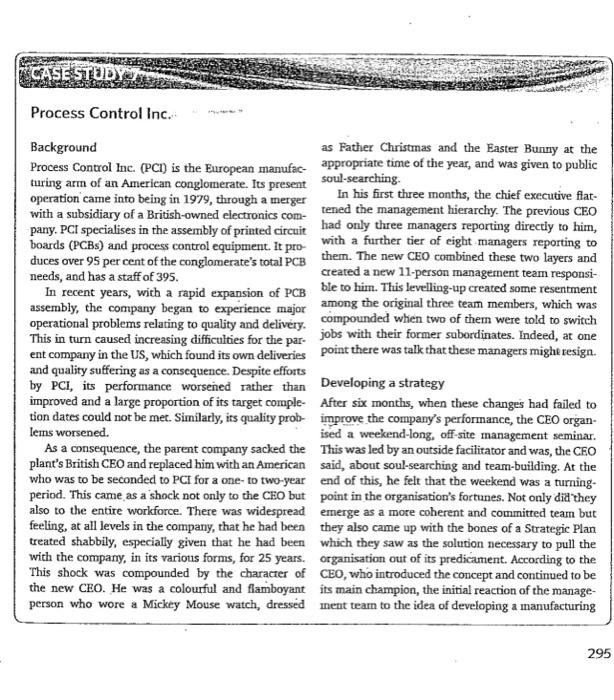
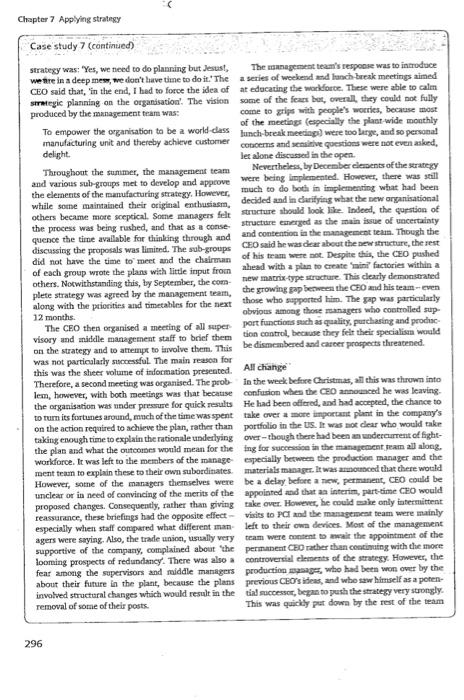
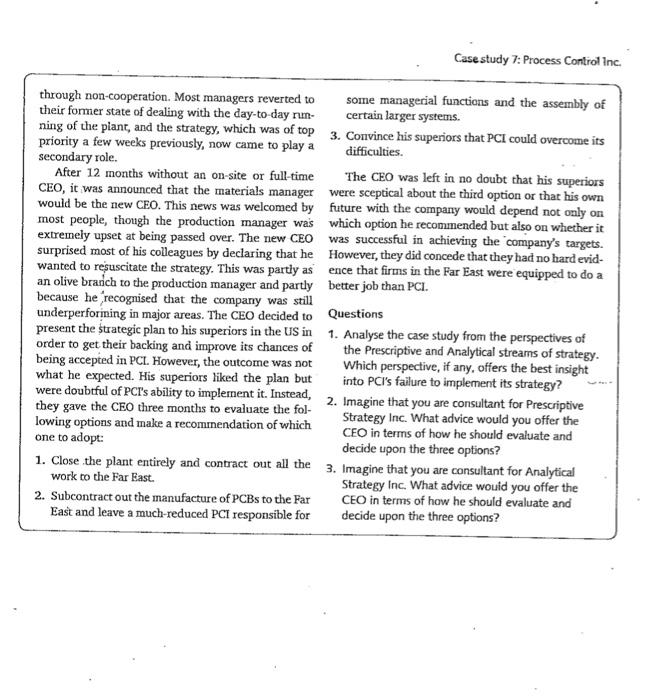
CASE STUDY Process Control Inc. Background as Father Christmas and the Easter Bunny at the Process Control Inc. (PCI) is the European manufac appropriate time of the year, and was given to public turing arm of an American conglomerate. Its present soul-searching operation came into being in 1979, through a merger In his first three months, the chief executive flat- with a subsidiary of a British-owned electronics com- tened the management hierarchy. The previous CEO pany. PCI specialises in the assembly of printed circuit had only three managers reporting directly to him, boards (PCBS) and process control equipment. It pro with a further tier of eight managers reporting to duces over 95 per cent of the conglomerate's total PCB them. The new CEO combined these two layers and needs, and has a staff of 395. created a new 11-person management team responsi- In recent years, with a rapid expansion of PCB ble to him. Thus levelling-up created some resentment assembly, the company began to experience major among the original three team members, which was operational problems relating to quality and delivery compounded when two of them were told to switch This in turn caused increasing difficulties for the par jobs with their former subordinates. Indeed, at one ent company in the US, which found its own deliveries point there was talk that these managers mighe resign. and quality suffering as a consequence. Despite efforts by PCI, its performance worsened rather than Developing a strategy improved and a large proportion of its target comple- After six months, when these changes had failed to tion dates could not be met. Similarly, its quality prob improve the company's performance, the CEO organ- lems worsened. ised a weekend-long, off-site management seminar. As a consequence, the parent company sacked the This was led by an outside facilitator and was the CEO plant's British CEO and replaced him with an American said, about soul-searching and team-building. At the who was to be seconded to PCI for a one-to two-year end of this, he felt that the weekend was a turning- period. This came as a shock not only to the CEO but point in the organisation's fortunes. Not only did they also to the entire workforce. There was widespread emerge as a more coherent and committed tearn but feeling, at all levels in the company, that he had been they also came up with the bones of a Strategic Plan treated shabbily, especially given that he had been which they saw as the solution necessary to pull the with the company, in its various forms, for 25 years. Organisation out of its predicament. According to the This shock was compounded by the character of CEO, who introduced the concept and continued to be the new CEO. He was a colourful and flamboyant its main champion, the initial reaction of the manage- person who wore a Mickey Mouse watch, dressed inent tearn to the idea of developing a manufacturing 295 Chapter 7 Applying strategy Case study 7 (continued) strategy was: 'Yes, we need to do planning but Jesus, The management team's response was to introduce we are in a deep mes, we don't have time to do it. The a series of weekend and lunch break meetings aimed CEO said that, in the end, I had to force the idea of at educating the workforce. These were able to calm strategic planning on the organisation. The vision some of the fears bet, overall, they could not fully produced by the management team was: come to grips with people's worries, because most of the meetings (especially the plant-wide monthly To empower the organisation to be a world-class lunch break meeting) were too larye, and so personal manufacturing unit and thereby achieve customer corders and sensitive questions were not even asked, delight les alone discussed in the open Throughout the sunimer, the management team Nevertheless, by December leidents of the strategy and various subgroups met to develop and approve were being implemented. However, there was still the elements of the manufacturing strategy. However, much to do bote in implementing what had been while some maintained their original enthusiasm, decided and in cartying what the new organisational others became more sceptical. Some managers felt structure should look like. Indeed, the question of the process was being rushed, and that as a conse structure emerged as the main issue of uncertainty quence the time available for thinking through and and contention in the management team. Though the discussing the proposals was limited. The sub-groups CEO said he was dear about the new structure, the rest did not have the time to meet and the chairman of his team were sot. Despite this, the CEO pushed of each group wrote the plans with little input from ahead with a plan to create 'mind factories within others. Notwithstanding this, by September, the com- new matrix-type structure. This clearly demonstrated plete strategy was agreed by the management team, the growing gap between the CEO and his team-even along with the priorities and timetables for the next those who supported him. The gap was particularly 12 months. obvious among those managers who controlled sup The CEO then organised a meeting of all super port functions such as quality purchasing and produc visory and middle management staff to brief them tion control, because they felt their specialisen would on the strategy and to attempt to involve them. This be dismembered and career prospects threatened was not particularly successful The main reason for this was the sheer volume of indormation presented All change Therefore, a second meeting was organised. The prob in the week before Christmas, all this was thrown into lem, however, with both meetings was that because confusion when the CEO announced he was leaving- the organisation was under pressure for quick results He had been offered and had accepted, the chance to to turn its fortunes around, much of the time was spent take over a more important plant in the company's on the action required to achieve the plan, rather than portfolio in the US. It was not clear who would take taking enough time to explain the rationale underlying over-though there had been an undercurrent of fight- the plan and what the outcomes would mean for the ing for success in the management team all along, workforce. It was left to the members of the manage especially between the production manager and the ment un to explain these to their own subordinates materials manager. It was acced that there would However, some of the managers themselves were be a delay before a new, permanent, CEO could be unclear or in need of convincing of the merits of the appointed and that an interim, part-time CEO would proposed changes. Consequently, rather than giving take over. However, he could make only intermittent reassurance, these briefings had the opposite effect visits to PC and the management team were mainly especially when staff compared what different man left to their own devices. Most of the management agers were saying. Also, the trade union, usually very team were content to the appointment of the supportive of the company, complained about the permanent CEO rather than continuing with the more looming prospects of redundancy. There was also a controversial clements of the strategy. However, the fear among the supervisors and middle managers production manager, who had been won over by the about their future in the plant, because the plans previous CEO's ideas, and who saw himself as a poten- involved structural changes which would result in the tal cesser, began to push the strategy very strongly removal of some of their posts. This was quickly put down by the rest of the team 296 Case study 7: Process Control Inc. through non-cooperation. Most managers reverted to some managerial functions and the assembly of their former state of dealing with the day-to-day rm- certain larger systems. ning of the plant, and the strategy, which was of top 3. Convince his superiors that PCI could overcome its priority a few weeks previously, now came to play a secondary role. difficulties. After 12 months without an on-site or full-time The CEO was left in no doubt that his superiors CEO, it was announced that the materials manager were sceptical about the third option or that his own would be the new CEO. This news was welcomed by future with the company would depend not only on most people, though the production manager was which option he recommended but also on whether it extremely upset at being passed over. The new CEO was successful in achieving the company's targets. surprised most of his colleagues by declaring that he However, they did concede that they had no hard evid- wanted to resuscitate the strategy. This was partly as ence that firms in the Far East were equipped to do a an olive branich to the production manager and partly better job than PCI. because he recognised that the company was still underperforming in major areas. The CEO decided to Questions present the strategic plan to his superiors in the US in 1. Analyse the case study from the perspectives of order to get their backing and improve its chances of the Prescriptive and Analytical streams of strategy. being accepted in PCI. However, the outcome was not Which perspective, if any, offers the best insight what he expected. His superiors liked the plan but into PC's failure to implement its strategy? were doubtful of PCI's ability to implement it. Instead, they gave the CEO three months to evaluate the fol 2. Imagine that you are consultant for Prescriptive lowing options and make a recommendation of which Strategy Inc. What advice would you offer the CEO in terms of how he should evaluate and one to adopt: decide upon the three options? 1. Close the plant entirely and contract out all the 3. Imagine that you are consultant for Analytical work to the Far East. Strategy Inc. What advice would you offer the 2. Subcontract out the manufacture of PCBs to the Far CEO in terms of how he should evaluate and East and leave a much-reduced PCI responsible for decide upon the three options









 Study Help