





Question: Case Study: While much of this chapter has discussed methods for achieving harmonious relationships and getting out of conflicts, it's also important to remember there
Case Study: While much of this chapter has
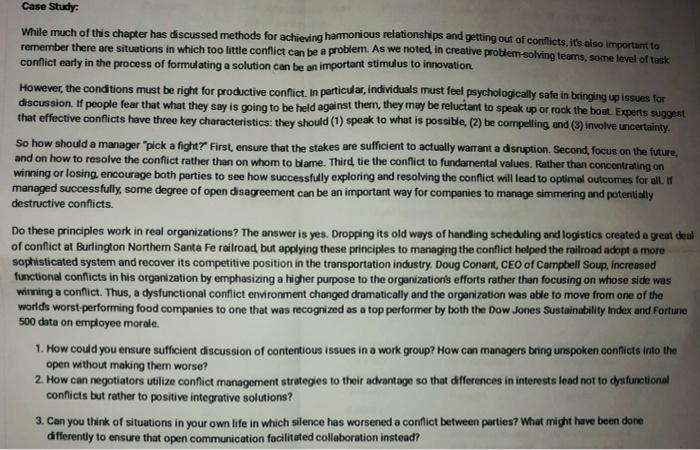
Case Study: While much of this chapter has discussed methods for achieving harmonious relationships and getting out of conflicts, it's also important to remember there are situations in which too little conflict can be a problem. As we noted in creative problem-solving teams, some level of task conflict early in the process of formulating a solution can be an important stimulus to innovation However, the conditions must be right for productive conflict. In particular, individuals must feel psychologically safe in bringing up issues for discussion. If people tear that what they say is going to be held against ther, they may be reluctant to speak up or rock the boat. Experts suggest that effective conflicts have three key characteristics: they should (1) speak to what is possible, (2) be compelling and (3) involve uncertainty. So how should a manager "pick a fight? First, ensure that the stakes are sufficient to actually warrant a disruption. Second, focus on the future, and on how to resolve the conflict rather than on whom to blame. Third tie the conflict to fundamental values. Rather than concentrating on winning or losing encourage both parties to see how successfully exploring and resolving the conflict will lead to optimal outcomes for all. If managed successfully, some degree of open disagreement can be an important way for companies to manage simmering and potentially destructive conflicts. Do these principles work in real organizations? The answer is yes. Dropping its old ways of handling scheduling and logistics created a great deal of conflict at Burlington Northern Santa Fe railroad but applying these principles to managing the conflict helped the railroad adopt a more sophisticated system and recover its competitive position in the transportation industry, Doug Conant, CEO of Campbell Soup, increased functional conflicts in his organization by emphasizing a higher purpose to the organization's efforts rather than focusing on whose side was winning a condict. Thus, a dysfunctional conflict environment changed dramatically and the organization was able to move from one of the worlds worst performing food companies to one that was recognized as a top performer by both the Dow Jones Sustainability Index and Fortune 500 data on employee morale. 1. How could you ensure sufficient discussion of contentious issues in a work group? How can managers bring unspoken conflicts into the open without making them worse? 2. How can negotiators utilize conflict management strategies to their advantage so that differences in interests lead not to dysfunctional conflicts but rather to positive integrative solutions? 3. Can you think of situations in your own life in which silence has worsened a conflict between parties? What might have been done fferently to ensure that open communication facilitated collaboration instead

Step by Step Solution

There are 3 Steps involved in it

1 Expert Approved Answer
Step: 1 Unlock blur-text-image

Question Has Been Solved by an Expert!

Get step-by-step solutions from verified subject matter experts

Step: 2 Unlock
Step: 3 Unlock

Students Have Also Explored These Related General Management Questions!