Question: Case Study- Worldwide Sourcing at Selex Que 7- identify when and where cross functional integration occurs at Selex? Selex, a U.S. -besed electronics company nual
Case Study- Worldwide Sourcing at Selex
Que 7- identify when and where cross functional integration occurs at Selex?
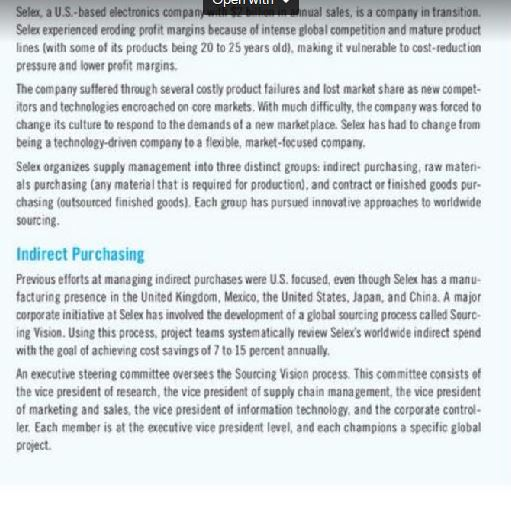
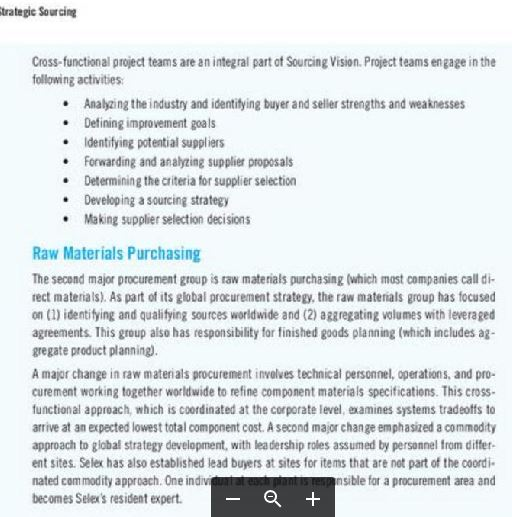
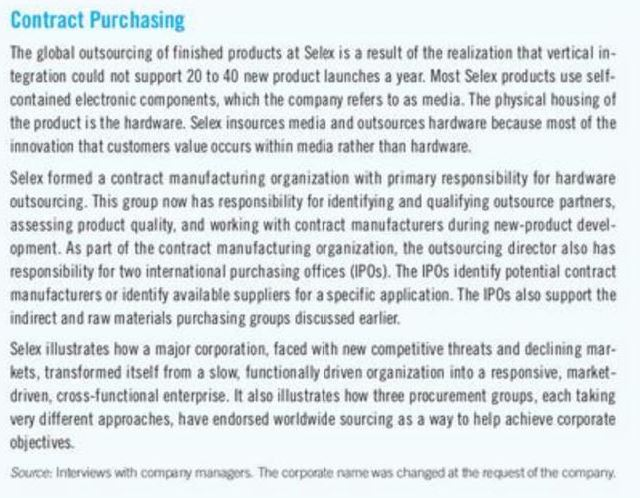
Selex, a U.S. -besed electronics company nual sales, is a company in transition. Selex experienced eroding profit margins because of intense global competition and mature product lines (with some of its products being 20 to 25 years old), making it vulnerable to cost-reduction pressure and lower profit margins. The company suffered through several costly product failures and lost market share as new compet- itors and technologies encroached on core markets. With much difficulty, the company was forced to change its culture to respond to the demands of a new market place. Selex has had to change from being a technology-driven company to a flexible, market-focused company, Selex organizes supply management into three distinct groups indirect purchasing, raw materi- als purchasing (any material that is required for production, and contract or finished goods pur- chasing (outsourced finished goods). Each group has pursued innovative approaches to worldwide sourcing. Indirect Purchasing Previous efforts al managing indirect purchases were US. focused, even though Selex has a manu- facturing presence in the United Kingdom, Mexico, the United States, Japan, and China. A major corporate initiative at Selex has involved the development of a global sourcing process called Sourc- ing Vision. Using this process, project teams systematically review Selex's worldwide indirect spend with the goal of achieving cost savings of 7 to 15 percent annually, An executive steering committee oversees the Sourcing Vision process. This committee consists of the vice president of research, the vice president of supply chain management, the vice president of marketing and sales, the vice president of information technology, and the corporate control- ler. Each member is at the executive vice president level, and each champions a specific global project Strategic Sourcing Cross-functional project teams are an integral part of Sourcing Vision. Project teams engage in the following activities Analyzing the industry and identifying buyer and seller strengths and weaknesses Defining improvement goals Identifying potential suppliers Forwarding and analyzing supplier proposals Determining the criteria for supplier selection Developing a sourcing strategy Making supplier selection decisions Raw Materials Purchasing The second major procurement group is raw materials purchasing (which must companies call di- rect materials). As part of its global procurement strategy, the raw materials group has focused on (1) identifying and qualifying sources worldwide and (2) aggregating volumes with leveraged agreements. This group also has responsibility for finished goods planning (which includes ag- gregate product planning) A major change in raw materials procurement involves technical personnel, operations, and pro- curement working together worldwide to refine component materials specifications. This cross- functional approach, which is coordinated at the corporate level examines systems tradeoffs to arrive at an expected lowest total component cost. A second major change emphasized a commodity approach to global strategy development, with leadership roles assumed by personnel from differ- ent sites. Selex has also established lead buyers at sites for items that are not part of the coordi- nated commodity approach. One individuta mis responsible for a procurement area and becomes Selex's resident expert Q + Contract Purchasing The global outsourcing of finished products at Selex is a result of the realization that vertical in- tegration could not support 20 to 40 new product launches a year. Most Selex products use self- contained electronic components, which the company refers to as media. The physical housing of the product is the hardware. Selex insources media and outsources hardware because most of the innovation that customers value occurs within media rather than hardware Selex formed a contract manufacturing organization with primary responsibility for hardware outsourcing. This group now has responsibility for identifying and qualifying outsource partners, assessing product quality, and working with contract manufacturers during new product devel- opment. As part of the contract manufacturing organization, the outsourcing director also has responsibility for two international purchasing offices (IPOs). The IPOs identify potential contract manufacturers or identify available suppliers for a specific application. The IPOs also support the indirect and raw materials purchasing groups discussed earlier. Selex illustrates how a major corporation, faced with new competitive threats and declining mar- kets, transformed itself from a slow, functionally driven organization into a responsive, market- driven, cross-functional enterprise. It also illustrates how three procurement groups, each taking very different approaches, have endorsed worldwide sourcing as a way to help achieve corporate objectives. Source: Interviews with company managers. The corporate name was changed at the request of the company Selex, a U.S. -besed electronics company nual sales, is a company in transition. Selex experienced eroding profit margins because of intense global competition and mature product lines (with some of its products being 20 to 25 years old), making it vulnerable to cost-reduction pressure and lower profit margins. The company suffered through several costly product failures and lost market share as new compet- itors and technologies encroached on core markets. With much difficulty, the company was forced to change its culture to respond to the demands of a new market place. Selex has had to change from being a technology-driven company to a flexible, market-focused company, Selex organizes supply management into three distinct groups indirect purchasing, raw materi- als purchasing (any material that is required for production, and contract or finished goods pur- chasing (outsourced finished goods). Each group has pursued innovative approaches to worldwide sourcing. Indirect Purchasing Previous efforts al managing indirect purchases were US. focused, even though Selex has a manu- facturing presence in the United Kingdom, Mexico, the United States, Japan, and China. A major corporate initiative at Selex has involved the development of a global sourcing process called Sourc- ing Vision. Using this process, project teams systematically review Selex's worldwide indirect spend with the goal of achieving cost savings of 7 to 15 percent annually, An executive steering committee oversees the Sourcing Vision process. This committee consists of the vice president of research, the vice president of supply chain management, the vice president of marketing and sales, the vice president of information technology, and the corporate control- ler. Each member is at the executive vice president level, and each champions a specific global project Strategic Sourcing Cross-functional project teams are an integral part of Sourcing Vision. Project teams engage in the following activities Analyzing the industry and identifying buyer and seller strengths and weaknesses Defining improvement goals Identifying potential suppliers Forwarding and analyzing supplier proposals Determining the criteria for supplier selection Developing a sourcing strategy Making supplier selection decisions Raw Materials Purchasing The second major procurement group is raw materials purchasing (which must companies call di- rect materials). As part of its global procurement strategy, the raw materials group has focused on (1) identifying and qualifying sources worldwide and (2) aggregating volumes with leveraged agreements. This group also has responsibility for finished goods planning (which includes ag- gregate product planning) A major change in raw materials procurement involves technical personnel, operations, and pro- curement working together worldwide to refine component materials specifications. This cross- functional approach, which is coordinated at the corporate level examines systems tradeoffs to arrive at an expected lowest total component cost. A second major change emphasized a commodity approach to global strategy development, with leadership roles assumed by personnel from differ- ent sites. Selex has also established lead buyers at sites for items that are not part of the coordi- nated commodity approach. One individuta mis responsible for a procurement area and becomes Selex's resident expert Q + Contract Purchasing The global outsourcing of finished products at Selex is a result of the realization that vertical in- tegration could not support 20 to 40 new product launches a year. Most Selex products use self- contained electronic components, which the company refers to as media. The physical housing of the product is the hardware. Selex insources media and outsources hardware because most of the innovation that customers value occurs within media rather than hardware Selex formed a contract manufacturing organization with primary responsibility for hardware outsourcing. This group now has responsibility for identifying and qualifying outsource partners, assessing product quality, and working with contract manufacturers during new product devel- opment. As part of the contract manufacturing organization, the outsourcing director also has responsibility for two international purchasing offices (IPOs). The IPOs identify potential contract manufacturers or identify available suppliers for a specific application. The IPOs also support the indirect and raw materials purchasing groups discussed earlier. Selex illustrates how a major corporation, faced with new competitive threats and declining mar- kets, transformed itself from a slow, functionally driven organization into a responsive, market- driven, cross-functional enterprise. It also illustrates how three procurement groups, each taking very different approaches, have endorsed worldwide sourcing as a way to help achieve corporate objectives. Source: Interviews with company managers. The corporate name was changed at the request of the company









 Study Help