







Question: CASE SUMMARY 2 2 . 5 State v . Yenzer, 1 9 5 P . 3 d 2 7 1 ( Kan . App. 2
CASE SUMMARY State v Yenzer, Pd Kan App.
EXCLUSIONARY RULE
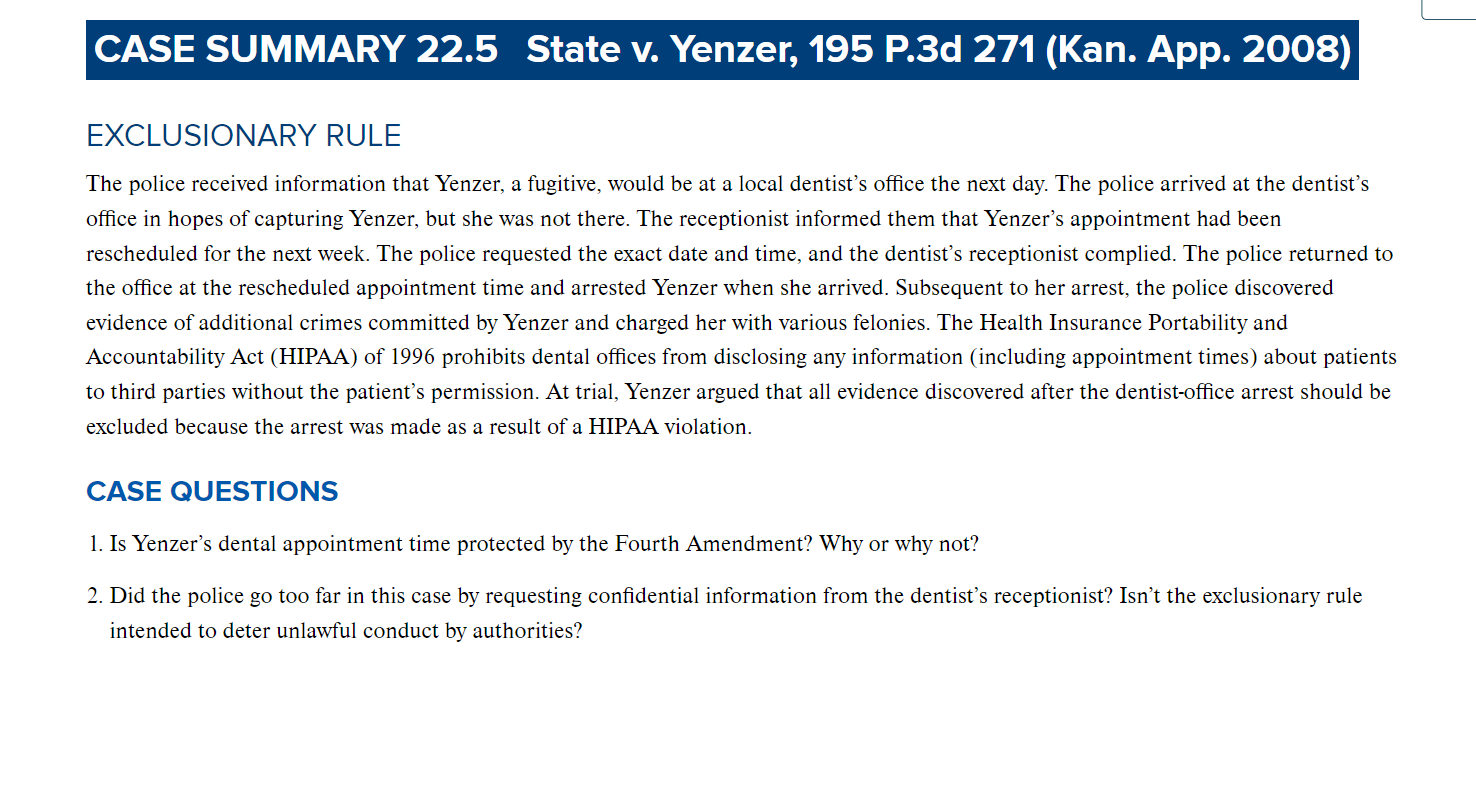
The police received information that Yenzer, a fugitive, would be at a local dentist's office the next day. The police arrived at the dentist's
office in hopes of capturing Yenzer, but she was not there. The receptionist informed them that Yenzer's appointment had been
rescheduled for the next week. The police requested the exact date and time, and the dentist's receptionist complied. The police returned to
the office at the rescheduled appointment time and arrested Yenzer when she arrived. Subsequent to her arrest, the police discovered
evidence of additional crimes committed by Yenzer and charged her with various felonies. The Health Insurance Portability and
Accountability Act HIPAA of prohibits dental offices from disclosing any information including appointment times about patients
to third parties without the patient's permission. At trial, Yenzer argued that all evidence discovered after the dentistoffice arrest should be
excluded because the arrest was made as a result of a HIPAA violation.
CASE QUESTIONS
Is Yenzer's dental appointment time protected by the Fourth Amendment? Why or why not?
Did the police go too far in this case by requesting confidential information from the dentist's receptionist? Isn't the exclusionary rule
intended to deter unlawful conduct by authorities?
Step by Step Solution
There are 3 Steps involved in it
1 Expert Approved Answer
Step: 1 Unlock

Question Has Been Solved by an Expert!
Get step-by-step solutions from verified subject matter experts
Step: 2 Unlock
Step: 3 Unlock
 Study Help