



Question: CASE TEXT & QUESTION PAPER A customer goes into a pharmacy complaining of hay fever (an allergy that is caused by pollen of dust) which
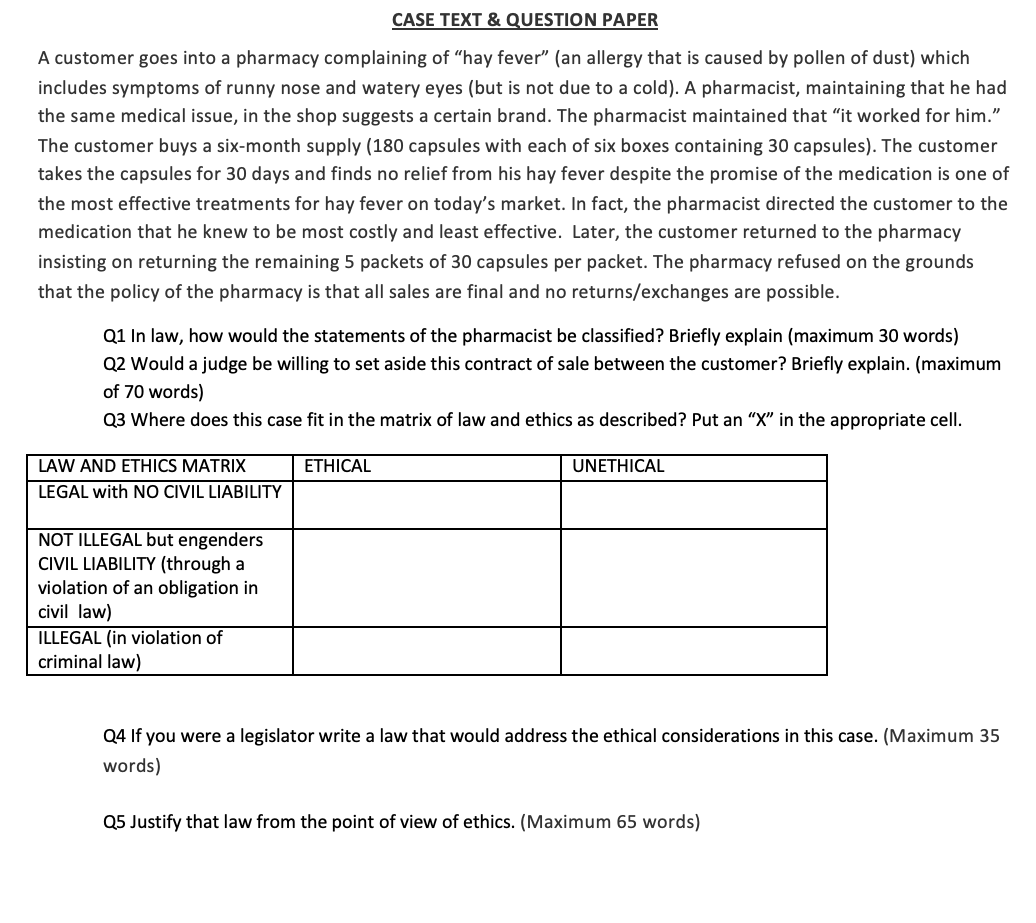
CASE TEXT & QUESTION PAPER A customer goes into a pharmacy complaining of hay fever (an allergy that is caused by pollen of dust) which includes symptoms of runny nose and watery eyes (but is not due to a cold). A pharmacist, maintaining that he had the same medical issue, in the shop suggests a certain brand. The pharmacist maintained that "it worked for him." The customer buys a six-month supply (180 capsules with each of six boxes containing 30 capsules). The customer takes the capsules for 30 days and finds no relief from his hay fever despite the promise of the medication is one of the most effective treatments for hay fever on today's market. In fact, the pharmacist directed the customer to the medication that he knew to be most costly and least effective. Later, the customer returned to the pharmacy insisting on returning the remaining 5 packets of 30 capsules per packet. The pharmacy refused on the grounds that the policy of the pharmacy is that all sales are final and no returns/exchanges are possible. Q1 In law, how would the statements of the pharmacist be classified? Briefly explain (maximum 30 words) Q2 Would a judge be willing to set aside this contract of sale between the customer? Briefly explain. (maximum of 70 words) Q3 Where does this case fit in the matrix of law and ethics as described? Put an X in the appropriate cell. ETHICAL UNETHICAL LAW AND ETHICS MATRIX LEGAL with NO CIVIL LIABILITY NOT ILLEGAL but engenders CIVIL LIABILITY (through a violation of an obligation in civil law) ILLEGAL (in violation of criminal law) Q4 If you were a legislator write a law that would address the ethical considerations in this case. (Maximum 35 words) Q5 Justify that law from the point of view of ethics. (Maximum 65 words) CASE TEXT & QUESTION PAPER A customer goes into a pharmacy complaining of hay fever (an allergy that is caused by pollen of dust) which includes symptoms of runny nose and watery eyes (but is not due to a cold). A pharmacist, maintaining that he had the same medical issue, in the shop suggests a certain brand. The pharmacist maintained that "it worked for him." The customer buys a six-month supply (180 capsules with each of six boxes containing 30 capsules). The customer takes the capsules for 30 days and finds no relief from his hay fever despite the promise of the medication is one of the most effective treatments for hay fever on today's market. In fact, the pharmacist directed the customer to the medication that he knew to be most costly and least effective. Later, the customer returned to the pharmacy insisting on returning the remaining 5 packets of 30 capsules per packet. The pharmacy refused on the grounds that the policy of the pharmacy is that all sales are final and no returns/exchanges are possible. Q1 In law, how would the statements of the pharmacist be classified? Briefly explain (maximum 30 words) Q2 Would a judge be willing to set aside this contract of sale between the customer? Briefly explain. (maximum of 70 words) Q3 Where does this case fit in the matrix of law and ethics as described? Put an X in the appropriate cell. ETHICAL UNETHICAL LAW AND ETHICS MATRIX LEGAL with NO CIVIL LIABILITY NOT ILLEGAL but engenders CIVIL LIABILITY (through a violation of an obligation in civil law) ILLEGAL (in violation of criminal law) Q4 If you were a legislator write a law that would address the ethical considerations in this case. (Maximum 35 words) Q5 Justify that law from the point of view of ethics. (Maximum 65 words)
Step by Step Solution
There are 3 Steps involved in it

Get step-by-step solutions from verified subject matter experts