



Question: Challenge 6 Design and optimize a microchannel heat exchanger for an electric vehicle (EV) charging station to efficiently transfer heat from the high-power electronics to
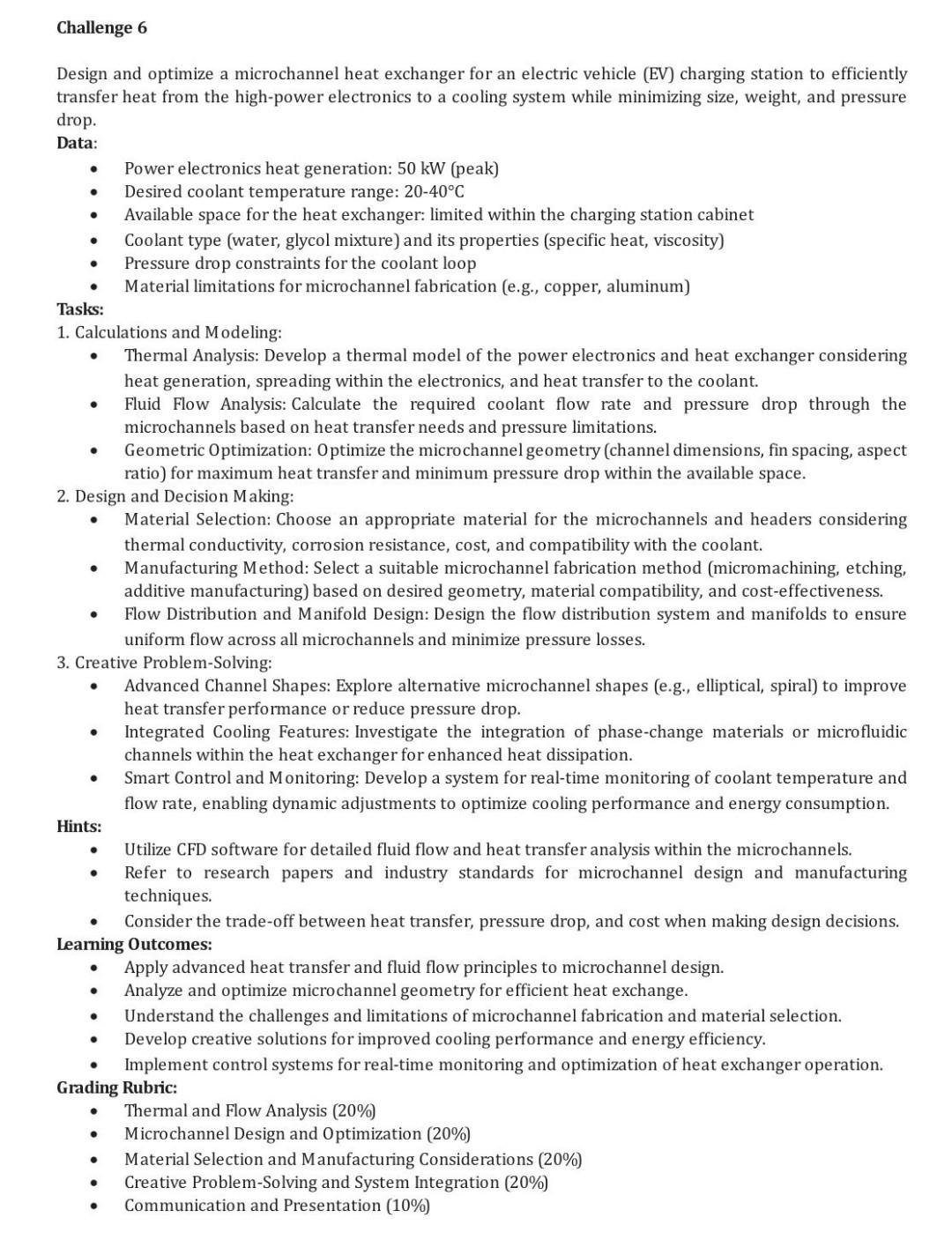
Challenge 6 Design and optimize a microchannel heat exchanger for an electric vehicle (EV) charging station to efficiently transfer heat from the high-power electronics to a cooling system while minimizing size, weight, and pressure drop. Data: - Power electronics heat generation: 50kW (peak) - Desired coolant temperature range: 2040C - Available space for the heat exchanger: limited within the charging station cabinet - Coolant type (water, glycol mixture) and its properties (specific heat, viscosity) - Pressure drop constraints for the coolant loop - Material limitations for microchannel fabrication (e.g., copper, aluminum) Tasks: 1. Calculations and Modeling: - Thermal Analysis: Develop a thermal model of the power electronics and heat exchanger considering heat generation, spreading within the electronics, and heat transfer to the coolant. - Fluid Flow Analysis: Calculate the required coolant flow rate and pressure drop through the microchannels based on heat transfer needs and pressure limitations. - Geometric Optimization: Optimize the microchannel geometry (channel dimensions, fin spacing, aspect ratio) for maximum heat transfer and minimum pressure drop within the available space. 2. Design and Decision Making: - Material Selection: Choose an appropriate material for the microchannels and headers considering thermal conductivity, corrosion resistance, cost, and compatibility with the coolant. - Manufacturing Method: Select a suitable microchannel fabrication method (micromachining, etching, additive manufacturing) based on desired geometry, material compatibility, and cost-effectiveness. - Flow Distribution and Manifold Design: Design the flow distribution system and manifolds to ensure uniform flow across all microchannels and minimize pressure losses. 3. Creative Problem-Solving: - Advanced Channel Shapes: Explore alternative microchannel shapes (e.g., elliptical, spiral) to improve heat transfer performance or reduce pressure drop. - Integrated Cooling Features: Investigate the integration of phase-change materials or microfluidic channels within the heat exchanger for enhanced heat dissipation. - Smart Control and Monitoring: Develop a system for real-time monitoring of coolant temperature and flow rate, enabling dynamic adjustments to optimize cooling performance and energy consumption. Hints: - Utilize CFD software for detailed fluid flow and heat transfer analysis within the microchannels. - Refer to research papers and industry standards for microchannel design and manufacturing techniques. - Consider the trade-off between heat transfer, pressure drop, and cost when making design decisions. Learning Outcomes: - Apply advanced heat transfer and fluid flow principles to microchannel design. - Analyze and optimize microchannel geometry for efficient heat exchange. - Understand the challenges and limitations of microchannel fabrication and material selection. - Develop creative solutions for improved cooling performance and energy efficiency. - Implement control systems for real-time monitoring and optimization of heat exchanger operation. Grading Rubric: - Thermal and Flow Analysis (20\%) - Microchannel Design and Optimization (20\%) - Material Selection and Manufacturing Considerations (20\%) - Creative Problem-Solving and System Integration (20\%) - Communication and Presentation (10\%)
Step by Step Solution
There are 3 Steps involved in it

Get step-by-step solutions from verified subject matter experts