Question: Chapter 1 1. How do companies like Walmart use one-way, circular, and/or transaction communication? What specific advice would you give Walmart executives to improve their
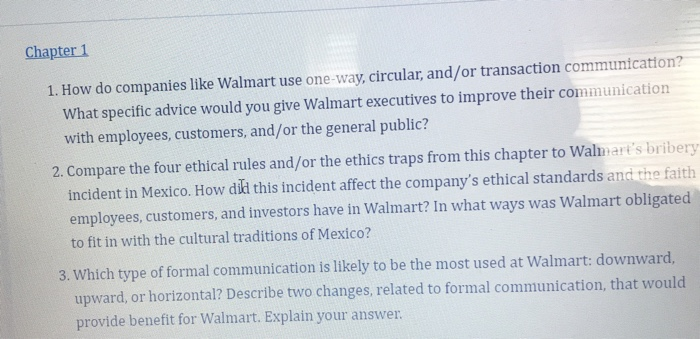
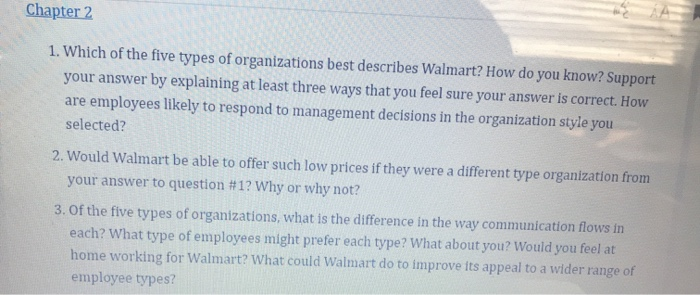
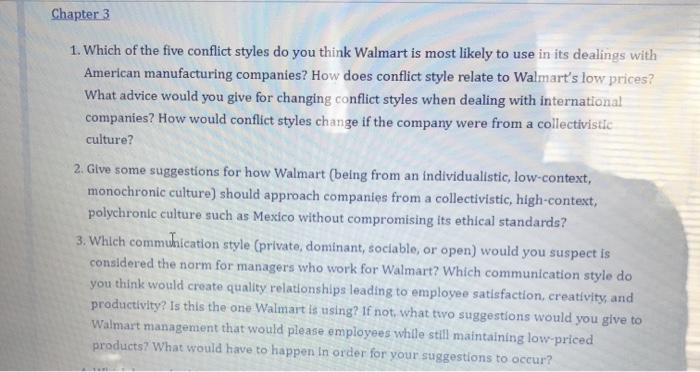
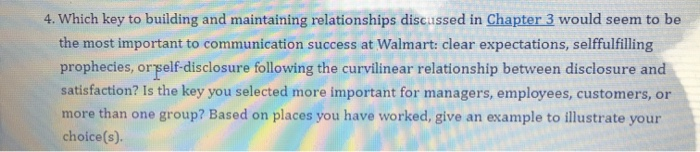
Chapter 1 1. How do companies like Walmart use one-way, circular, and/or transaction communication? What specific advice would you give Walmart executives to improve their communication with employees, customers, and/or the general public? 2. Compare the four ethical rules and/or the ethics traps from this chapter to Walmart's bribery incident in Mexico. How did this incident affect the company's ethical standards and the faith employees, customers, and investors have in Walmart? In what ways was Walmart obligated to fit in with the cultural traditions of Mexico? 3. Which type of formal communication is likely to be the most used at Walmart: downward, upward, or horizontal? Describe two changes, related to formal communication, that would provide benefit for Walmart. Explain your answer. Chapter 2 1. Which of the five types of organizations best describes Walmart? How do you know? Support your answer by explaining at least three ways that you feel sure your answer is correct. How are employees likely to respond to management decisions in the organization style you selected? 2. Would Walmart be able to offer such low prices if they were a different type organization from your answer to question #1? Why or why not? 3. Of the five types of organizations, what is the difference in the way communication flows in each? What type of employees might prefer each type? What about you? Would you feel at home working for Walmart? What could Walmart do to improve its appeal to a wider range of employee types? Chapter 3 1. Which of the five conflict styles do you think Walmart is most likely to use in its dealings with American manufacturing companies? How does conflict style relate to Walmart's low prices? What advice would you give for changing conflict styles when dealing with international companies? How would conflict styles change if the company were from a collectivistic culture? 2. Give some suggestions for how Walmart (being from an individualistic, low-context, monochronic culture) should approach companies from a collectivistic, high-context, polychronic culture such as Mexico without compromising its ethical standards? 3. Which communication style (private, dominant, sociable, or open) would you suspect is considered the norm for managers who work for Walmart? Which communication style do you think would create quality relationships leading to employee satisfaction, creativity, and productivity? Is this the one Walmart is using? If not, what two suggestions would you give to Walmart management that would please employees while still maintaining low-priced products? What would have to happen in order for your suggestions to occur? 4. Which key to building and maintaining relationships discussed in Chapter 3 would seem to be the most important to communication success at Walmart: clear expectations, selffulfilling prophecies, or self-disclosure following the curvilinear relationship between disclosure and satisfaction? Is the key you selected more important for managers, employees, customers, or more than one group? Based on places you have worked, give an example to illustrate your choice(s)









 Study Help