





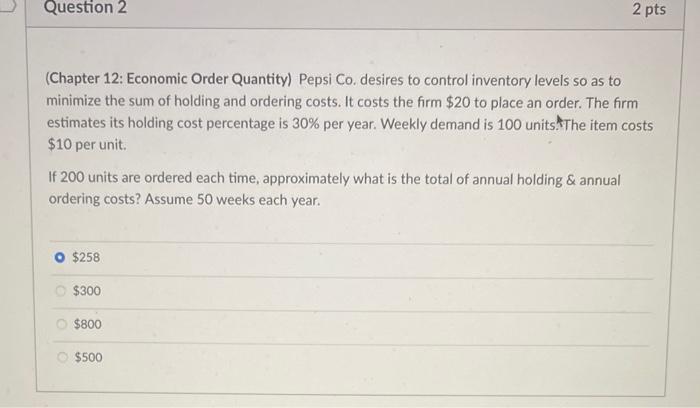
Question: (Chapter 12: Economic Order Quantity) Pepsi Co. desires to control inventory levels so as to minimize the sum of holding and ordering costs. It costs
(Chapter 12: Economic Order Quantity) Pepsi Co.
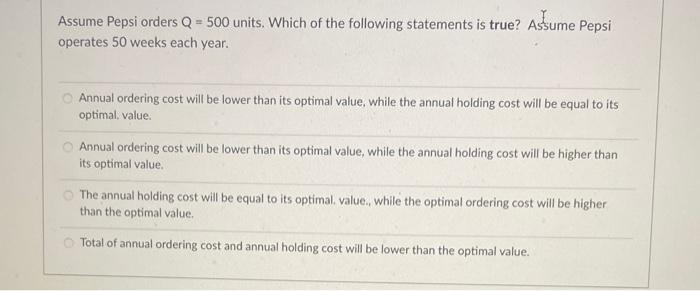
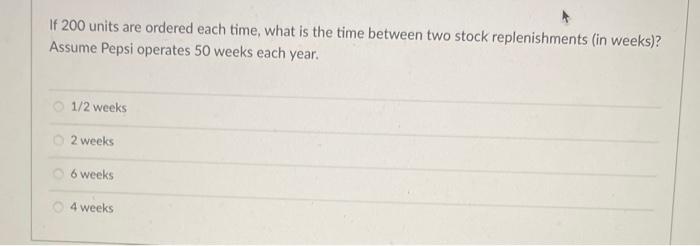
(Chapter 12: Economic Order Quantity) Pepsi Co. desires to control inventory levels so as to minimize the sum of holding and ordering costs. It costs the firm $20 to place an order. The firm estimates its holding cost percentage is 30% per year. Weekly demand is 100 units. The item costs $10 per unit. If 200 units are ordered each time, approximately what is the total of annual holding \& annual ordering costs? Assume 50 weeks each year. $258 $300 $800 $500 Assume Pepsi orders Q=500 units. Which of the following statements is true? Assume Pepsi operates 50 weeks each year. Annual ordering cost will be lower than its optimal value, while the annual holding cost will be equal to its optimal, value. Annual ordering cost will be lower than its optimal value, while the annual holding cost will be higher than its optimal value. The annual holding cost will be equal to its optimal, value., while the optimal ordering cost will be higher than the optimal value. Total of annual ordering cost and annual holding cost will be lower than the optimal value. If 200 units are ordered each time, what is the time between two stock replenishments (in weeks)? Assume Pepsi operates 50 weeks each year. 1/2 weeks 2 weeks 6 weeks 4 weeks
Step by Step Solution

There are 3 Steps involved in it

1 Expert Approved Answer
Step: 1 Unlock blur-text-image

Question Has Been Solved by an Expert!

Get step-by-step solutions from verified subject matter experts

Step: 2 Unlock
Step: 3 Unlock

Students Have Also Explored These Related General Management Questions!