Question: Chapter 12 presents a number of quantitatively based methods for creating forecasts. However, another important aspect of forecasting is the use of qualitative methods as

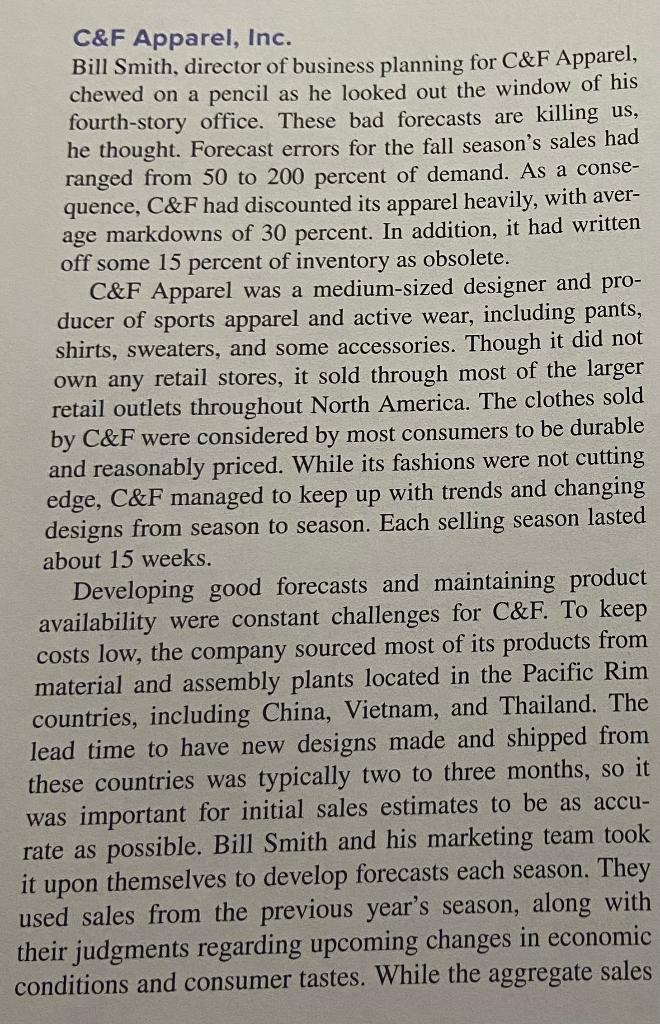
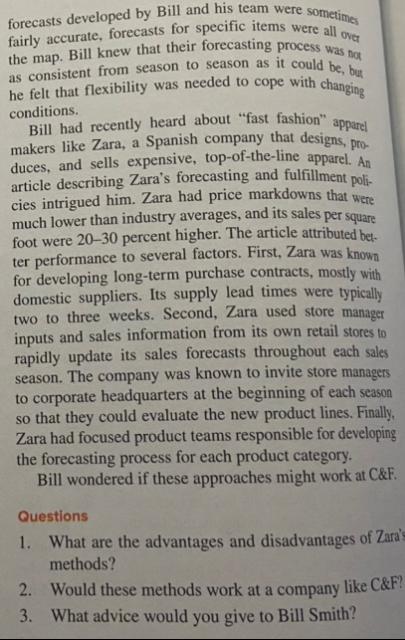
Chapter 12 presents a number of quantitatively based methods for creating forecasts. However, another important aspect of forecasting is the use of qualitative methods as well as understanding demand characteristics well enough to select the proper quantitative method. This case is to get you thinking about when and why to use the various methods. Read the case at the end of chapter 12 on page 450 "C&F Apparel, Inc." Review the end of case questions and post your responses to the following prompts: What are the key differences between the markets served by Bill at C&F and those of Zara? What changes to the supply chain would you recommend to Bill and why? C&F Apparel, Inc. Bill Smith, director of business planning for C&F Apparel, chewed on a pencil as he looked out the window of his fourth-story office. These bad forecasts are killing us, he thought. Forecast errors for the fall season's sales had ranged from 50 to 200 percent of demand. As a conse- quence, C&F had discounted its apparel heavily, with aver- age markdowns of 30 percent. In addition, it had written off some 15 percent of inventory as obsolete. C&F Apparel was a medium-sized designer and pro- ducer of sports apparel and active wear, including pants, shirts, sweaters, and some accessories. Though it did not own any retail stores, it sold through most of the larger retail outlets throughout North America. The clothes sold by C&F were considered by most consumers to be durable and reasonably priced. While its fashions were not cutting edge, C&F managed to keep up with trends and changing designs from season to season. Each selling season lasted about 15 weeks. Developing good forecasts and maintaining product availability were constant challenges for C&F. To keep costs low, the company sourced most of its products from material and assembly plants located in the Pacific Rim countries, including China, Vietnam, and Thailand. The lead time to have new designs made and shipped from these countries was typically two to three months, so it was important for initial sales estimates to be as accu- rate as possible. Bill Smith and his marketing team took it upon themselves to develop forecasts each season. They used sales from the previous year's season, along with their judgments regarding upcoming changes in economic conditions and consumer tastes. While the aggregate sales fairly accurate, forecasts for specific items were all over forecasts developed by Bill and his team were sometimes the map. Bill knew that their forecasting process was to as consistent from season to season as it could be, but he felt that flexibility was needed to cope with changing conditions. makers like Zara, a Spanish company that designs, pro- Bill had recently heard about "fast fashion apparel duces, and sells expensive, top-of-the-line apparel. An article describing Zara's forecasting and fulfillment poli- cies intrigued him. Zara had price markdowns that were much lower than industry averages, and its sales per square foot were 20-30 percent higher. The article attributed bet- ter performance to several factors. First, Zara was known for developing long-term purchase contracts, mostly with domestic suppliers. Its supply lead times were typically two to three weeks. Second, Zara used store manager inputs and sales information from its own retail stores to rapidly update its sales forecasts throughout each sales season. The company was known to invite store managers to corporate headquarters at the beginning of each season so that they could evaluate the new product lines. Finally, Zara had focused product teams responsible for developing the forecasting process for each product category. Bill wondered if these approaches might work at C&F. Questions 1. What are the advantages and disadvantages of Zara= methods? 2. Would these methods work at a company like C&F? 3. What advice would you give to Bill Smith









 Study Help