







Question: Chapter 13, Problem 8P Bookmark Show all steps: ON Problem An early proposal for a digital signature scheme using symmetric encryption is based on the
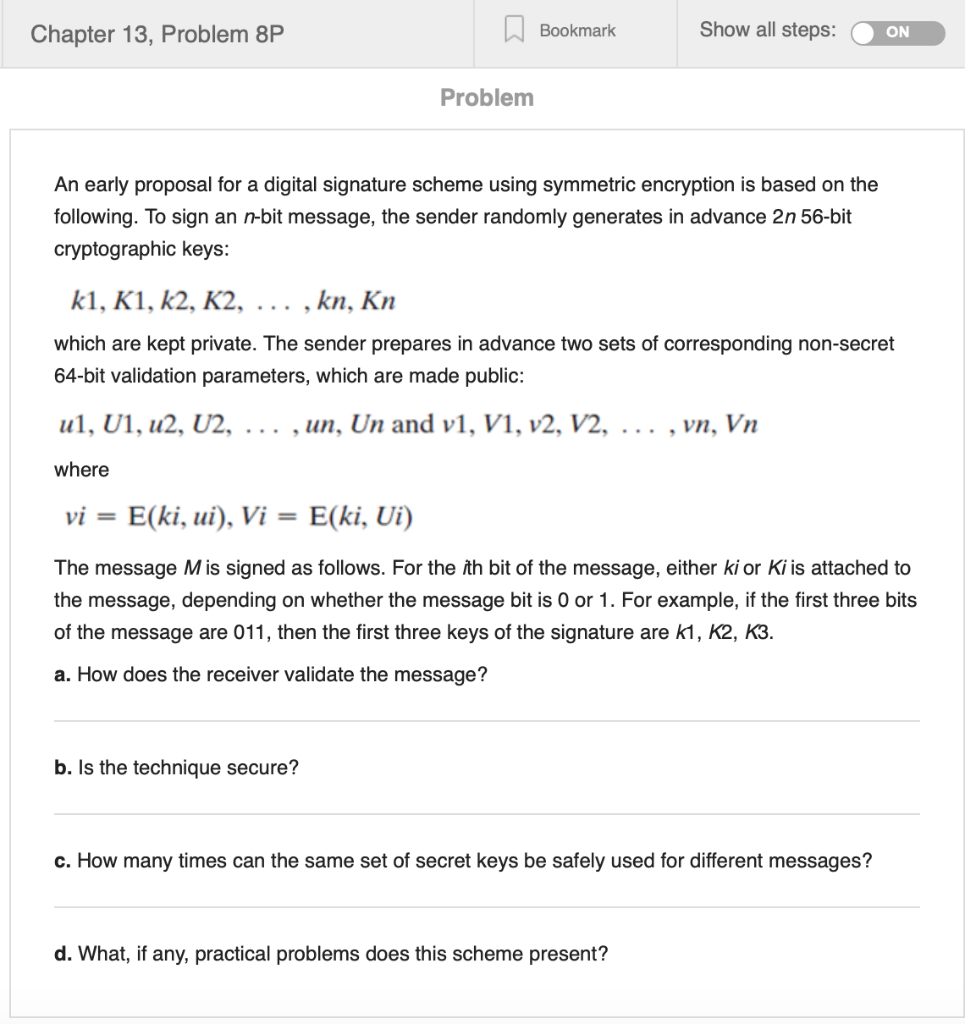
Chapter 13, Problem 8P Bookmark Show all steps: ON Problem An early proposal for a digital signature scheme using symmetric encryption is based on the following. To sign an n-bit message, the sender randomly generates in advance 2n 56-bit cryptographic keys: k1, K1, K2, K2, ... , kn, Kn which are kept private. The sender prepares in advance two sets of corresponding non-secret 64-bit validation parameters, which are made public: u1, U1, u2, U2, ... , un, Un and v1, V1, V2, V2, ..., vn, Vn where vi = E(ki, ui), Vi = E(ki, Ui) The message Mis signed as follows. For the ith bit of the message, either ki or Ki is attached to the message, depending on whether the message bit is 0 or 1. For example, if the first three bits of the message are 011, then the first three keys of the signature are k1, K2, K3. a. How does the receiver validate the message? b. Is the technique secure? c. How many times can the same set of secret keys be safely used for different messages? d. What, if any, practical problems does this scheme present
Step by Step Solution
There are 3 Steps involved in it

Get step-by-step solutions from verified subject matter experts
 Study Help