







Question: Chapter 16 Comprehensive Problem - Due Mar 3, 2020 9:30 am On January 1, 2016, Sheffield Company issued 10-year, $106,000 face value, 6% bonds at
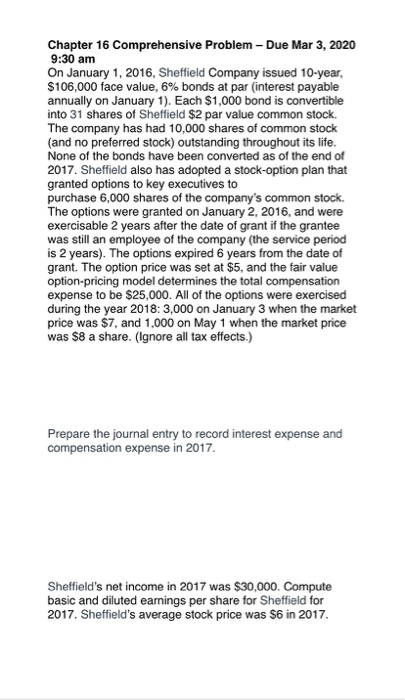
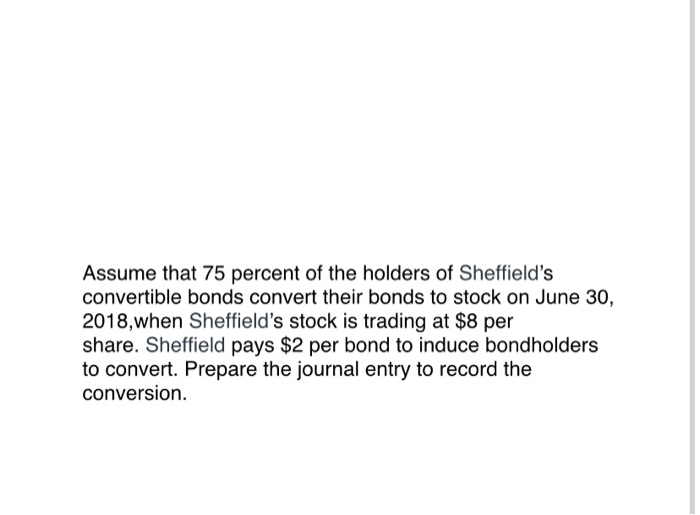
Chapter 16 Comprehensive Problem - Due Mar 3, 2020 9:30 am On January 1, 2016, Sheffield Company issued 10-year, $106,000 face value, 6% bonds at par interest payable annually on January 1). Each $1,000 bond is convertible into 31 shares of Sheffield $2 par value common stock The company has had 10,000 shares of common stock (and no preferred stock) outstanding throughout its life. None of the bonds have been converted as of the end of 2017. Sheffield also has adopted a stock-option plan that granted options to key executives to purchase 6,000 shares of the company's common stock. The options were granted on January 2, 2016, and were exercisable 2 years after the date of grant if the grantee was still an employee of the company (the service period is 2 years). The options expired 6 years from the date of grant. The option price was set at $5, and the fair value option-pricing model determines the total compensation expense to be $25,000. All of the options were exercised during the year 2018: 3,000 on January 3 when the market price was $7, and 1,000 on May 1 when the market price was $8 a share. (Ignore all tax effects.) Prepare the journal entry to record interest expense and compensation expense in 2017. Sheffield's net income in 2017 was $30,000. Compute basic and diluted earnings per share for Sheffield for 2017. Sheffield's average stock price was $6 in 2017. Assume that 75 percent of the holders of Sheffield's convertible bonds convert their bonds to stock on June 30, 2018,when Sheffield's stock is trading at $8 per share. Sheffield pays $2 per bond to induce bondholders to convert. Prepare the journal entry to record the conversion
Step by Step Solution
There are 3 Steps involved in it

Get step-by-step solutions from verified subject matter experts
 Study Help