Question: CHAPTER 5 | HOW BRAND COMMUNIC A deeper meaning was the product comparison hinted at through Big Brother, who could be inter- preted as representing
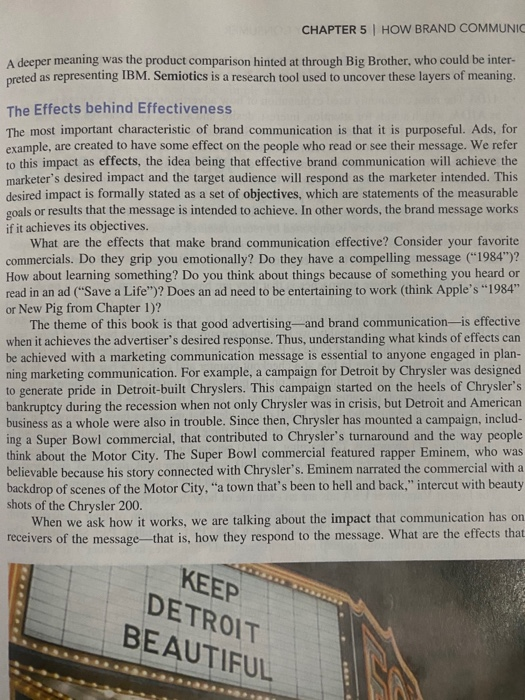
CHAPTER 5 | HOW BRAND COMMUNIC A deeper meaning was the product comparison hinted at through Big Brother, who could be inter- preted as representing IBM. Semiotics is a research tool used to uncover these layers of meaning. The Effects behind Effectiveness The most important characteristic of brand communication is that it is purposeful. Ads, for example, are created to have some effect on the people who read or see their message. We refer to this impact as effects, the idea being that effective brand communication will achieve the marketer's desired impact and the target audience will respond as the marketer intended. This desired impact is formally stated as a set of objectives, which are statements of the measurable goals or results that the message is intended to achieve. In other words, the brand message works if it achieves its objectives. What are the effects that make brand communication effective? Consider your favorite commercials. Do they grip you emotionally? Do they have a compelling message ("1984")? How about learning something? Do you think about things because of something you heard or read in an ad ("Save a Life")? Does an ad need to be entertaining to work (think Apple's "1984" or New Pig from Chapter 1)? The theme of this book is that good advertising-and brand communication is effective when it achieves the advertiser's desired response. Thus, understanding what kinds of effects can be achieved with a marketing communication message is essential to anyone engaged in plan- ning marketing communication. For example, a campaign for Detroit by Chrysler was designed to generate pride in Detroit-built Chryslers. This campaign started on the heels of Chrysler's bankruptcy during the recession when not only Chrysler was in crisis, but Detroit and American business as a whole were also in trouble. Since then, Chrysler has mounted a campaign, includ- ing a Super Bowl commercial, that contributed Chrysler's turnaround and the way people think about the Motor City. The Super Bowl commercial featured rapper Eminem, who was believable because his story connected with Chrysler's. Eminem narrated the commercial with a backdrop of scenes of the Motor City, "a town that's been to hell and back," intercut with beauty shots of the Chrysler 200. When we ask how it works, we are talking about the impact that communication has on receivers of the message that is, how they respond to the message. What are the effects that KEEP DETROIT BEAUTIFUL determine whether an advertisement works? Here are two of the traditional approaches by PRINCIPLE: BE TRUE TO THY BRAND_AND THY CONSUMER professionals to outline the impact of advertising. AIDA The most commonly used explanation of how advertising works is referred to as AIDA, which stands for attention, interest, desire, and action. This concept was first expressed around 1900 by advertising pioneer St. Elmo Lewis. Because AIDA assume predictable set of steps, it also is referred to as a hierarchy of effects model. Think/Feel/Do Another relatively simple answer to how advertising works is the think/feed do model developed in the 1970s. Also referred to as the FCB model in honor of the agency where it was developed as a strategic planning tool, the idea is that advertising motivates peon ple to think about the message, feel something about the brand, and then do something, such as try it or buy it. This view is supported by recent research by Gergely Nyilasy and Leonard Reid, whose in-depth interviews found that "agency practitioners strongly believe that expo- sure to ads causes changes in human cognition, emotions, and behavior"-or think/feel/do. 11 One problem with these approaches is that they are based on the concepts of a predictable process that consumers go through in making decisions, beginning with exposure to a brand message. The assumption is that consumers are engaged in systematic processing of information before they make a purchase. In reality, we know that consumers sometimes buy out of habit, such as people who are loyal drinkers of Coke or Pepsi. In other situations, consumers buy on impulse. such as when you are standing in line at a checkout counter and pick up a bar of candy. In both situations, you buy first and then think back on the purchase, if you give it any thought at all. A different approach that attempts to eliminate the idea of predictable linear steps is found in Sandra Moriarty's domains model. It is based on the idea that messages have an impact on con- sumer responses, not in steps but at the same time. The three key effects, or domains, identified in this approach are (1) awareness, (2) learning, and (3) persuasion. The idea is that a message can engage consumers' perceptions (attention and interest), engage their thinking (learn), and persuade them (change attitude and behavior), and to some degree, all that occurs all at the same time." The Port of Vancouver USA ads are an example of how these effects interact. Even though the ads are in the business-to-business category, they get the attention of their audience with curiosity-provoking headlines: the "Vacancy" sign and "Part Specialist, Part Shepherd." The vacancy" ad uses explanation to help readers understand ("858 acres to be exact"). It's also per suasive in that it makes the argument that the Port of Vancouver has room to grow and provide A different approach to analyzing what works in brand communication is presented in space to meet the needs of its customers. J. Scott Armstrong's Persuasive Advertising, which identifies a set of 194 principles based on research findings over the years. Armstrong has reduced these principles to four categories that drive strategies, information, influence, emotion, and exposure. Other sets of categories describe tactics and media uses. How do we make sense of all these ideas about how brand communication works? One goal of this book is to organize these effects so that they are useful for setting objectives 13 5-14. Mini-Case Analysis: We discussed some aspects of the "Imported from Detroit" campaign for the Chrysler turnaround in the chapter. Briefly summarize the key decisions behind this campaign. Now apply the Facets Model of Effects to analyze how the campaign worked and explain your conclusions about what did or didn't make it an effective campaign. Write a short analysis (10 more than one double-spaced page) that explains your thinking









 Study Help