







Question: Chapter 7 - Interpersonal Behavior in the Workplace Conflict, Cooperation. Trust, and Draimee 203 Making the Case for... Interpersonal Behavior in the Workplace NASCAR: The
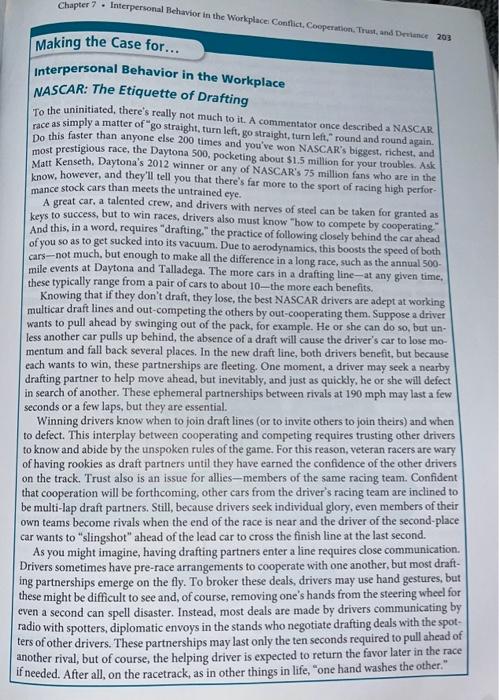
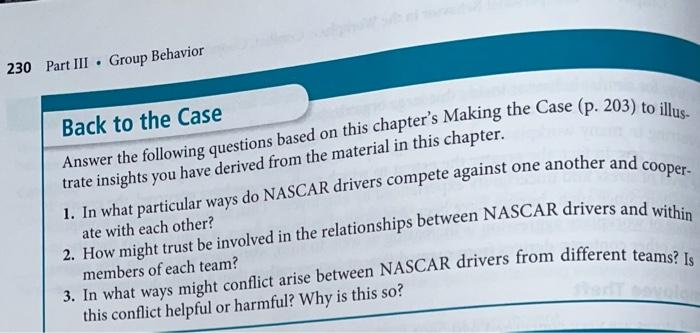
Chapter 7 - Interpersonal Behavior in the Workplace Conflict, Cooperation. Trust, and Draimee 203 Making the Case for... Interpersonal Behavior in the Workplace NASCAR: The Etiquette of Drafting To the uninitiated, there's really not much to it. A commentator once described a NASCAR race as simply a matter of "go straight, turn left, go straight, turn left," round and round again. Do this faster than anyone else 200 times and you've won NASCAR's biggest, richest, and most prestigious race, the Daytona 500 , pocketing about $1.5 million for your troubles. Ask Matt Kenseth, Daytona's 2012 winner or any of NASCAR's 75 million fans who are in the know, however, and they'll tell you that there's far more to the sport of racing high performance stock cars than meets the untrained eye. A great car, a talented crew, and drivers with nerves of steel can be taken for granted as keys to success, but to win races, drivers also must know "how to compete by cooperating" And this, in a word, requires "drafting." the practice of following closely behind the car ahead of you so as to get sucked into its vacuum. Due to aerodynamics, this boosts the speed of both cars-not much, but enough to make all the difference in a long race, such as the annual 500 mile events at Daytona and Talladega. The more cars in a drafting line-at any given time, these typically range from a pair of cars to about 10 -the more each benefits. Knowing that if they don't draft, they lose, the best NASCAR drivers are adept at working multicar draft lines and out-competing the others by out-cooperating them. Suppose a driver wants to pull ahead by swinging out of the pack, for example. He or she can do so, but unless another car pulls up behind, the absence of a draft will cause the driver's car to lose momentum and fall back several places. In the new draft line, both drivers benefit, but because each wants to win, these partnerships are fleeting. One moment, a driver may seek a nearby drafting partner to help move ahead, but inevitably, and just as quickly, he or she will defect in search of another. These ephemeral partnerships between rivals at 190 mph may last a few seconds or a few laps, but they are essential. Winning drivers know when to join draft lines (or to invite others to join theirs) and when to defect. This interplay between cooperating and competing requires trusting other drivers to know and abide by the unspoken rules of the game. For this reason, veteran racers are wary of having rookies as draft partners until they have earned the confidence of the other drivers on the track. Trust also is an issue for allies-members of the same racing team. Confident that cooperation will be forthcoming, other cars from the driver's racing team are inclined to be multi-lap draft partners. Still, because drivers seek individual glory, even members of their own teams become rivals when the end of the race is near and the driver of the second-place car wants to "slingshot" ahead of the lead car to cross the finish line at the last second. As you might imagine, having drafting partners enter a line requires close communication. Drivers sometimes have pre-race arrangements to cooperate with one another, but most drafting partnerships emerge on the fly. To broker these deals, drivers may use hand gestures, but these might be difficult to see and, of course, removing one's hands from the steering wheel for even a second can spell disaster. Instead, most deals are made by drivers communicating by adio with spotters, diplomatic envoys in the stands who negotiate drafting deals with the spoters of other drivers. These partnerships may last only the ten seconds required to pull ahead ot inother rival, but of course, the helping driver is expected to return the favor later in the race needed. After all, on the racetrack, as in other things in life, "one hand washes the other." Answer the following questions based on this chapter's Making the Case (p. 203) to illus- Back to the Case trate insights you have derived from the material in this chapter. 1. In what particular ways do NASCAR drivers compete against one another and cooper- 2. How might trust be involved in the relationships between NASCAR drivers and within ate with each other? 3. In what ways might conflict arise between NASCAR drivers from different teams? Is members of each team? this conflict helpful or harmful? Why is this so
Step by Step Solution
There are 3 Steps involved in it

Get step-by-step solutions from verified subject matter experts
 Study Help