







Question: Chemical Formulas and the Mole Concept - Study Guide sections 3.8, 3.9 and 3.10 in the textbook Molar Mass (section 3.7) The molar mass of
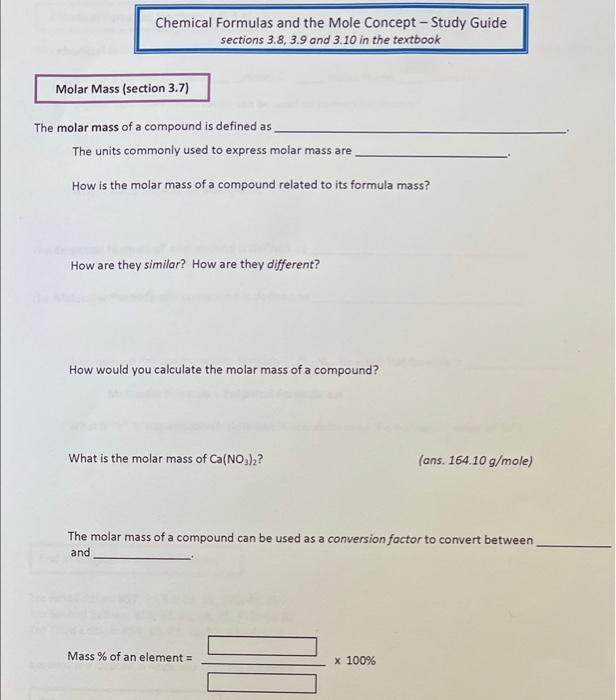
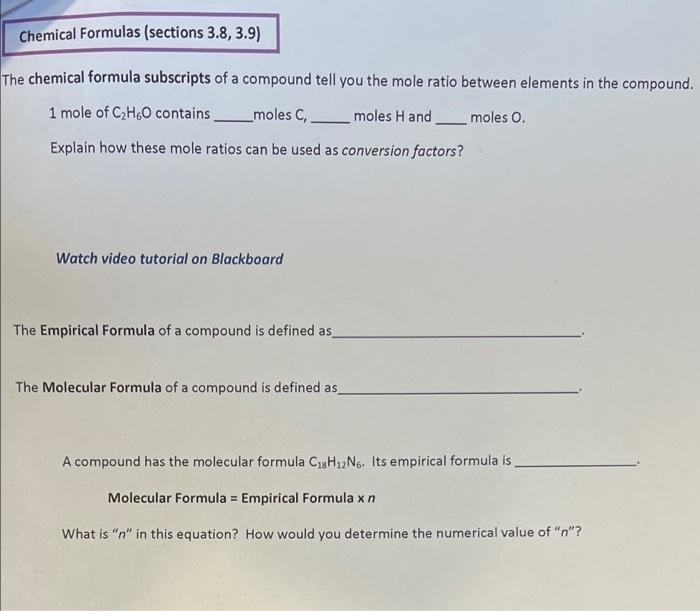
Chemical Formulas and the Mole Concept - Study Guide sections 3.8, 3.9 and 3.10 in the textbook Molar Mass (section 3.7) The molar mass of a compound is defined as The units commonly used to express molar mass are How is the molar mass of a compound related to its formula mass? How are they similar? How are they different? How would you calculate the molar mass of a compound? What is the molar mass of Ca(NO3),? (ans. 164.10 g/mole) The molar mass of a compound can be used as a conversion factor to convert between and Mass % of an element = x 100% Chemical Formulas (sections 3.8, 3.9) The chemical formula subscripts of a compound tell you the mole ratio between elements in the compound. 1 mole of C2H60 contains _moles C, moles Hand moles O. Explain how these mole ratios can be used as conversion factors? Watch video tutorial on Blackboard The Empirical Formula of a compound is defined as The Molecular Formula of a compound is defined as A compound has the molecular formula C18H12N6. Its empirical formula is Molecular Formula = Empirical Formula xn What is "n" in this equation? How would you determine the numerical value of "n
Step by Step Solution
There are 3 Steps involved in it

Get step-by-step solutions from verified subject matter experts
 Study Help