







Question: Chemical Reactor Engineering. Please solve step by step. No ChatGPT answers, please. Much appreciated A palladium based monolith reactor is employed for the catalytic oxidation
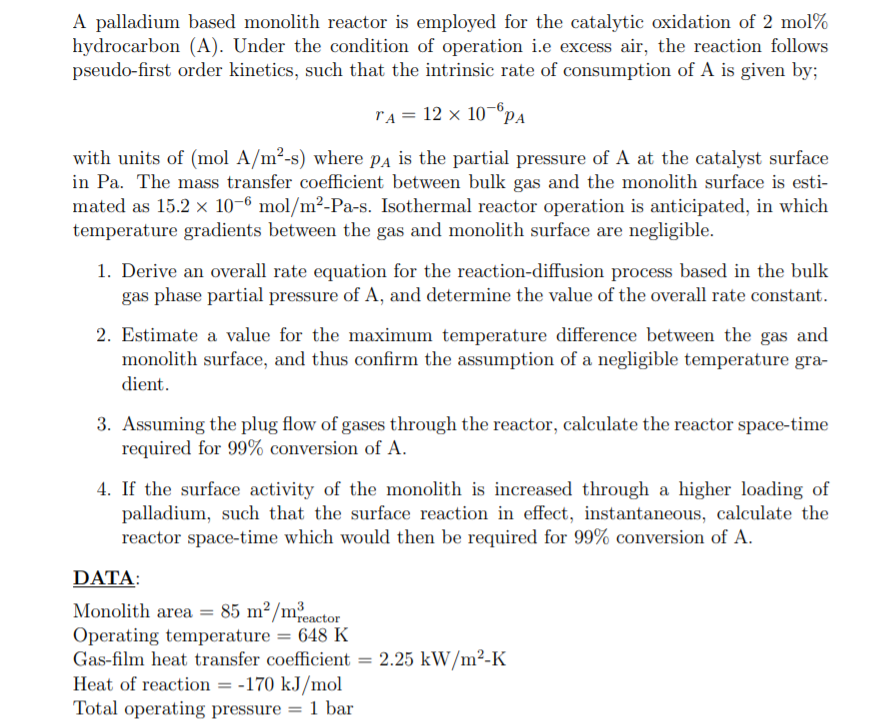 Chemical Reactor Engineering. Please solve step by step. No ChatGPT answers, please. Much appreciated
A palladium based monolith reactor is employed for the catalytic oxidation of 2mol% hydrocarbon (A). Under the condition of operation i.e excess air, the reaction follows pseudo-first order kinetics, such that the intrinsic rate of consumption of A is given by; rA=12106pA with units of (molA/m2s) where pA is the partial pressure of A at the catalyst surface in Pa. The mass transfer coefficient between bulk gas and the monolith surface is estimated as 15.2106mol/m2-Pa-s. Isothermal reactor operation is anticipated, in which temperature gradients between the gas and monolith surface are negligible. 1. Derive an overall rate equation for the reaction-diffusion process based in the bulk gas phase partial pressure of A, and determine the value of the overall rate constant. 2. Estimate a value for the maximum temperature difference between the gas and monolith surface, and thus confirm the assumption of a negligible temperature gradient. 3. Assuming the plug flow of gases through the reactor, calculate the reactor space-time required for 99% conversion of A. 4. If the surface activity of the monolith is increased through a higher loading of palladium, such that the surface reaction in effect, instantaneous, calculate the reactor space-time which would then be required for 99% conversion of A. DATA: Monolith area =85m2/mreactor3 Operating temperature =648K Gas-film heat transfer coefficient =2.25kW/m2K
Step by Step Solution
There are 3 Steps involved in it

Get step-by-step solutions from verified subject matter experts
 Study Help