







Question: Chief executives with multi-milliondollar pay packets are not necessarily working in the best interests of shareholders and there may be a case to cap their
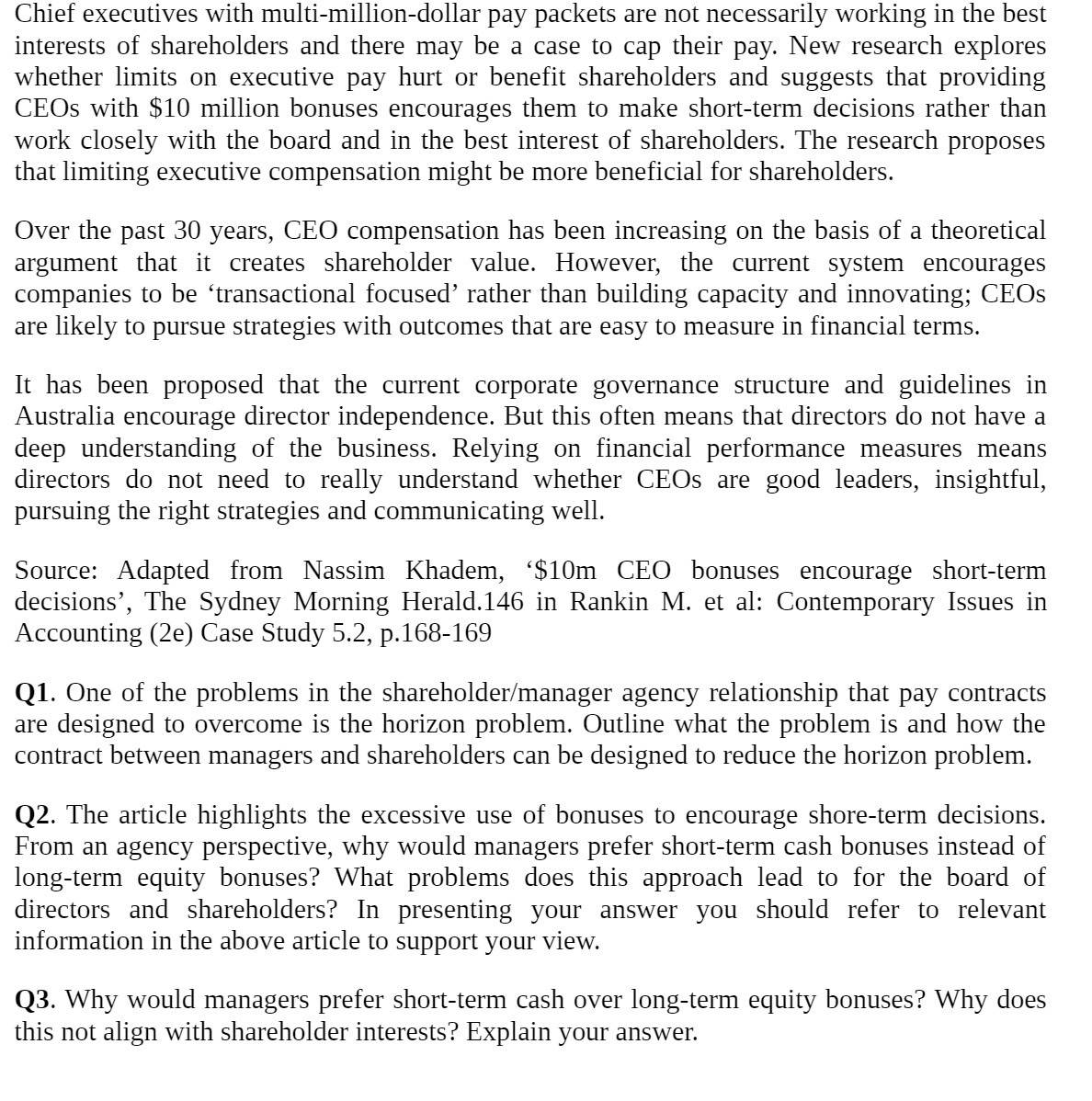
Chief executives with multi-milliondollar pay packets are not necessarily working in the best interests of shareholders and there may be a case to cap their pay. New research explores whether limits on executive pay hurt or benefit shareholders and suggests that providing CEOs with $10 million bonuses encourages them to make shortterm decisions rather than work closely with the board and in the best interest of shareholders. The research proposes that limiting executive compensation might be more beneficial for shareholders. Over the past 30 years, CEO compensation has been increasing on the basis of a theoretical argument that it creates shareholder value. However, the current system encourages companies to be 'transactional focused' rather than building capacity and innovating; CEOs are likely to pursue strategies with outcomes that are easy to measure in financial terms. It has been proposed that the current corporate governance structure and guidelines in Australia encourage director independence. But this often means that directors do not have a deep understanding of the business. Relying on financial performance measures means directors do not need to really understand whether CEOs are good leaders, insightful, pursuing the right strategies and communicating well. Source: Adapted from Nassim Khadem, '$10m CEO bonuses encourage short-term decisions', The Sydney Morning Herald.146 in Rankin M. et al: Contemporary Issues in Accounting (2e) Case Study 5.2, p.168169 Q1. One of the problems in the shareholder/manager agency relationship that pay contracts are designed to overcome is the horizon problem. Outline what the problem is and how the contract between managers and shareholders can be designed to reduce the horizon problem. Q2. The article highlights the excessive use of bonuses to encourage shoreterm decisions. From an agency perspective, why would managers prefer short-term cash bonuses instead of long-term equity bonuses? What problems does this approach lead to for the board of directors and shareholders? In presenting your answer you should refer to relevant information in the above article to support your view. Q3. Why would managers prefer short-term cash over longterm equity bonuses? Why does this not align with shareholder interests? Explain your
Step by Step Solution
There are 3 Steps involved in it

Get step-by-step solutions from verified subject matter experts
 Study Help