







Question: Please read following article and answer rhe following : why being ethical is important to firms? why do managers make unethical decisions ? How can
Please read following article and answer rhe following : why being ethical is important to firms? why do managers make unethical decisions ? How can you reduce the chances that managers make bad ethical decisions in a company? 
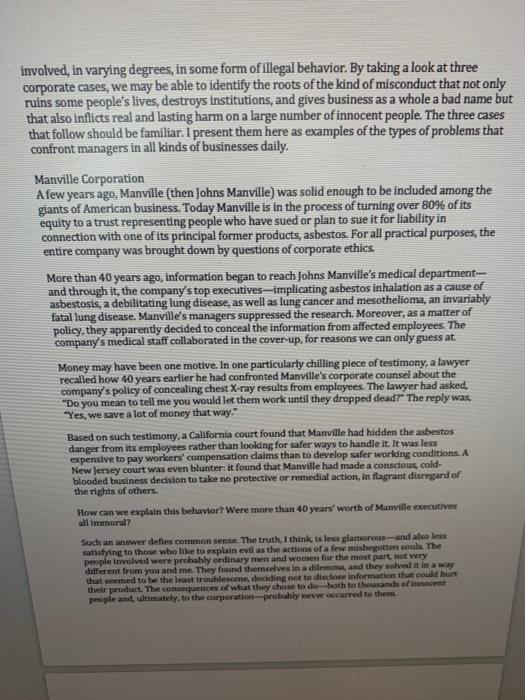
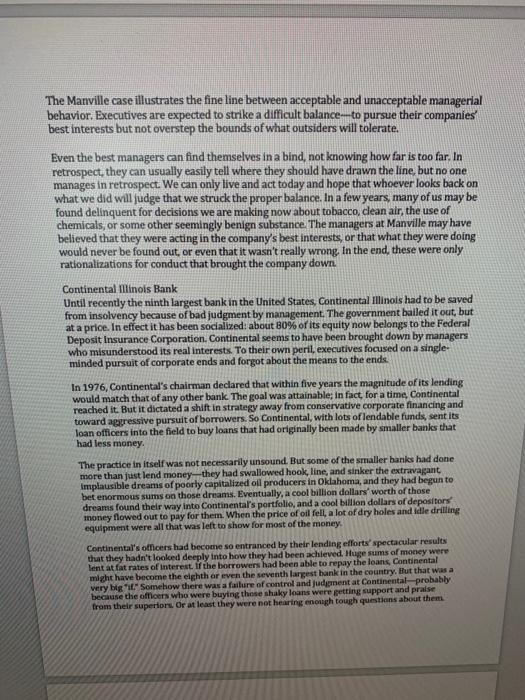
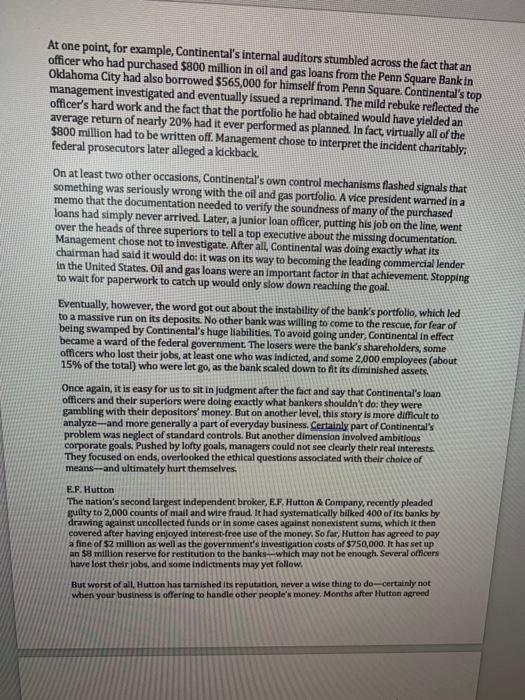
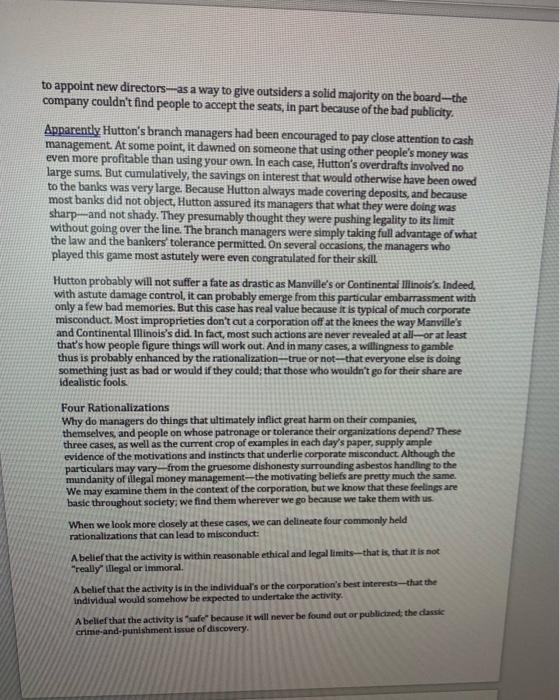
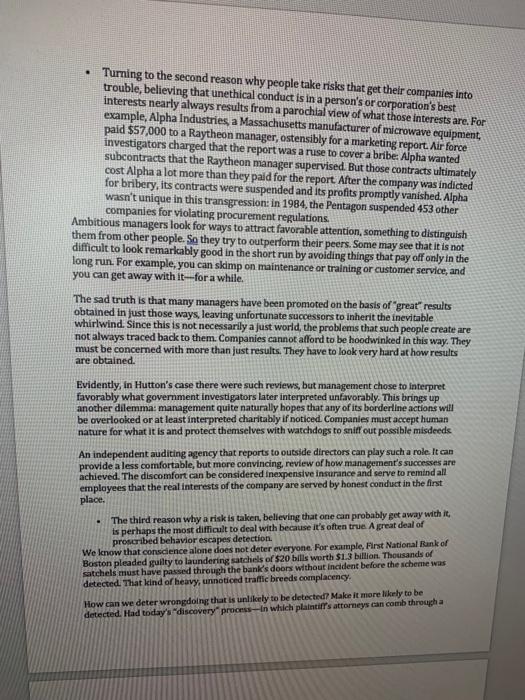
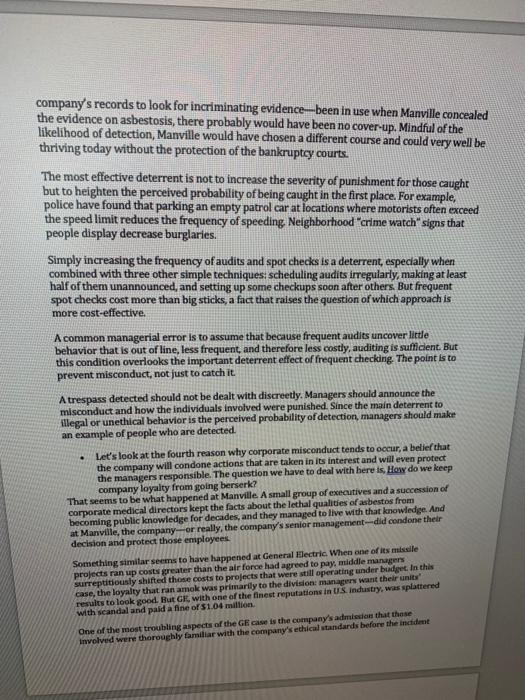
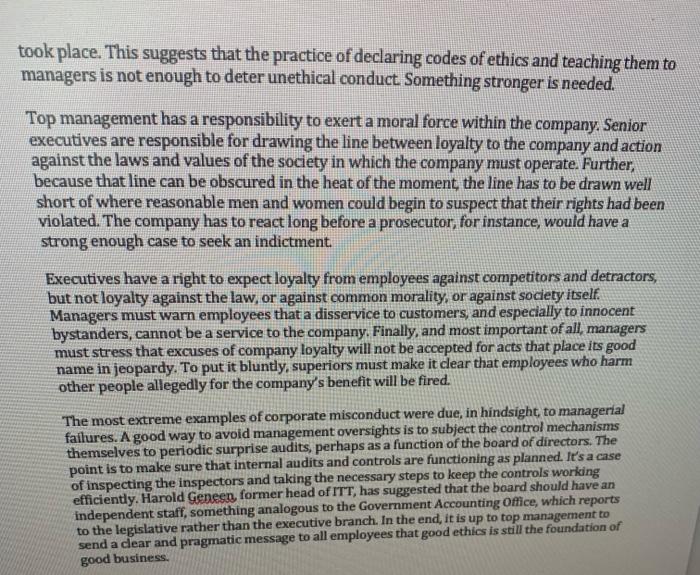
Why "Good Managers Make Bad Ethical Choices How could top-level executives at the Manville Corporation have suppressed evidence for decades that proved that asbestos inhalation was killing their own employees? What could have driven the managers of Continental Illinois Bank to pursue a course of action that threatened to bankrupt the institution, ruined its reputation, and cost thousands of innocent employees and investors their jobs and their savings? Why did managers at E.F. Hutton find themselves pleading guilty to 2,000 counts of mail and wire fraud, accepting a fine of $2 million, and putting up an $8 million fund for restitution to the 400 banks that the company had systematically bilked? How can we explain the misbehavior that took place in these organizations-or in any of the others, public and private, that litter our newspapers' front pages: workers at a defense contractor who accused their superiors of falsifying time cards; alleged bribes and kickbacks that honeycombed New York City government, a company that knowingly marketedan unsafe birth control device; the decision-making process that led to the space shuttle Challenger tragedy The stories are always slightly different, but they have a lot in common since they're full of the oldest questions in the world, questions of human behavior and human judgment applied in ordinary day-to-day situations. Reading them we have to ask how usually honest, intelligent, compassionate human beings could act in ways that are callous, dishonest, and wrongheaded. In my view, the explanations go back to four rationalizations that people have relied on through the ages to justify questionable conduct: believing that the activity is not really illegal or immoral; that it is in the individual's or the corporation's best interest; that it will never be found out, or that because it helps the company the company will condone it. By looking at these rationalizations in light of these cases, we can develop some practical rules to more effectively control managers actions that lead to trouble-control, but not eliminate. For the hard truth is that corporate misconduct, like the lowly cockroach, is a plague that we can suppress but never exterminate. Three Cases Amitai Etzioni, professor of sociology at George Washington University, recently concluded that in the last ten years, roughly two-thirds of America's 500 largest corporations have been involved in varying degrees, in some form of illegal behavior. By taking a look at three corporate cases, we may be able to identify the roots of the kind of misconduct that not only ruins some people's lives, destroys institutions, and gives business as a whole a bad name but that also inflicts real and lasting harm on a large number of innocent people. The three cases that follow should be familiar. I present them here as examples of the types of problems that confront managers in all kinds of businesses daily. Manville Corporation A few years ago, Manville (then Johns Manville) was solid enough to be included among the giants of American business. Today Manville is in the process of turning over 80% of its equity to a trust representing people who have sued or plan to sue it for liability in connection with one of its principal former products, asbestos. For all practical purposes, the entire company was brought down by questions of corporate ethics. More than 40 years ago, information began to reach Johns Manville's medical department- and through it, the company's top executives-implicating asbestos inhalation as a cause of asbestosis, a debilitating lung disease, as well as lung cancer and mesothelioma, an invariably fatal lung disease. Manville's managers suppressed the research. Moreover, as a matter of policy, they apparently decided to conceal the information from affected employees. The company's medical staff collaborated in the cover-up, for reasons we can only guess at. Money may have been one motive. In one particularly chilling piece of testimony, a lawyer recalled how 40 years earlier he had confronted Manville's corporate counsel about the company's policy of concealing chest X-ray results from employees. The lawyer had asked, "Do you mean to tell me you would let them work until they dropped dead? The reply was, Yes, we save a lot of money that way." Based on such testimony, a California court found that Manville had hidden the asbestos danger from its employees rather than looking for safer ways to handle it. It was less expensive to pay workers' compensation daims than to develop safer working conditions. A New Jersey court was even blunter: it found that Manville had made a conscious cold- blooded business decision to take no protective or remedial action, in flagrant disregard of the rights of others. How can we explain this behavior? Were more than 40 years' worth of Manville executives all immoral? Such an answer defies common sense. The truth, I think is less glamorous--and also less satisfying to those who like to explain evil as the actions of a few misbegotten souls The people involved were probably ordinary men and women for the most part not very different from you and me. They found themselves in a dilemm, and they solved it in a way that seemed to be the last troublesome, deciding not to disclose information that could hurt their product. The consequences of what they chose to do both to thousands of innocent people and ultimately, to the corporation probably never occurred to them. The Manville case illustrates the fine line between acceptable and unacceptable managerial behavior. Executives are expected to strike a difficult balance-to pursue their companies best interests but not overstep the bounds of what outsiders will tolerate. Even the best managers can find themselves in a bind, not knowing how far is too far. In retrospect, they can usually easily tell where they should have drawn the line, but no one manages in retrospect. We can only live and act today and hope that whoever looks back on what we did will judge that we struck the proper balance. In a few years, many of us may be found delinquent for decisions we are making now about tobacco, dean air, the use of chemicals, or some other seemingly benign substance. The managers at Manville may have believed that they were acting in the company's best interests, or that what they were doing would never be found out, or even that it wasn't really wrong. In the end, these were only rationalizations for conduct that brought the company down Continental Minois Bank Until recently the ninth largest bank in the United States, Continental Illinois had to be saved from insolvency because of bad judgment by management. The government bailed it out, but at a price. In effect it has been socialized: about 80% of its equity now belongs to the Federal Deposit Insurance Corporation. Continental seems to have been brought down by managers who misunderstood its real interests. To their own peril, executives focused on a single- minded pursuit of corporate ends and forgot about the means to the ends. In 1976, Continental's chairman declared that within five years the magnitude of its lending would match that of any other bank. The goal was attainable; in fact for a time, Continental reached it. But it dictated a shift in strategy away from conservative corporate financing and toward aggressive pursuit of borrowers. So Continental, with lots of lendable funds, sent its loan officers into the field to buy loans that had originally been made by smaller banks that had less money The practice in itself was not necessarily unsound. But some of the smaller banks had done more than just lend money they had swallowed hook, line, and sinker the extravagant Implausible dreams of poorly capitalized oll producers in Oklahoma, and they had begun to bet enormous sums on those dreams. Eventually, a cool billion dollars' worth of those dreams found their way into Continental's portfolio, and a cool billion dollars of depositors money flowed out to pay for them. When the price of oil fell, a lot of dry holes and idle drilling equipment were all that was left to show for most of the money. Continental's others had become so entranced by their lending efforts spectacular results that they hadn't looked deeply into how they had been achieved. Huge sums of money were lent at fat rates of interest if the borrowers had been able to repay the loans, Continental might have become the eighth or even the seventh largest bank in the country. But that was a very big "it" Somehow there was a failure of control and judgment at Continental probably because the officers who were buying those shaky loans were getting support and praise from their superiors Or at least they were not hearing enough tough questions about them At one point, for example, Continental's internal auditors stumbled across the fact that an officer who had purchased $800 million in oil and gas loans from the Penn Square Bank in Oklahoma City had also borrowed $565,000 for himself from Penn Square. Continental's top management investigated and eventually issued a reprimand. The mild rebuke reflected the officer's hard work and the fact that the portfolio he had obtained would have yielded an average return of nearly 20% had it ever performed as planned. In fact, virtually all of the $800 million had to be written off. Management chose to interpret the incident charitably; federal prosecutors later alleged a kickback On at least two other occasions, Continental's own control mechanisms flashed signals that something was seriously wrong with the oil and gas portfolio. A vice president wamed in a memo that the documentation needed to verify the soundness of many of the purchased loans had simply never arrived. Later, a junior loan officer, putting his job on the line, went over the heads of three superiors to tell a top executive about the missing documentation Management chose not to investigate. After all, Continental was doing exactly what its chairman had said it would do it was on its way to becoming the leading commercial lender in the United States Oil and gas loans were an important factor in that achievement Stopping to wait for paperwork to catch up would only slow down reaching the goal Eventually, however, the word got out about the instability of the bank's portfolio, which led to a massive run on its deposits. No other bank was willing to come to the rescue, for fear of being swamped by Continental's huge liabilities. To avoid going under, Continental in effect became a ward of the federal government. The losers were the bank's shareholders, some officers who lost their jobs, at least one who was indicted, and some 2,000 employees about 15% of the total) who were let go, as the bank scaled down to fit its diminished assets. Once again, it is easy for us to sit in judgment after the fact and say that Continental's loan officers and their superiors were doing exactly what bankers shouldn't do they were gambling with their depositors' money. But on another level, this story is more difficult to analyze and more generally a part of everyday business. Certainly part of Continental's problem was neglect of standard controls. But another dimension involved ambitious corporate goals. Pushed by lofty goals, managers could not see clearly their real interests. They focused on ends, overlooked the ethical questions associated with their choice of means--and ultimately hurt themselves. E.F. Hutton The nation's second largest independent broker, E.F. Hutton & Company, recently pleaded guilty to 2,000 counts of mail and wire fraud. It had systematically bilked 400 of its banks by drawing against uncollected funds or in some cases against nonexistent surns, which it then covered after having enjoyed interest-free use of the money. So far, Hutton has agreed to pay a fine of 2 million as well as the government's investigation costs of $750,000. It has set up an $8 million reserve for restitution to the banks which may not be enough. Several officers have lost their jobs, and some indictments may yet follow. But worst of all, Hutton has tarnished its reputation, never a wise thing to do certainly not when your business is offering to handle other people's money, Months after Hutton agreed to appoint new directors as a way to give outsiders a solid majority on the board-the company couldn't find people to accept the seats, in part because of the bad publicity. Apparently Hutton's branch managers had been encouraged to pay close attention to cash management At some point, it dawned on someone that using other people's money was even more profitable than using your own. In each case, Hutton's overdrafts involved no large sums. But cumulatively, the savings on interest that would otherwise have been owed to the banks was very large. Because Hutton always made covering deposits, and because most banks did not object, Hutton assured its managers that what they were doing was sharp-and not shady. They presumably thought they were pushing legality to its limit without going over the line. The branch managers were simply taking full advantage of what the law and the bankers' tolerance permitted. On several occasions, the managers who played this game most astutely were even congratulated for their skill Hutton probably will not suffer a fate as drastic as Manville's or Continental llinois's. Indeed, with astute damage control, it can probably emerge from this particular embarrassment with only a few bad memories. But this case has real value because it is typical of much corporate misconduct. Most improprieties don't cut a corporation off at the knees the way Manville's and Continental Illinois's did. In fact, most such actions are never revealed at all or at least that's how people figure things will work out. And in many cases, a willingness to gamble thus is probably enhanced by the rationalization--true or not-that everyone else is doing something just as bad or would if they could that those who wouldn't go for their share are idealistic fools Four Rationalizations Why do managers do things that ultimately inflict great harm on their companies, themselves, and people on whose patronage or tolerance their organizations depend? These three cases, as well as the current crop of examples in each day's paper, supply ample evidence of the motivations and instincts that underlie corporate misconduct Although the particulars may vary from the gruesome dishonesty surrounding asbestos handling to the mundanity of illegal money management--the motivating beliefs are pretty much the same. We may examine them in the context of the corporation, but we know that these feelings are basic throughout society, we find them wherever we go because we take them with us When we look more closely at these cases, we can delineate four commonly held rationalizations that can lead to misconduct: A belief that the activity is within reasonable ethical and legal limits-that is that it is not "really illegal or immoral. Abelief that the activity is in the individual's or the corporation's best interests-that the Individual would somehow be expected to undertake the activity. A belief that the activity is "safe" because it will never be found out or publiceed, the classk crime-and-punishment issue of discovery. to appoint new directors as a way to give outsiders a solid majority on the board-the company couldn't find people to accept the seats, in part because of the bad publicity. Apparently Hutton's branch managers had been encouraged to pay close attention to cash management At some point, it dawned on someone that using other people's money was even more profitable than using your own. In each case, Hutton's overdrafts involved no large sums. But cumulatively, the savings on interest that would otherwise have been owed to the banks was very large. Because Hutton always made covering deposits, and because most banks did not object, Hutton assured its managers that what they were doing was sharp-and not shady. They presumably thought they were pushing legality to its limit without going over the line. The branch managers were simply taking full advantage of what the law and the bankers' tolerance permitted. On several occasions, the managers who played this game most astutely were even congratulated for their skill Hutton probably will not suffer a fate as drastic as Manville's or Continental llinois's. Indeed, with astute damage control, it can probably emerge from this particular embarrassment with only a few bad memories. But this case has real value because it is typical of much corporate misconduct. Most improprieties don't cut a corporation off at the knees the way Manville's and Continental Illinois's did. In fact, most such actions are never revealed at all or at least that's how people figure things will work out. And in many cases, a willingness to gamble thus is probably enhanced by the rationalization--true or not-that everyone else is doing something just as bad or would if they could that those who wouldn't go for their share are idealistic fools Four Rationalizations Why do managers do things that ultimately inflict great harm on their companies, themselves, and people on whose patronage or tolerance their organizations depend? These three cases, as well as the current crop of examples in each day's paper, supply ample evidence of the motivations and instincts that underlie corporate misconduct Although the particulars may vary from the gruesome dishonesty surrounding asbestos handling to the mundanity of illegal money management--the motivating beliefs are pretty much the same. We may examine them in the context of the corporation, but we know that these feelings are basic throughout society, we find them wherever we go because we take them with us When we look more closely at these cases, we can delineate four commonly held rationalizations that can lead to misconduct: A belief that the activity is within reasonable ethical and legal limits-that is that it is not "really illegal or immoral. Abelief that the activity is in the individual's or the corporation's best interests-that the Individual would somehow be expected to undertake the activity. A belief that the activity is "safe" because it will never be found out or publiceed, the classk crime-and-punishment issue of discovery. Turning to the second reason why people take risks that get their companies into trouble, believing that unethical conduct is in a person's or corporation's best interests nearly always results from a parochial view of what those interests are. For example, Alpha Industries, a Massachusetts manufacturer of microwave equipment, paid $57,000 to a Raytheon manager, ostensibly for a marketing report. Air force investigators charged that the report was a ruse to cover a bribe: Alpha wanted subcontracts that the Raytheon manager supervised. But those contracts ultimately cost Alpha a lot more than they paid for the report After the company was indicted for bribery, its contracts were suspended and its profits promptly vanished. Alpha wasn't unique in this transgression in 1984, the Pentagon suspended 453 other companies for violating procurement regulations Ambitious managers look for ways to attract favorable attention, something to distinguish them from other people. So they try to outperform their peers. Some may see that it is not difficult to look remarkably good in the short run by avoiding things that pay off only in the long run. For example, you can skimp on maintenance or training or customer service, and you can get away with it--for a while. The sad truth is that many managers have been promoted on the basis of great results obtained in just those ways, leaving unfortunate successors to inherit the inevitable whirlwind. Since this is not necessarily a just world, the problems that such people create are not always traced back to them. Companies cannot afford to be hoodwinked in this way. They must be concerned with more than just results. They have to look very hard at how results are obtained. Evidently, in Hutton's case there were such reviews, but management chose to interpret favorably what government investigators later interpreted unfavorably. This brings up another dilemma: management quite naturally hopes that any of its borderline actions will be overlooked or at least interpreted charitably if noticed. Companies must accept human nature for what it is and protect themselves with watchdogs to sniff out possible misdeeds . An independent auditing agency that reports to outside directors can play such a role. It can provide a less comfortable, but more convincing, review of how management's successes are achieved. The discomfort can be considered inexpensive insurance and serve to remind all employees that the real interests of the company are served by honest conduct in the first place. The third reason why a risk is taken, believing that one can probably get away with it is perhaps the most difficult to deal with because it's often true. A great deal of proscribed behavior escapes detection We know that conscience alone does not deter everyone. For example, First National Rank of Boston pleaded guilty to laundering satchels of $20 bills worth $1.3 billion. Thousands of satchels must have passed through the bank's doors without incident before the scheme was detected. That kind of heavy, unnoticed traffic breeds complacency. How can we deter wrongdoing that is unlikely to be detected? Make it more likely to be detected. Had today's discovery process in which plaintiff's attorneys can comb through a company's records to look for incriminating evidence-been in use when Manville concealed the evidence on asbestosis, there probably would have been no cover-up, Mindful of the likelihood of detection, Manville would have chosen a different course and could very well be thriving today without the protection of the bankruptcy courts. The most effective deterrent is not to increase the severity of punishment for those caught but to heighten the perceived probability of being caught in the first place. For example, police have found that parking an empty patrol car at locations where motorists often exceed the speed limit reduces the frequency of speeding Neighborhood "crime watch" signs that people display decrease burglaries. Simply increasing the frequency of audits and spot checks is a deterrent, especially when combined with three other simple techniques, scheduling audits irregularly, making at least half of them unannounced, and setting up some checkups soon after others. But frequent spot checks cost more than big sticks, a fact that raises the question of which approach is more cost-effective. A common managerial error is to assume that because frequent audits uncover little behavior that is out of line, less frequent, and therefore less costly, auditing is sufficient. But this condition overlooks the important deterrent effect of frequent checking. The point is to prevent misconduct, not just to catch it Atrespass detected should not be dealt with discreetly. Managers should announce the misconduct and how the individuals involved were punished. Since the main deterrent to illegal or unethical behavior is the perceived probability of detection, managers should make an example of people who are detected. Let's look at the fourth reason why corporate misconduct tends to occur, a belief that the company will condone actions that are taken in its interest and will even protect the managers responsible. The question we have to deal with here is How do we keep company loyalty from going berserk? That seems to be what happened at Manville A small group of executives and a succession of corporate medical directors kept the facts about the lethal qualities of asbestos from becoming public knowledge for decades, and they managed to live with that knowledge. And at Manville, the company-or really, the company's senior management did condone their decision and protect those employees Something similar seems to have happened at General Electric When one of its missile projects ran up costs greater than the air force had agreed to pay, middle managers surreptitiously shifted those costs to projects that were still operating under budget. In this case, the loyalty that ran amok was primarily to the division managers want their units results to look good. But GE with one of the finest reputations in US. Industry, was splattered with scandal and paid a fine of $1.04 million. One of the most troubling aspects of the GE case is the company's admission that these Involved were thoroughly familiar with the company's ethical standards before the incident took place. This suggests that the practice of declaring codes of ethics and teaching them to managers is not enough to deter unethical conduct. Something stronger is needed. Top management has a responsibility to exert a moral force within the company, Senior executives are responsible for drawing the line between loyalty to the company and action against the laws and values of the society in which the company must operate. Further, because that line can be obscured in the heat of the moment, the line has to be drawn well short of where reasonable men and women could begin to suspect that their rights had been violated. The company has to react long before a prosecutor, for instance, would have a strong enough case to seek an indictment Executives have a right to expect loyalty from employees against competitors and detractors, but not loyalty against the law, or against common morality, or against society itself . Managers must warn employees that a disservice to customers, and especially to innocent bystanders, cannot be a service to the company. Finally, and most important of all, managers must stress that excuses of company loyalty will not be accepted for acts that place its good name in jeopardy. To put it bluntly, superiors must make it clear that employees who harm other people allegedly for the company's benefit will be fired. The most extreme examples of corporate misconduct were due, in hindsight, to managerial failures. A good way to avoid management oversights is to subject the control mechanisms themselves to periodic surprise audits, perhaps as a function of the board of directors. The point is to make sure that internal audits and controls are functioning as planned. It's a case of inspecting the inspectors and taking the necessary steps to keep the controls working efficiently. Harold Geneen former head of ITT, has suggested that the board should have an independent staff, something analogous to the Government Accounting Office, which reports to the legislative rather than the executive branch. In the end, it is up to top management to send a clear and pragmatic message to all employees that good ethics is still the foundation of good business
Step by Step Solution
There are 3 Steps involved in it
1 Expert Approved Answer
Step: 1 Unlock

Question Has Been Solved by an Expert!
Get step-by-step solutions from verified subject matter experts
Step: 2 Unlock
Step: 3 Unlock
 Study Help