



Question: Choose From Resource Management, Garbage collection, Network Management, Protection, Hardware abstraction Choose from Bandwith allocation, Process Management, File and Store Management, Kernel Management, Memory Managment,
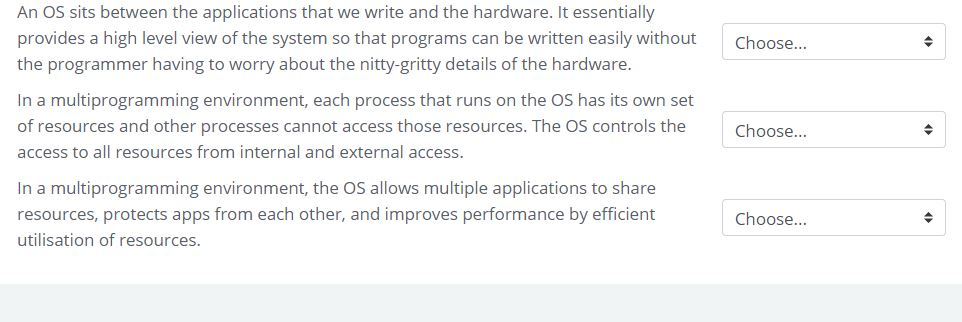
Choose From Resource Management, Garbage collection, Network Management, Protection, Hardware abstraction
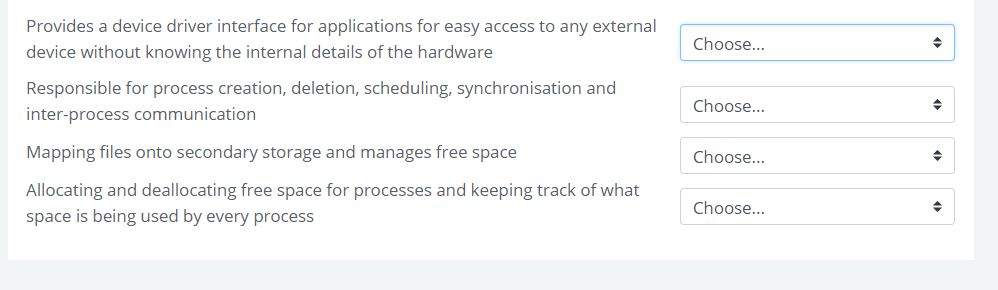
Choose from Bandwith allocation, Process Management, File and Store Management, Kernel Management, Memory Managment, I/O Management, Network Management
An OS sits between the applications that we write and the hardware. It essentially provides a high level view of the system so that programs can be written easily without the programmer having to worry about the nitty-gritty details of the hardware. Choose... In a multiprogramming environment, each process that runs on the OS has its own set of resources and other processes cannot access those resources. The OS controls the access to all resources from internal and external access. Choose... In a multiprogramming environment, the OS allows multiple applications to share resources, protects apps from each other, and improves performance by efficient utilisation of resources. Choose... Provides a device driver interface for applications for easy access to any external device without knowing the internal details of the hardware Responsible for process creation, deletion, scheduling, synchronisation and inter-process communication Mapping files onto secondary storage and manages free space Allocating and deallocating free space for processes and keeping track of what space is being used by every process Choose... Choose... Choose... Choose
Step by Step Solution
There are 3 Steps involved in it

Get step-by-step solutions from verified subject matter experts