Question: Compare the first draft with the final draft. Identify all improvements in terms of content, arrangement, organization, and style 106 CHAPTER 6 An Overview of
Compare the first draft with the final draft. Identify all improvements in terms of content, arrangement, organization, and style
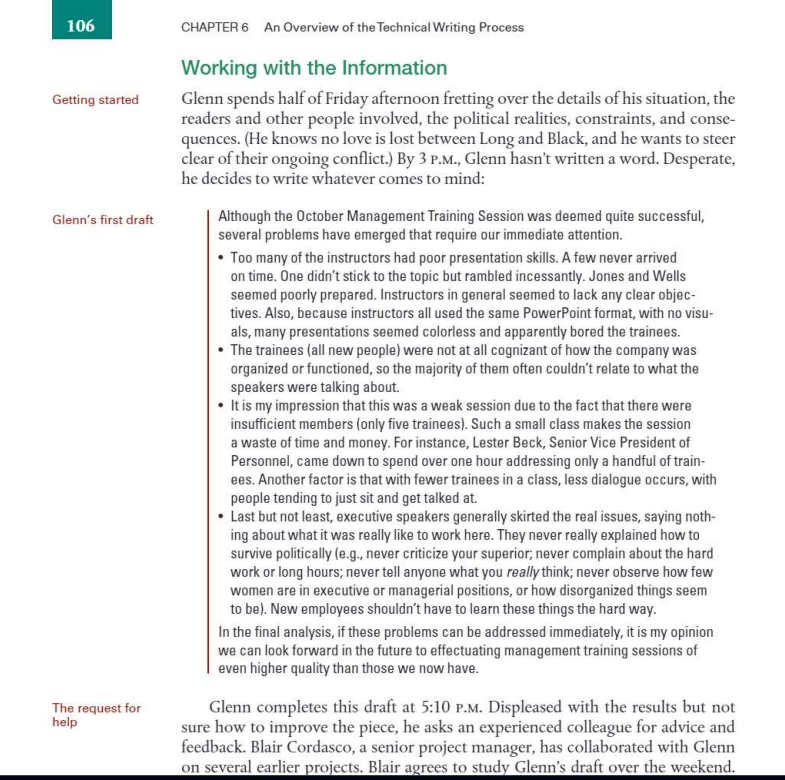
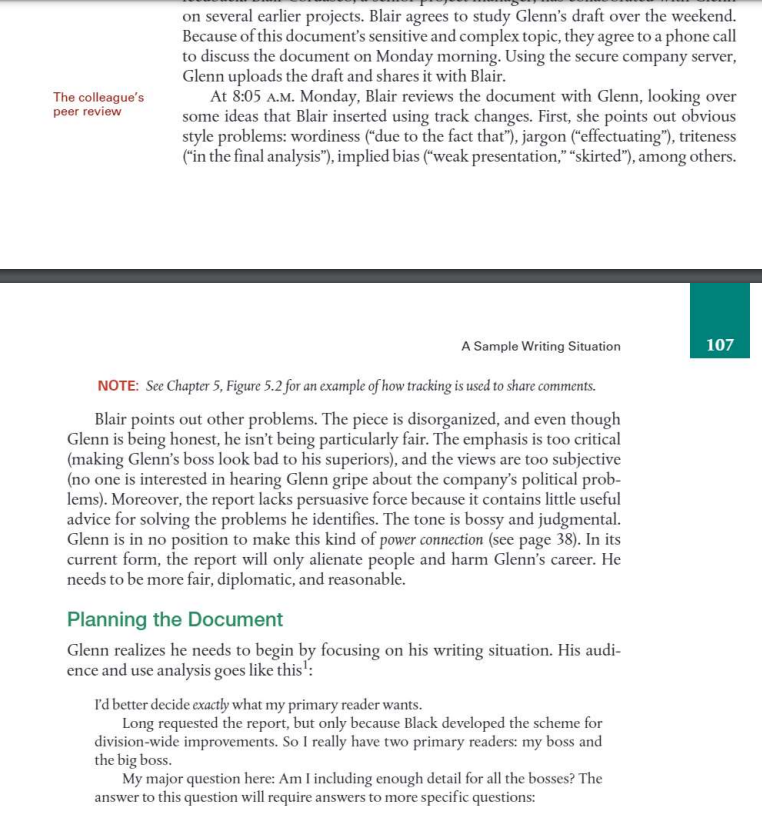
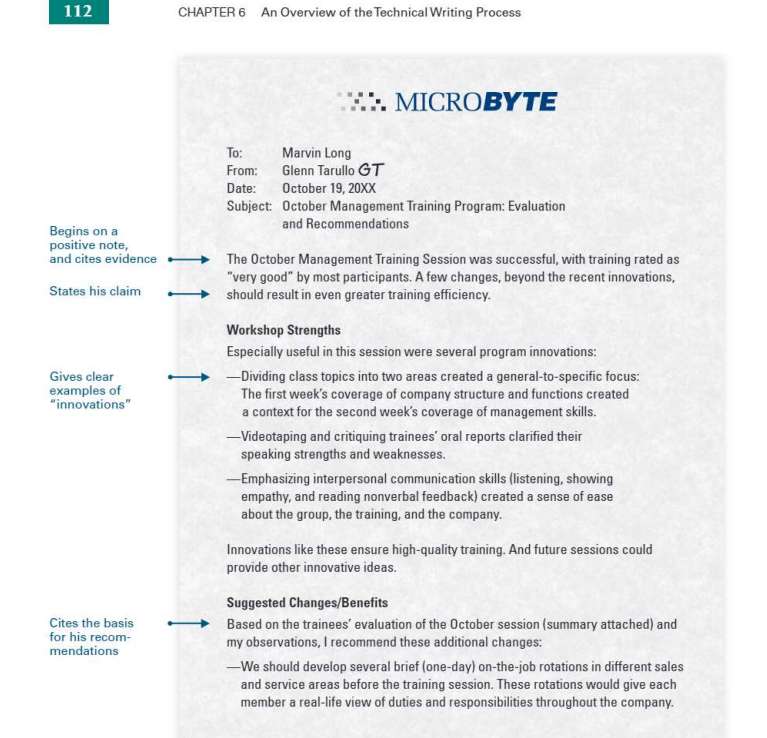
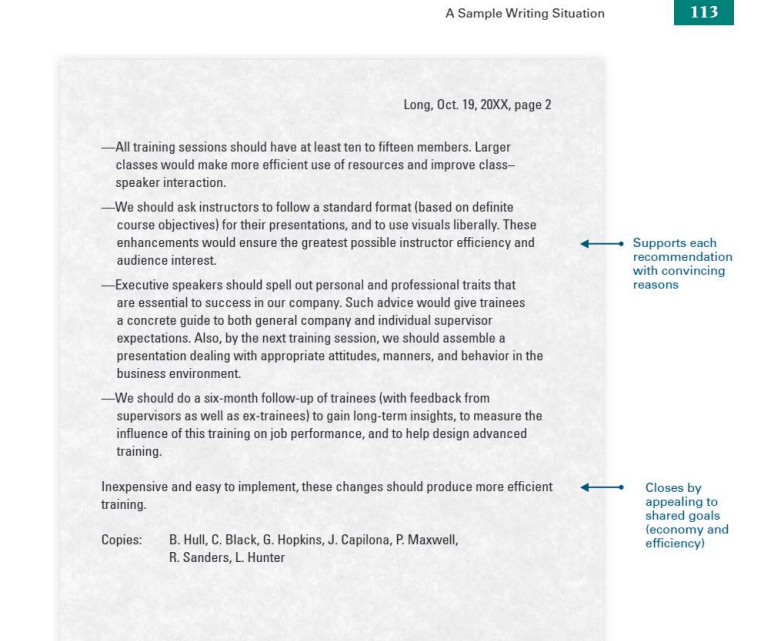
106 CHAPTER 6 An Overview of the Technical Writing Process Getting started Glenn's first draft Working with the Information Glenn spends half of Friday afternoon fretting over the details of his situation, the readers and other people involved, the political realities, constraints, and conse- quences. (He knows no love is lost between Long and Black, and he wants to steer clear of their ongoing conflict.) By 3 P.M., Glenn hasn't written a word. Desperate, he decides to write whatever comes to mind: Although the October Management Training Session was deemed quite successful, several problems have emerged that require our immediate attention. Too many of the instructors had poor presentation skills. A few never arrived on time. One didn't stick to the topic but rambled incessantly. Jones and Wells seemed poorly prepared. Instructors in general seemed to lack any clear objec- tives. Also, because instructors all used the same PowerPoint format, with no visu- als, many presentations seemed colorless and apparently bored the trainees. The trainees (all new people) were not at all cognizant of how the company was organized or functioned, so the majority of them often couldn't relate to what the speakers were talking about. It is my impression that this was a weak session due to the fact that there were insufficient members (only five trainees). Such a small class makes the session a waste of time and money. For instance, Lester Beck, Senior Vice President of Personnel, came down to spend over one hour addressing only a handful of train- ees. Another factor is that with fewer trainees in a class, less dialogue occurs, with people tending to just sit and get talked at Last but not least, executive speakers generally skirted the real issues, saying noth- ing about what it was really like to work here. They never really explained how to survive politically (e.g., never criticize your superior, never complain about the hard work or long hours; never tell anyone what you really think; never observe how few women are in executive or managerial positions, or how disorganized things seem to be). New employees shouldn't have to learn these things the hard way. In the final analysis, if these problems can be addressed immediately, it is my opinion we can look forward in the future to effectuating management training sessions of even higher quality than those we now have. Glenn completes this draft at 5:10 P.M. Displeased with the results but not sure how to improve the piece, he asks an experienced colleague for advice and feedback. Blair Cordasco, a senior project manager, has collaborated with Glenn on several earlier projects. Blair agrees to study Glenn's draft over the weekend. The request for help on several earlier projects. Blair agrees to study Glenn's draft over the weekend. Because of this document's sensitive and complex topic, they agree to a phone call to discuss the document on Monday morning. Using the secure company server, Glenn uploads the draft and shares it with Blair. At 8:05 A.M. Monday, Blair reviews the document with Glenn, looking over some ideas that Blair inserted using track changes. First, she points out obvious style problems: wordiness (due to the fact that), jargon ("effectuating), triteness (in the final analysis), implied bias ("weak presentation," "skirted), among others. The colleague's peer review A Sample Writing Situation 107 NOTE: See Chapter 5, Figure 5.2 for an example of how tracking is used to share comments. Blair points out other problems. The piece is disorganized, and even though Glenn is being honest, he isn't being particularly fair. The emphasis is too critical (making Glenn's boss look bad to his superiors), and the views are too subjective (no one is interested in hearing Glenn gripe about the company's political prob- lems). Moreover, the report lacks persuasive force because it contains little useful advice for solving the problems he identifies. The tone is bossy and judgmental. Glenn is in no position to make this kind of power connection (see page 38). In its current form, the report will only alienate people and harm Glenn's career. He needs to be more fair, diplomatic, and reasonable. Planning the Document Glenn realizes he needs to begin by focusing on his writing situation. His audi- ence and use analysis goes like this': I'd better decide exactly what my primary reader wants. Long requested the report, but only because Black developed the scheme for division-wide improvements. So I really have two primary readers: my boss and the big boss. My major question here: Am I including enough detail for all the bosses? The answer to this question will require answers to more specific questions: 112 CHAPTER 6 An Overview of the Technical Writing Process 5. MICROBYTE To: Marvin Long From: Glenn Tarullo GT Date: October 19, 20XX Subject: October Management Training Program: Evaluation and Recommendations Begins on a positive note, and cites evidence The October Management Training Session was successful, with training rated as "very good" by most participants. A few changes, beyond the recent innovations, should result in even greater training efficiency. States his claim Gives clear examples of "innovations" Workshop Strengths Especially useful in this session were several program innovations: -Dividing class topics into two areas created a general-to-specific focus: The first week's coverage of company structure and functions created a context for the second week's coverage of management skills. - Videotaping and critiquing trainees' oral reports clarified their speaking strengths and weaknesses. --Emphasizing interpersonal communication skills (listening, showing empathy, and reading nonverbal feedback) created a sense of ease about the group, the training, and the company. Innovations like these ensure high-quality training. And future sessions could provide other innovative ideas. Cites the basis for his recom- mendations Suggested Changes/Benefits Based on the trainees' evaluation of the October session (summary attached) and my observations, I recommend these additional changes: -We should develop several brief (one-day) on-the-job rotations in different sales and service areas before the training session. These rotations would give each member a real-life view of duties and responsibilities throughout the company. A Sample Writing Situation 113 Long, Oct. 19, 20XX, page 2 Supports each recommendation with convincing reasons -All training sessions should have at least ten to fifteen members. Larger classes would make more efficient use of resources and improve class- speaker interaction -We should ask instructors to follow a standard format (based on definite course objectives) for their presentations, and to use visuals liberally. These enhancements would ensure the greatest possible instructor efficiency and audience interest --Executive speakers should spell out personal and professional traits that are essential to success in our company. Such advice would give trainees a concrete guide to both general company and individual supervisor expectations. Also, by the next training session, we should assemble a presentation dealing with appropriate attitudes, manners, and behavior in the business environment -We should do a six-month follow-up of trainees (with feedback from supervisors as well as ex-trainees) to gain long-term insights, to measure the influence of this training on job performance, and to help design advanced training. Inexpensive and easy to implement, these changes should produce more efficient training. Closes by appealing to shared goals (economy and efficiency) Copies: B. Hull, C. Black, G. Hopkins, J. Capilona, P. Maxwell, R. Sanders, L. Hunter









 Study Help