Question: Compare/contrast human behavior and consumer behavior. Why do marketers study consumer behavior? What activities of Randys would you identify as being examples of consumer behavior
Compare/contrast human behavior and consumer behavior. Why do marketers study consumer behavior? What activities of Randys would you identify as being examples of consumer behavior and why?
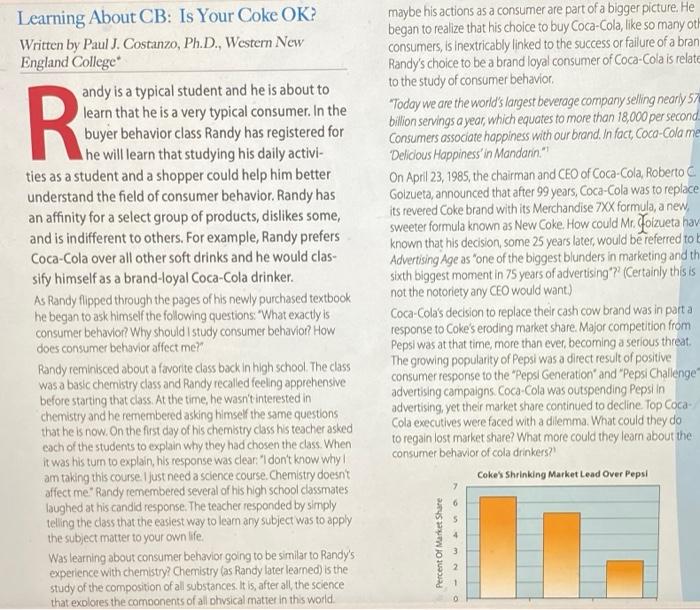
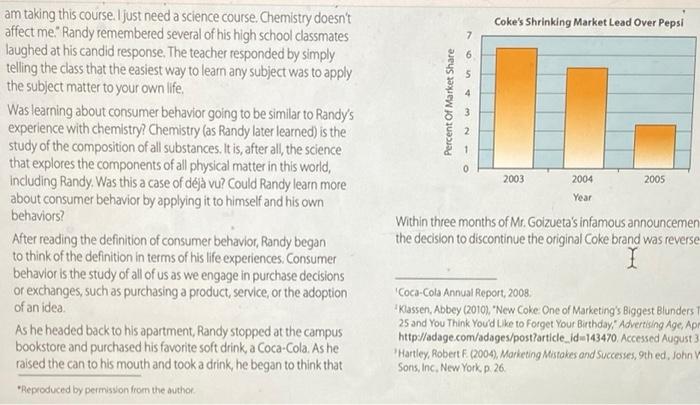
R Learning About CB: Is Your Coke OK? Written by Paul J. Costanzo, Ph.D., Western New England College andy is a typical student and he is about to learn that he is a very typical consumer. In the buyer behavior class Randy has registered for he will learn that studying his daily activi- ties as a student and a shopper could help him better understand the field of consumer behavior. Randy has an affinity for a select group of products, dislikes some, and is indifferent to others. For example, Randy prefers Coca-Cola over all other soft drinks and he would clas- sify himself as a brand-loyal Coca-Cola drinker. As Randy flipped through the pages of his newly purchased textbook he began to ask himself the following questions. "What exactly is consumer behavior? Why should I study consumer behavior? How does consumer behavior affect me?" Randy reminisced about a favorite class back in high school. The class was a basic chemistry class and Randy recalled feeling apprehensive before starting that class. At the time, he wasn't interested in chemistry and he remembered asking himself the same questions that he is now. On the first day of his chemistry class his teacher asked each of the students to explain why they had chosen the class. When it was his turn to explain, his response was dear. "I don't know why am taking this course. I just need a science course. Chemistry doesn't affect meRandy remembered several of his high school classmates laughed at his candid response. The teacher responded by simply telling the class that the easiest way to learn any subject was to apply the subject matter to your own life. Was learning about consumer behavior going to be similar to Randy's experience with chemistry Chemistry (as Randy later learned) is the study of the composition of all substances. It is, after all, the science that explores the components of all physical matter in this world maybe his actions as a consumer are part of a bigger picture. He began to realize that his choice to buy Coca-Cola, like so many oth consumers, is inextricably linked to the success or failure of a bran Randy's choice to be a brand loyal consumer of Coca-Cola is relate to the study of consumer behavior. **Today we are the world's largest beverage company selling nearly 57 billion servings a year, which equates to more than 18,000 per second Consumers associate happiness with our brand. In fact, Coca-Cola me Delicious Happiness' in Mandarin." On April 23, 1985, the chairman and CEO of Coca-Cola, Roberto Goizueta, announced that after 99 years, Coca-Cola was to replace its revered Coke brand with its Merchandise 7XX formula, a new, sweeter formula known as New Coke How could Mr. Coizueta hav known that his decision, some 25 years later, would be referred to Advertising Age as one of the biggest blunders in marketing and th sixth biggest moment in 75 years of advertising? (Certainly this is not the notoriety any CEO would want.) Coca-Cola's decision to replace their cash cow brand was in part a response to Coke's eroding market share. Major competition from Pepsi was at that time, more than ever becoming a serious threat. The growing popularity of Pepsi was a direct result of positive consumer response to the "Pepsi Generation and "Pepsi Challenge advertising campaigns Coca-Cola was outspending Pepsi in advertising, yet their market share continued to decline Top Coca- Cola executives were faced with a dilemma. What could they do to regain lost market share? What more could they learn about the consumer behavior of cola drinkers?! Coke's Shrinking Market Lead Over Pepsi Percent of Market Share Coke's Shrinking Market Lead Over Pepsi 7 6 Percent of Market Share 2003 2004 2005 am taking this course. I just need a science course, Chemistry doesn't affect me." Randy remembered several of his high school classmates laughed at his candid response. The teacher responded by simply telling the class that the easiest way to learn any subject was to apply the subject matter to your own life Was learning about consumer behavior going to be similar to Randy's experience with chemistry? Chemistry (as Randy later learned) is the study of the composition of all substances. It is, after all, the science that explores the components of all physical matter in this world, including Randy. Was this a case of dj vu? Could Randy learn more about consumer behavior by applying it to himself and his own behaviors? After reading the definition of consumer behavior, Randy began to think of the definition in terms of his life experiences Consumer behavior is the study of all of us as we engage in purchase decisions or exchanges, such as purchasing a product, service, or the adoption of an idea As he headed back to his apartment, Randy stopped at the campus bookstore and purchased his favorite soft drink, a Coca-Cola. As he raised the can to his mouth and took a drink, he began to think that "Reproduced by permission from the author Year Within three months of Mr. Goizueta's infamous announcemen the decision to discontinue the original Coke brand was reverse Coca-Cola Annual Report, 2008) Klassen, Abbey (2010). "New Coke One of Marketing's Biggest Blunders 25 and You Think You'd like to Forget Your Birthday Advertising Age, Apr http://adage.com/adages/post/article_id w143470. Accessed August 3 Hartley, Robert F (2004), Marketing Mistakes and successes, 9th ed, John Sons, Inc., New York p 26 The reversal was the driven by the dissatisfaction of brand-loyal consumers. Consumer outrage about the decision to remove the original Coke was substantial. The news media fanned the flames of discontent, with numerous reports featuring unhappy consumers. Outspoken celebrities, politicians , and sports figures publicly chastised Coca-Cola and demanded the return of their beloved soft drink Interpreting consumer behavior data is not a pure science, as top Coca-Cola marketing executive Zergio Zyman found out. Mr. Zyman not only was a key figure in the decision to introduce New Coke and discontinue Coke, but later, in 1993, he helped introduce another Coca-Cola brand he thought would be embraced by younger consumers . This product was known as OK Soda OK Soda, like New Coke was not well received. The OK name was adopted because test marketing found it to be the most recognized word worldwide. The Ok Soda brand was quickly discontinued and was never distributed nationwide because it did not meet its expectation to capture 4% of the US, beverage market To view an OK Soda commercial aimed at the younger consumer market, search YouTube.com Questions 1. Define marketing and consumer behavior. Provide your own definition (not the textbook definition) of consumer behavior. How can consumer behavior be applied to your life experiences? I 2. Compare/contrast human behavior and consumer behavior. Why do marketers study consumer behavior? What activities of Randy's would you Identify as being examples of consumer behavior and why? 3. What factors do you think contributed to the failure of New Coke and OK Soda? Do you think these products could be successfully re-marketed today? 4. Keep a log of your daily activities for three days List and describe those activities which you would categorize as consumer behavior. How might your activities be studied by a consumer behavior researcher Zyman, Sergio (2000). "The End of Marketing as We Know It Marketing is Science, Harper Business, New York, pp. 47-49









 Study Help